Menu · 1 component
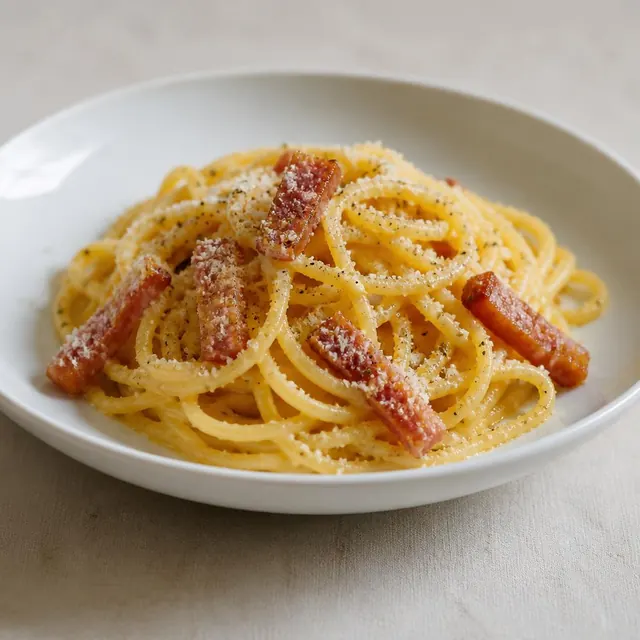
Spaghetti alla carbonara
Roman spaghetti with guanciale, egg yolks, Pecorino Romano and black pepper, without cream; a complete main course.
Menu portion35 min689.5 kcal per menu portion
- Good for lunch
- Good for dinner
1Main course
Spaghetti alla carbonara
690 kcal per menu portion · 1 × recipe portion per menu portion
- Low in lactose
Contains: Gluten, Egg, Milk
Quantities for the whole recipe (4 servings).
Ingredients
- 320 gPasta, dry, unenriched
- 150 gPork, fresh, variety meats and by-products, jowl, raw
- 5 pieces · largeEgg, yolk, raw, fresh
- 80 gCheese, romano
- 2 gSpices, pepper, black
- 580 mlBeverages, water, tap, drinking
- 2.4 lBeverages, water, tap, drinking not counted – removed
- 2 gSalt, table editorial addition
Method
- Cut the hard rind off the guanciale, slice the meat about 0.5 cm thick, then cut it into strips or cubes of about 0.5 × 1 cm. Finely grate the pecorino and coarsely crush the pepper in a mortar.
- Put the guanciale into a cold pan without any fat and render it slowly over low to medium heat for about 10 minutes until the fat turns translucent and the pieces are golden; the edges should be crisp and the centre still tender. Take the pan off the heat and leave the rendered fat in it.
TipRendering bacon and lardBacon needs patience: on gentle heat its fat runs out and it crisps, on fierce heat it burns outside and stays rubbery within.Why and howShow less
Why
The fat in bacon and in pork back fat is held in the cells of fatty tissue bound together by connective tissue; heat liquefies the fat so it gradually runs out, the water evaporates, and the lean parts shrink and turn crisp. This takes time, which is why bacon goes into a cold pan, even with a little water, and is heated over medium heat: the water keeps the temperature low at first, the fat renders before the surface scorches, and the bacon crisps evenly. In a fiercely hot pan the surface burns, the fat blackens and smokes, and the fatty parts stay rubbery. Pork fat for cracklings is rendered over gentle heat with frequent stirring until the cracklings are light brown and crush easily; overcooked cracklings give dark lard with a burnt taste. Bacon cured with nitrite also forms nitrosamines when fried over fierce heat, and EFSA regards dietary exposure to nitrosamines as a health concern, so this is one more reason to fry bacon until crisp, not black.
How to do it
- Cut the bacon into slices, strips or cubes of even thickness, spread it in a cold pan in a single layer and, if you like, add about 4 tablespoons of water.
- Heat over medium heat and turn it now and then; the water evaporates and the bacon then keeps frying in its own fat.
- Take the bacon out as soon as it is golden brown; it crisps further on paper towel, and if it is dark while still in the pan, it is overcooked.
- Cut pork fat for cracklings into even cubes and render it in a heavy pot over gentle heat, stirring often, until the cracklings turn golden.
- Carefully strain the hot lard through a sieve into dry jars and keep it covered in the fridge once cool; never add water to hot fat, it boils up violently and spatters.
- Use the fat rendered from bacon to soften onions or vegetables; let the rest set and put it in the bin, not down the drain.
If it goes wrong
Put rubbery bacon back in the pan and let it keep rendering slowly over gentle heat until it crisps. Burnt bacon cannot be saved, it is bitter; take fat that has blackened or smoked heavily off the heat, let it cool a little, pour it carefully into a dry container and carry on in a clean pan. If the cracklings catch on the bottom before they release their fat, lower the heat and stir more often. Lard that has darkened and smells scorched is edible, but use it only where a stronger flavour does no harm.
- In a bowl, beat the 5 egg yolks with 60 g of the pecorino and most of the pepper into a thick cream. If it is too stiff, stir in a spoonful of lukewarm pasta water, never boiling.
- Bring 3 litres of water with 20 g of salt to the boil (the guanciale and pecorino are salty, so do not add more) and cook the spaghetti one minute less than the packet says, usually 8–10 minutes. Before draining, set aside about 200 ml of the pasta water.
TipCooking pastaPasta water isn't waste, it's liquid glue that talks the sauce into clinging to the pasta.Why and howShow less
Why
In the first minutes of boiling, starch is released from the surface of the pasta and it turns sticky; plenty of rapidly boiling water and a stir at that point stop it clumping, and the water doesn't cool down as much when the pasta goes in. Salt only gets into pasta while it cooks, which is why the water is salted generously, roughly 10 g per litre; that amount has a negligible effect on the boiling point, and oil in the water is pointless because it floats on top and doesn't prevent sticking. The cooking water is full of dissolved starch that thickens the sauce and helps its fat combine with water into a smooth emulsion that clings to the pasta. That is why pasta isn't rinsed after draining – you would wash off the starch the sauce holds on to and cool the pasta down; the only exception is pasta for a cold salad.
How to do it
- Allow roughly a litre of water per 100 g of pasta and add about 10 g of salt per litre once it boils.
- Drop the pasta into rapidly boiling water and stir now and then for the first two minutes.
- Don't add oil to the water; it won't stop sticking.
- Cook a minute or two less than the packet says and keep tasting.
- Before draining, scoop out a mugful of the cooking water.
- Don't rinse the pasta; transfer it straight into the sauce and finish cooking it there with a little of the cooking water.
If it goes wrong
Loosen pasta that has stuck together in the sauce with a little hot cooking water, or dip it briefly in boiling water and stir. Overcooked pasta won't firm up again – bake it or add it to a soup, and next time start tasting earlier. Under-salted pasta can only be rescued by a well-seasoned sauce.
- Lift the spaghetti with tongs into the pan with the guanciale and fat, standing off the heat, and toss with 2–3 tablespoons of pasta water for half a minute so they are coated in fat. Wait until the pan stops sizzling, then add the egg cream and stir and toss vigorously, adding pasta water a spoonful at a time, until a glossy cream clings to the pasta. The cream thickens at around 60–65 °C; if it stays runny, put the pan back over the lowest flame for a few seconds while stirring constantly, and if it starts to curdle into lumps, add water at once.
- Serve at once on warmed plates, sprinkled with the remaining pecorino and pepper.
Allergens
Contains: Egg, Gluten, Milk
Derived from ingredients – check the package label.
Nutrition, allergens and calories are for the default choice – the first alternative of every slot.
Nutrition per menu portion
Per serving
- Protein22.6 g13%
- Fat38.4 g51%
- Total carbohydrate (by difference)61.5 g36%
Share of energy from protein, fat and carbohydrate (4 / 9 / 4 kcal per g), not share by weight.
- Energy
- 689.5 kcal
- Protein
- 22.6 g
- Fat
- 38.4 g
- Total carbohydrate (by difference)
- 61.5 g
- Total dietary fibre (USDA)
- 2.7 g
- Saturated fatty acids
- 15.2 g
- Sodium
- 510.7 mg
- Salt (sodium × 2.5)
- 1.3 g
Per 100 g
- Energy
- 250.7 kcal
- Protein
- 8.2 g
- Fat
- 13.9 g
- Total carbohydrate (by difference)
- 22.4 g
- Total dietary fibre (USDA)
- 0.98 g
- Saturated fatty acids
- 5.5 g
- Sodium
- 185.7 mg
- Salt (sodium × 2.5)
- 0.46 g
A dash means the value is unknown, not zero. Salt is calculated from sodium (g salt = mg sodium × 2.5 / 1000) and includes sodium from all ingredients.
Calculation limitations
- Nutrition is a calculated estimate, not a laboratory measurement.
- Some ingredient quantities use documented estimates or household-measure assumptions.
- The number of servings is an editorial estimate (midpoint of the source range or based on the dish type and energy).
- Some specific ingredients are represented by the closest generic food with the same culinary function.
- Fibre, saturated fat and sodium of cooked ingredients are estimated from the consumed ingredient amounts; for drained ingredients, sodium is included only where the retained amount is an explicit editorial estimate.
- Some process effects could not be resolved in this calculation.
- Menu nutrition is the sum of its component recipes, each scaled to one menu portion.