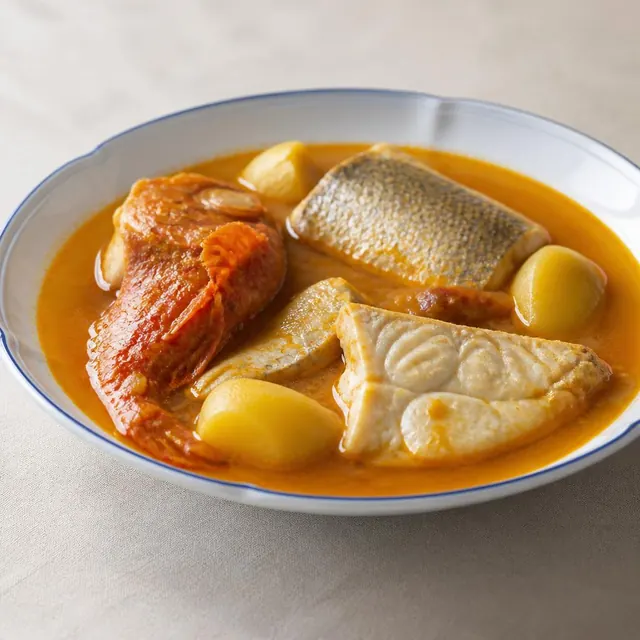
Bouillabaisse
Marseille fish soup made with four kinds of Mediterranean rockfish, boiled hard with olive oil, tomatoes, fennel, orange peel and saffron, with potatoes; following J.-B. Reboul (La Cuisinière provençale) and the Marseille Bouillabaisse Charter (1980). 6 servings, served in two dishes with toasted bread and rouille.
Total time: 75 min6 servingsFinal yield 4,300 g
Ingredients
- 600 gFish, rockfish, Pacific, mixed species, raw
- 500 gFish, monkfish, raw
- 400 gFish, sea bass, mixed species, raw
- 300 gFish, scup, raw
- 300 gOnions, raw
- 16 gGarlic, raw
- 300 gTomatoes, red, ripe, raw, year round average
- 100 gFennel, bulb, raw
- 2 gThyme, fresh
- 0.2 gSpices, bay leaf not counted – removed
- 3 gOrange peel, raw not counted – removed
- 0.3 gSpices, saffron
- 90 mlOil, olive, salad or cooking
- 10 gSalt, table
- 1 gSpices, pepper, black
- 1.5 lBeverages, water, tap, drinking
- 600 gPotatoes, flesh and skin, raw
- 10 gParsley, fresh
Allergens
Contains: Fish
Derived from ingredients – check the package label.
Method
- Clean the fish and cut it into pieces of about 5–6 cm. Keep the firm fish (scorpionfish and monkfish) separate from the delicate ones (sea bass and gurnard or John Dory).
- Thinly slice the onions and crush the garlic. Blanch, peel and deseed the tomatoes and chop them. Thinly slice the fennel and chop the parsley. Peel the potatoes and cut them into slices about 5 mm thick.
- Put the onions, garlic, tomatoes, fennel, thyme, bay leaf, orange peel, saffron, 10 g of salt, the pepper and 90 ml of olive oil into a wide pot (5–6 litres) and lay the potatoes on top. Meanwhile bring 1.5 litres of water to the boil.
- Pour the boiling water over the vegetables and boil hard, uncovered, over high heat for 10 minutes so that the potatoes are half cooked.
- Add the firm fish; the broth should just cover it, so top up with a little boiling water if needed. Boil hard for 5 minutes: the rolling boil binds the oil into the broth as a lightly cloudy emulsion, whereas a gentle simmer would leave the oil floating on top.
TipFish soups and stewsFish stock simmers briefly and the fish only finishes in it – cook it like beef and you ladle out bitter broth and broken pieces.Show less
Why
Fish has little collagen, which dissolves at low temperatures, and its proteins set earlier than in the meat of land animals (Fish: when is it done card), so pieces of fish in soup are done within minutes and break up with hard boiling and stirring. That is why they go into the soup or sauce only towards the end, into gently bubbling liquid, and only need to reach 63 °C in the centre; large firm pieces can take longer, delicate fillets go in last. Stock made from the bones, heads and trimmings of lean white fish simmers far shorter than meat stock, mostly 20–45 minutes, because many cooks find that longer cooking clouds it and turns it bitter; heads go in without the gills, whose blood gives the stock an off taste. Soups with cream or milk are no longer boiled hard once it is added, so the dairy doesn't curdle (Why milk and cream curdle card). In fish such as tuna, mackerel, sardines or herring, histamine forms when they are kept warm; neither boiling nor freezing destroys it and you usually can't smell or taste it, so fish for soup goes into the fridge as soon as you buy it.
How to do it
- Simmer fish stock from the bones and heads of lean white fish, gills removed, gently for only 20–45 minutes and strain it through a fine sieve.
- Cook the vegetables and potatoes in the soup first and add the fish when they are almost tender.
- Cut the fish into larger pieces, add it to gently bubbling liquid and don't stir; just shake the pot gently.
- Cook the fish for only a few minutes, until it is opaque and flakes, or to 63 °C in the centre; add delicate fillets and seafood last.
- Add cream or milk at the latest together with the fish and don't let the soup boil hard afterwards.
- Cool fish soup and refrigerate it within 2 hours; reheat it only once and only as much as you will eat (Cooling and storing leftovers card).
If it goes wrong
Broken-up fish tastes just the same; serve it as a thicker fish soup and next time add it later and don't stir. The only way to get small bones out of finished soup is to lift out the pieces of fish, feel through them and return them, then strain the broth. Dilute bitter or gluey stock with water or vegetable stock and season with lemon. Don't eat fish that smells bad; if it tastes unusually sharp, peppery or tingles on the tongue, it may contain histamine. A normal taste is no guarantee of safety, though – only keeping it cold is.
- Add the delicate fish on top and boil hard for another 5–7 minutes until the flesh turns opaque and flakes easily and the potatoes are tender. Remove the bay leaf and orange peel and sprinkle with parsley.
TipFish: when is it doneFish has no patience: one minute too long and the fillet becomes a dry jigsaw of flakes.Show less
Why
Fish flesh is more delicate than the meat of land animals: the muscle fibres are short and held together by thin layers of collagen, which is less heat-stable than mammalian collagen and dissolves at a lower temperature. In fish, the main muscle protein myosin starts to change structure at around 40 °C, so a fillet is done early, and a few degrees more are enough for it to lose its juices, dry out and fall apart. For safety, the US FDA and USDA give 63 °C in the core or, without a thermometer, flesh that turns opaque and separates easily into flakes with a fork; the UK FSA uses the same sign. Cooks often leave salmon or tuna translucent inside, at around 50 °C, which is a culinary choice at your own risk: according to the FDA, pregnant women, young children, older people and anyone with weakened immunity should avoid raw and undercooked fish, and for eating raw or with a translucent centre, choose fish that has been frozen first, because freezing kills parasites (EFSA gives, for example, −20 °C for at least 24 hours), though not all other germs.
How to do it
- Pat the fillet dry with kitchen paper before cooking so it fries rather than steams in the pan.
- Push the thermometer into the thickest part; for fish that is safe for everyone, aim for 63 °C.
- Without a thermometer, try a fork: the fish is done when it is opaque and separates easily into flakes.
- Cook thin fillets for just a few minutes and keep an eye on them; in a hot pan they finish cooking even after the heat is off.
- Prawns are done when they are firm and opaque; throw away any mussels that stay closed during cooking.
- Keep fresh fish in the fridge for 2 days at most, otherwise freeze it, and thaw it overnight in the fridge.
If it goes wrong
Dried-out fish won't turn juicy again; flake it and use it in a spread, fish cakes or a sauce. If it is still raw near the bone, put it back, covered, over a gentle heat or in the oven for a few minutes. Next time take a smaller piece off a little earlier and let carryover heat finish it.
- Serve at once in two dishes: lift the fish and potatoes onto a warmed platter with a slotted spoon and pour the broth into a tureen over slices of toasted bread. Serve the rouille separately.
Recipe tradition
Not yet verified
This recipe has not been checked against a documented culinary reference.
Food data sources
- USDA FoodData Central SR Legacy (2018-04) · USDA Agricultural Research Service, FoodData Central SR Legacy. · CC0 1.0 Universal
Nutrition
Calculated from the selected ingredients; not a laboratory measurement.
Whole recipe
- Energy
- 3,049.3 kcal
- Protein
- 334 g
- Fat
- 115.9 g
- Total carbohydrate (by difference)
- 159.2 g
- Total dietary fibre (USDA)
- 25.6 g
- Saturated fatty acids
- 19.5 g
- Sodium
- 4,993.6 mg
- Salt (sodium × 2.5)
- 12.5 g
Per serving
- Protein55.7 g44%
- Fat19.3 g35%
- Total carbohydrate (by difference)26.5 g21%
Share of energy from protein, fat and carbohydrate (4 / 9 / 4 kcal per g), not share by weight.
- Energy
- 508.2 kcal
- Protein
- 55.7 g
- Fat
- 19.3 g
- Total carbohydrate (by difference)
- 26.5 g
- Total dietary fibre (USDA)
- 4.3 g
- Saturated fatty acids
- 3.3 g
- Sodium
- 832.3 mg
- Salt (sodium × 2.5)
- 2.1 g
Per 100 g of finished food
- Energy
- 70.9 kcal
- Protein
- 7.8 g
- Fat
- 2.7 g
- Total carbohydrate (by difference)
- 3.7 g
- Total dietary fibre (USDA)
- 0.6 g
- Saturated fatty acids
- 0.45 g
- Sodium
- 116.1 mg
- Salt (sodium × 2.5)
- 0.29 g
Salt is calculated from sodium (g salt = mg sodium × 2.5 / 1000) and includes sodium from all ingredients.
A dash means the value is unknown, not zero.
Calculation limitations
- Nutrition is a calculated estimate, not a laboratory measurement.
- The final yield is an editorial estimate.
- Some ingredient quantities use documented estimates or household-measure assumptions.
- The number of servings is an editorial estimate (midpoint of the source range or based on the dish type and energy).
- Some specific ingredients are represented by the closest generic food with the same culinary function.
- Fibre, saturated fat and sodium of cooked ingredients are estimated from the consumed ingredient amounts; for drained ingredients, sodium is included only where the retained amount is an explicit editorial estimate.
- Some process effects could not be resolved in this calculation.