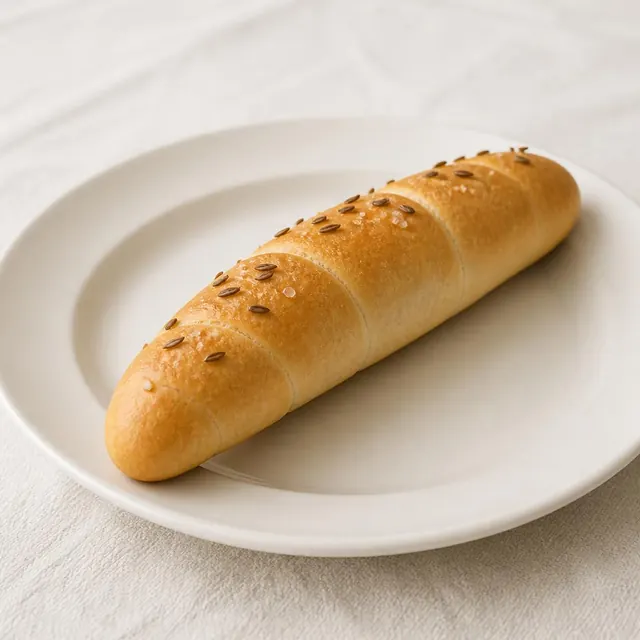
Czech bread roll (rohlík)
Homemade Czech enriched yeast roll; the recipe makes 10 rolls of about 43 g, one roll per serving.
Total time: 125 min10 servingsFinal yield 430 g
Ingredients
- 290 gFLOUR, WHEAT FLOUR, SEMI-COARSE
- 90 gMILK, 1.5% FAT, 1 UG ADDED VITAMIN D
- 80 gWATER, TAP WATER
- 12 gBAKING YEAST, FRESH
- 5 gSUGAR
- 6 gSALT, AVERAGE
- 15 gBUTTER, UNSALTED
Allergens
Contains: Gluten, Milk
Derived from ingredients – check the package label.
Method
- Crumble the yeast into the lukewarm milk with the sugar and leave for 10 minutes until frothy.
TipYeast doughYeast is only human: cosy warmth gets it working, real heat finishes it off, and in the cold it just dawdles.Show less
Why
The yeast cells break down sugars from the flour into carbon dioxide and alcohol; the gas, trapped in the gluten network, inflates the dough, while the by-products give it flavour. They work best at roughly 25–35 °C, slow down in the cold without dying, and begin to die from about 50–55 °C, so milk that is too hot kills the yeast before the dough ever reaches the oven. Salt slows fermentation and strengthens the gluten; plenty of sugar draws water away from the yeast and plenty of fat coats it, so sweet, buttery yeast doughs take longer to rise. A longer, cooler rise, such as overnight in the fridge, gives the dough more flavour, whereas over-proofed dough runs out of strength, collapses and smells sour and boozy.
How to do it
- Warm the milk or water only until lukewarm, about body temperature – it mustn't feel hot on your wrist.
- Stir fresh yeast with a little lukewarm liquid, a teaspoon of sugar and some flour, and let the starter get going.
- Mix the salt into the flour, not straight into the starter.
- Leave the dough to rise covered in a warm, draught-free spot until it has roughly doubled in size.
- Give sweet doughs rich in butter and sugar more time to rise, or add a little more yeast.
- Check the rise with a finger: the dent should spring back slowly; if it stays, the dough is over-proofed.
If it goes wrong
If the starter didn't bubble, the yeast was old or scalded – make a new one with fresh yeast. Dough that won't rise should go somewhere warmer (not directly on a radiator) and be given time. Knock back over-proofed dough briefly, shape it and let it rise again for a short while; it will be a little denser, but it will still bake.
- Add the flour, salt, water and butter and knead for 10 minutes into a smooth, elastic dough.
TipKneading and glutenGluten is the dough's gym: give bread a proper workout, and let sponge cakes and pancakes put their feet up.Show less
Why
When wheat flour meets water, its proteins gliadin and glutenin link up into gluten, and kneading stretches and aligns these chains into a springy, extensible network. In bread and yeast doughs a strong network is exactly what you want: it traps the gas from fermentation, the dough rises and the crumb is springy. In shortcrust pastry, sponge cake, pancakes or muffins the same network does damage – the result is tough and rubbery, muffins develop tunnels and pastry shrinks in the oven. Fat coats the flour particles and sugar holds on to water, so both hold back gluten formation; that's why such mixtures are only briefly combined and small lumps are left in. Resting relaxes the gluten, so the dough then rolls out more easily and shrinks less.
How to do it
- Knead bread dough by hand for about 10 minutes, until smooth and elastic and it stretches into a thin membrane without tearing.
- Stir pancake and muffin batters only briefly, until no dry flour remains – small lumps are fine.
- Bring shortcrust together quickly, with cold butter and cool hands, and simply press it into a ball.
- Fold the flour into a sponge mixture last and gently with a spatula, lifting from the bottom.
- If dough springs back as you roll it, cover it and let it rest for 10–20 minutes.
If it goes wrong
Wrap overworked pastry and chill it for at least half an hour: the gluten relaxes and the fat firms up, so it shrinks less in the oven, though it will be a little tougher. Let overmixed pancake batter rest for 15–30 minutes before cooking; that will at least ease the toughness. A tough baked sponge or muffin can't be fixed – mix less next time.
TipCzech flour: hladká, polohrubá, hrubáCzech fine, medium and coarse flours differ not in strength but in particle size – and so in how fast they soak up water.Show less
Why
The Czech labels hladká (fine), polohrubá (medium-coarse) and hrubá (coarse) describe granulation, that is particle size: under Czech Decree No. 18/2020 Sb., at least 96 % of fine flour must pass through a sieve with a 257 µm mesh, of medium-coarse flour through 366 µm and of coarse flour through 485 µm, and coarse flour may contain at most 15 % of particles smaller than 162 µm. The words světlá (white), polosvětlá (light) and chlebová (bread) used for fine flour instead state the ash content, the minerals from the outer layers of the grain, and thus how dark the flour is; fine white flour may contain at most 0.60 % in dry matter, polohrubá and hrubá only 0.50 %. Coarser particles absorb water more slowly, so a dough made with polohrubá stays firmer and drier and a dumpling made from it holds its shape better in water or steam, whereas hladká combines quickly into a smooth dough, roux or sponge. That is why the amount of liquid is off when you swap them: hladká instead of polohrubá gives a stickier, softer dough, polohrubá instead of hladká a stiffer, grainier one.
How to do it
- Use polohrubá for Czech bread dumplings and doughs that are boiled, unless the recipe says otherwise.
- Reach for hladká for sponge cake, roux, thickening and delicate cakes; sift it into a sponge batter.
- When swapping flours, add the liquid a little at a time and let the dough rest briefly, as coarser flour absorbs water more slowly.
- In Austria buy glattes Mehl instead of hladká and griffiges Mehl instead of polohrubá; in Germany Type 405 matches white hladká and Weizendunst is closer to hrubá; use griffiges Mehl for polohrubá.
- In English-speaking countries plain or all-purpose flour replaces hladká; polohrubá and hrubá have no common counterpart there, and semolina is coarse wheat meal, not flour.
If it goes wrong
Firm up a sticky dough made with hladká instead of polohrubá with a little flour and let it rest briefly before adding more. Loosen a dough that is too stiff from polohrubá with a spoonful of milk or water. A dumpling that falls apart in the water can't be saved; steam the remaining dough instead.
- Cover the dough and let it rise in a warm place for 45 minutes.
- Divide into 10 pieces of about 50 g, roll each into a triangle, roll it up from the wide side into a crescent and place on a lined baking tray.
- Let the rolls prove for 25 minutes and brush them with water.
- Bake in an oven preheated to 220 °C for about 15 minutes until golden and cool on a rack.
TipBaking bread and rollsBread needs steam and patience: steam at the start lets it rise, and waiting until it cools before slicing spares you a gummy crumb.Show less
Why
In the first minutes of baking the gas and steam in the dough expand with the heat and the loaf keeps rising; moisture in the oven keeps the surface soft and supple, so the crust does not set before the bread has risen, and the starch on the surface gelatinises, giving the crust shine and a deeper colour. According to King Arthur Baking, steam is needed only at the start, while the loaf is still rising, roughly the first 15–20 minutes; moisture throughout the bake gives a thick, rubbery crust. Inside, bread bakes until the starch has gelatinised and the proteins have set: America's Test Kitchen gives about 93–99 °C in the centre for lean breads and about 88–91 °C for breads with butter and eggs, but regards a sufficiently dark, well-baked crust as the more reliable sign. As the bread cools, steam keeps leaving the crumb and the gelatinised starch firms up, which is why a loaf cut hot is gummy and dense rye bread needs the longest time to cool.
How to do it
- Preheat the oven in good time, ideally with a baking sheet or cast-iron pot inside, and put the bread in only once it is fully hot.
- Score the loaf with a sharp knife just before baking; the cut decides where the bread expands, so it does not burst at random.
- Give the bread steam at the start: put a tray or dish of hot water on the oven floor, or bake the loaf under a lid for the first 20 minutes.
- After roughly 15–20 minutes, once the loaf stops rising, take out the water or lift off the lid so the crust dries and browns; beware of hot steam when you open the oven.
- Judge doneness by the colour of the crust, with a thermometer in the centre of the loaf; bake a pale loaf longer, even out of its tin for the last 10 minutes.
- Cool the bread on a rack, a loaf for at least 2 hours and dense rye bread longer; rolls cool faster.
If it goes wrong
If the bread is sticky and raw inside when cut, put it back in the oven for about 10–15 minutes at 180 °C and let it cool completely; an underbaked loaf finishes baking this way, while a crumb that was merely cut too hot will dry out a little. Finish a pale crust for a few minutes directly on the oven rack. A crust that is too hard softens if the bread cools wrapped in a tea towel. Sprinkle stale bread with water and put it in a hot oven for 5–10 minutes.
Recipe tradition
Not yet verified
This recipe has not been checked against a documented culinary reference.
Food data sources
- THL Fineli (20.0) · Terveyden ja hyvinvoinnin laitos (THL), Fineli · CC BY 4.0
Make at home or buy?
This recipe describes the homemade version. In menus and plans you can count on the ready-made product instead.
- Make at home (this recipe): 124.7 kcal per portion
- Buy ready-made: Czech bread roll (shop-bought) · 102.7 kcal per portion
Contains: Gluten · May contain: Egg, Soy, Milk, Sesame
Nutrition
Calculated from the selected ingredients; not a laboratory measurement.
Whole recipe
- Energy
- 1,247.4 kcal
- Protein
- 38.1 g
- Fat
- 18.1 g
- Carbohydrate
- 224.2 g
- Total carbohydrate (by difference)
- 231.3 g
- Fibre (Fineli)
- 11 g
- Saturated fatty acids
- 9.5 g
- Sodium
- 2,363.1 mg
- Salt (sodium × 2.5)
- 5.9 g
Per serving
- Protein3.8 g12%
- Fat1.8 g13%
- Total carbohydrate (by difference)23.1 g75%
Share of energy from protein, fat and carbohydrate (4 / 9 / 4 kcal per g), not share by weight.
- Energy
- 124.7 kcal
- Protein
- 3.8 g
- Fat
- 1.8 g
- Carbohydrate
- 22.4 g
- Total carbohydrate (by difference)
- 23.1 g
- Fibre (Fineli)
- 1.1 g
- Saturated fatty acids
- 0.95 g
- Sodium
- 236.3 mg
- Salt (sodium × 2.5)
- 0.59 g
Per 100 g of finished food
- Energy
- 290.1 kcal
- Protein
- 8.9 g
- Fat
- 4.2 g
- Carbohydrate
- 52.1 g
- Total carbohydrate (by difference)
- 53.8 g
- Fibre (Fineli)
- 2.6 g
- Saturated fatty acids
- 2.2 g
- Sodium
- 549.6 mg
- Salt (sodium × 2.5)
- 1.4 g
Salt is calculated from sodium (g salt = mg sodium × 2.5 / 1000) and includes sodium from all ingredients.
A dash means the value is unknown, not zero.
Calculation limitations
- Nutrition is a calculated estimate, not a laboratory measurement.
- The final yield is an editorial estimate.
- Fibre, saturated fat and sodium of cooked ingredients are estimated from the consumed ingredient amounts; for drained ingredients, sodium is included only where the retained amount is an explicit editorial estimate.
- Some process effects could not be resolved in this calculation.