Menu · 2 components
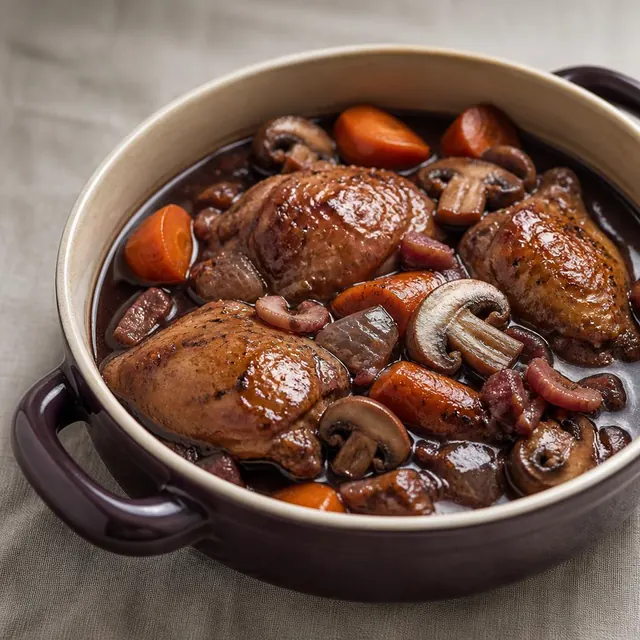
Coq au vin with mashed potatoes
Chicken braised in red wine with bacon and mushrooms, with French pommes purée; a quarter of a baguette (about 65 g) is the further choice.
Menu portion182 min1,029 kcal per menu portion
- Good for lunch
Less suited for dinner.
1Main course
Coq au vin
635 kcal per menu portion · 1 × recipe portion per menu portion
Contains: Gluten, Sulphites · May contain: Soy, Milk, Celery
Quantities for the whole recipe (5 servings).
Ingredients
- 1,000 gChicken, broilers or fryers, thigh, meat and skin, raw
- 120 gPork, cured, bacon, unprepared
- 300 gMushrooms, white, raw
- 200 gOnions, raw
- 200 gCarrots, raw
- 500 mlAlcoholic beverage, wine, table, red
- 300 mlSoup, beef broth, less/reduced sodium, ready to serve
- 10 gGarlic, raw
- 25 gWheat flour, white, all-purpose, unenriched
- 3 gThyme, fresh
Method
- Prepare 1,000 g boneless chicken thigh meat with skin, 120 g bacon, 300 g mushrooms, 200 g onion, 200 g carrot and 10 g garlic. Cut onion, carrot and garlic; halve the mushrooms.
TipRaw poultry and cross-contaminationChicken doesn't need a shower: the tap would only send its bacteria on a tour of the whole kitchen.Why and howShow less
Why
Raw poultry isn't sterile: it often carries Campylobacter and Salmonella bacteria – according to the US CDC, roughly 1 in 25 packs of chicken in US shops is contaminated with Salmonella, and according to the German BfR, Campylobacter is the most common bacterial cause of diarrhoea in Germany. A small number of bacteria is enough to make you ill, and they don't spoil the food, so you can't tell by look or smell. Rinsing under the tap doesn't remove them, it just spreads them in droplets over the sink, worktop, utensils and hands; the CDC and the BfR therefore advise against rinsing poultry, since only thorough cooking reliably destroys the bacteria. So the danger usually isn't the well-cooked chicken itself but whatever touched it raw: the board, knife, hands or plate that later meet salad vegetables or cooked meat.
How to do it
- Don't rinse chicken; lift it out of the pack with a fork or tongs straight into the pan or roasting tin, and pat a wet surface dry with kitchen paper you throw away at once.
- Keep a separate board and knife for raw poultry, apart from vegetables, bread and cooked food.
- After handling poultry, wash your hands with soap and water, and clean the board, knife and worktop with water as hot as possible and washing-up liquid.
- Store raw poultry covered on the bottom shelf of the fridge and thaw it in the fridge in a bowl so juices don't drip onto other food.
- Don't put cooked meat back on the plate or board where it lay raw.
- Change tea towels and cloths often and wash them at 60 °C or above.
If it goes wrong
If you cut salad vegetables on the board you used for raw chicken, it's safer to throw them away or cook them thoroughly. Wash the board and knife with hot water and washing-up liquid, and next time keep a separate board for raw meat, perhaps a different colour.
- In a deep pot cook the bacon over medium heat for 6 minutes until it renders its fat. In the bacon fat brown the chicken skin-side down in two batches on both sides until golden and transfer it to a plate; the bacon stays in the pot.
TipSearing meatA seared crust seals in nothing but flavour – and for a crust, that's achievement enough.Why and howShow less
Why
The brown crust and aroma of seared meat come from the Maillard reaction, in which proteins and sugars on the surface turn into hundreds of aromatic compounds; it only gets going quickly above roughly 140 °C. As long as the surface of the meat is wet, the water holds it at around 100 °C and the meat steams instead of searing – which is why you dry the meat and get the pan and fat properly hot. Put too much meat in the pan and its temperature drops sharply, juices run out and the pieces simmer in them, grey and crustless. The idea that searing 'seals the pores' and keeps the juices in is a myth: the crust isn't watertight and seared meat loses as much juice or even more – you sear for flavour, not for juiciness.
How to do it
- Pat the surface of the meat thoroughly dry with kitchen paper.
- Heat the pan first, then add a fat that can take high heat, such as rapeseed oil or clarified butter; don't heat a non-stick pan empty on full power.
- Leave space between the pieces; if they don't fit, sear in batches.
- Leave the meat alone and don't move it until it releases by itself; if it sticks, it hasn't formed a crust yet.
- Deglaze the browned bits on the bottom of the pan with wine or stock – they are the base of a sauce.
If it goes wrong
If the meat has released its juices and is stewing, take it out, pour the juices aside, reheat the pan and sear the meat in smaller batches; then add the juices to the sauce. Grey meat that is already cooked through can't get a crust afterwards without overcooking – serve it with a sauce, and next time dry the meat and don't crowd the pan.
TipRendering bacon and lardBacon needs patience: on gentle heat its fat runs out and it crisps, on fierce heat it burns outside and stays rubbery within.Why and howShow less
Why
The fat in bacon and in pork back fat is held in the cells of fatty tissue bound together by connective tissue; heat liquefies the fat so it gradually runs out, the water evaporates, and the lean parts shrink and turn crisp. This takes time, which is why bacon goes into a cold pan, even with a little water, and is heated over medium heat: the water keeps the temperature low at first, the fat renders before the surface scorches, and the bacon crisps evenly. In a fiercely hot pan the surface burns, the fat blackens and smokes, and the fatty parts stay rubbery. Pork fat for cracklings is rendered over gentle heat with frequent stirring until the cracklings are light brown and crush easily; overcooked cracklings give dark lard with a burnt taste. Bacon cured with nitrite also forms nitrosamines when fried over fierce heat, and EFSA regards dietary exposure to nitrosamines as a health concern, so this is one more reason to fry bacon until crisp, not black.
How to do it
- Cut the bacon into slices, strips or cubes of even thickness, spread it in a cold pan in a single layer and, if you like, add about 4 tablespoons of water.
- Heat over medium heat and turn it now and then; the water evaporates and the bacon then keeps frying in its own fat.
- Take the bacon out as soon as it is golden brown; it crisps further on paper towel, and if it is dark while still in the pan, it is overcooked.
- Cut pork fat for cracklings into even cubes and render it in a heavy pot over gentle heat, stirring often, until the cracklings turn golden.
- Carefully strain the hot lard through a sieve into dry jars and keep it covered in the fridge once cool; never add water to hot fat, it boils up violently and spatters.
- Use the fat rendered from bacon to soften onions or vegetables; let the rest set and put it in the bin, not down the drain.
If it goes wrong
Put rubbery bacon back in the pan and let it keep rendering slowly over gentle heat until it crisps. Burnt bacon cannot be saved, it is bitter; take fat that has blackened or smoked heavily off the heat, let it cool a little, pour it carefully into a dry container and carry on in a clean pan. If the cracklings catch on the bottom before they release their fat, lower the heat and stir more often. Lard that has darkened and smells scorched is edible, but use it only where a stronger flavour does no harm.
- Put onion, carrot, garlic and 25 g flour into the pot. After two minutes return chicken, add 500 ml red wine and 300 ml stock, then 3 g thyme. Cover and braise for 75 minutes.
TipBraising tough cutsCollagen won't be rushed: a gentle simmer turns it into gelatin, a rolling boil turns the meat into shoe leather.Why and howShow less
Why
Tough cuts such as shoulder, shin, neck or cheek contain a lot of connective tissue, and its main protein, collagen, slowly dissolves into gelatin under long, moist heat – noticeably from roughly 70 °C, and over hours, not minutes. Meanwhile the muscle fibres lose more water the hotter they get, and a hard boil tightens and wrings them out, so the meat ends up dry and stringy even while sitting in liquid. That is why you braise covered, just below the boil, with only the occasional bubble breaking the surface: the collagen has time to break down and the fibres are not heated more than they need to be. The gelatin then coats the fibres, making the meat succulent and the sauce glossy and rich; lean cuts with little connective tissue, such as pork tenderloin, only dry out with long braising because they lack the collagen that would rescue them.
How to do it
- Choose cuts with sinew and connective tissue for braising: shoulder, shin, neck, cheeks or oxtail.
- Brown the meat well first, then add liquid to come only about halfway up the meat.
- Keep it at a bare simmer, with the surface barely trembling; in a covered pot in the oven, about 140–160 °C is plenty.
- Test for doneness with a fork, not the clock: the meat is ready when it pulls apart easily.
- Let the cooked meat cool a little in its liquid: the surface won't dry out and the gelatin-rich juices will coat it.
If it goes wrong
Tough meat is almost always underbraised: add a splash of liquid and keep it at a gentle simmer until it softens. Meat that has boiled into dry strands won't become juicy again; shred it, moisten it with the sauce and serve it as a ragù or filling. Next time, lower heat and more time.
- Add mushrooms and braise uncovered for 23 minutes, until the chicken reaches at least 74 °C in its thickest part.
TipInternal temperature of meatThe colour of meat likes to lie; the thermometer is the only witness you can trust.Why and howShow less
Why
Safety depends on the temperature in the thickest part of the piece, not on the recipe's timing or the colour: minced meat can turn brown before it reaches a safe temperature, while lean meat may stay pink even when cooked through. US authorities (USDA, CDC) give minimum core temperatures of 74 °C for all poultry, 71 °C for minced meat and 63 °C for whole cuts of beef, pork, veal and lamb, which should then rest for at least 3 minutes. European authorities work with a holding time: the UK FSA and the German BfR give 70 °C in the core for 2 minutes, and the FSA advises cooking poultry, pork and minced meat right through, with no pink. According to the FSA, a whole cut of beef or lamb may be served pink because the bacteria sit on the surface, which gets seared; culinary levels such as rare (around 52–55 °C) or medium rare (around 55–60 °C) lie below the US threshold, though, so they are a matter of personal choice, and for pregnant women, young children, older people and anyone with weakened immunity it is safer to cook the meat through.
How to do it
- Measure with a probe thermometer in the thickest part, away from bone and fat; push it into a thin patty from the side.
- Cook poultry until the core reads at least 74 °C, including the thighs and stuffing.
- Cook minced meat, sausages and stuffed rolls to at least 71 °C, with no pink inside.
- Take whole cuts of beef and lamb off at 63 °C at the earliest and rest them for at least 3 minutes; cook pork through to 70 °C, as in European practice.
- If you choose a pink steak, always sear it well on all sides, and serve it cooked through to vulnerable groups.
If it goes wrong
If the thermometer reads too low, put the meat back in the oven or pan and measure again after a few minutes; finish cut slices in the pan. Overcooked, dry meat won't turn juicy again – slice it thinly and serve it with a sauce; next time take it off a few degrees earlier and allow for carryover cooking.
TipMushroomsIn the pan a mushroom acts like a kitchen sponge: first it lets go of its water, and only then does it bother turning golden.Why and howShow less
Why
Fresh mushrooms are mostly water, button mushrooms about 90 %, and they release it into the pan as they heat; so they first stew in their own juice and brown only once the water has evaporated. An overcrowded pan or fat that isn't hot enough only prolongs this stage, and salt added at the start draws the water out sooner; mushrooms taken off the heat before the juice has evaporated end up grey and rubbery. Wild mushrooms are not eaten raw, even edible species often cause digestive upsets when raw, and dishes made from them should therefore be cooked for at least 15 minutes. The widespread claim that mushroom dishes must never be reheated is only half true: problems come mainly from badly stored mushrooms and dishes, whereas a dish cooled quickly and kept briefly in the fridge can be reheated once. Only gather and eat mushrooms you can identify with certainty; phone apps often cannot identify a species unambiguously.
How to do it
- Clean mushrooms with a knife or brush, rinse dirty ones only briefly and dry them at once; never leave them sitting in water.
- If you want them browned, heat a pan with fat and fry them in batches in a single layer; for a sauce or soup, softening them is enough.
- Let fried mushrooms evaporate their juice and brown; you can salt them at any point, salt at the start only speeds up the release of water.
- Never eat wild mushrooms raw, and cook dishes made from them for at least 15 minutes.
- Cool leftover mushroom dishes quickly, refrigerate them (ideally at 2–4 °C), use them up soon and reheat only once, until piping hot throughout, to at least 74 °C in the centre.
- Gather and cook only mushrooms you know with certainty; have uncertain finds checked at a mushroom advice centre, not by an app.
If it goes wrong
Leave watery mushrooms in the pan uncovered until the juice has evaporated, then brown them; you can also pour the juice off into a sauce. To get rid of grit from dried mushrooms, strain the soaking water through a fine sieve or a paper filter. If nausea, vomiting or diarrhoea appear after a mushroom meal, call a doctor, the emergency services or a poison information centre, even if the symptoms start many hours after eating – the most dangerous poisonings often have a late onset. Keep any leftover mushrooms and food for identification.
2Side dish
French mashed potatoes (pommes purée) traditional
394 kcal per menu portion · 1 × recipe portion per menu portion
- Vegetarian
- Gluten free
Contains: Milk
Quantities for the whole recipe (6 servings).
or:
- Baguette (shop-bought) · 177 kcal per menu portion
Ingredients
- 1,000 gPotatoes, flesh and skin, raw
- 200 gButter, without salt
- 250 mlMilk, whole, 3.25% milkfat, with added vitamin D
- 8 gSalt, table
- 2 lBeverages, water, tap, drinking not counted – removed
- 2 gSalt, table editorial addition
Method
- Wash potatoes of even size, put them in a pot in their skins, cover with 2 litres of cold water with 20 g of salt and bring to the boil. Simmer for about 25 minutes until a knife slides in without resistance.
- Drain the potatoes and peel them while still hot, holding them in a cloth. Immediately pass them through a food mill with a fine disc or a potato ricer into a saucepan. Never use a blender: broken cells release starch and the purée turns gluey.
- Set the pan over low heat and stir the purée with a wooden spoon for 4–5 minutes to drive off moisture; it must not catch. Meanwhile bring 250 ml of milk to the boil.
- Vigorously work 200 g of cold diced butter into the purée a little at a time and add 8 g of salt. Then pour in the boiling milk in a thin stream while stirring constantly, and finally whisk the purée until smooth. Heat it through without boiling and serve at once.
Alternative: Baguette (shop-bought)
Ingredients
- 65 gBread, French or Vienna
Method
- Cut the baguette into quarters and serve fresh.
Allergens
Contains: Gluten, Milk, Sulphites
May contain: Celery, Soy
Derived from ingredients – check the package label.
Nutrition, allergens and calories are for the default choice – the first alternative of every slot.
Nutrition per menu portion
Per serving
- Protein45.4 g18%
- Fat71.2 g63%
- Total carbohydrate (by difference)48.6 g19%
Share of energy from protein, fat and carbohydrate (4 / 9 / 4 kcal per g), not share by weight.
- Energy
- 1,029 kcal
- Protein
- 45.4 g
- Fat
- 71.2 g
- Total carbohydrate (by difference)
- 48.6 g
- Total dietary fibre (USDA)
- 6.2 g
- Saturated fatty acids
- 29.8 g
- Sodium
- 1,182 mg
- Salt (sodium × 2.5)
- 3 g
Per 100 g
- Energy
- 157.5 kcal
- Protein
- 7 g
- Fat
- 10.9 g
- Total carbohydrate (by difference)
- 7.4 g
- Total dietary fibre (USDA)
- 0.94 g
- Saturated fatty acids
- 4.6 g
- Sodium
- 180.9 mg
- Salt (sodium × 2.5)
- 0.45 g
A dash means the value is unknown, not zero. Salt is calculated from sodium (g salt = mg sodium × 2.5 / 1000) and includes sodium from all ingredients.
Calculation limitations
- Nutrition is a calculated estimate, not a laboratory measurement.
- Some ingredient quantities use documented estimates or household-measure assumptions.
- The number of servings is an editorial estimate (midpoint of the source range or based on the dish type and energy).
- Fibre, saturated fat and sodium of cooked ingredients are estimated from the consumed ingredient amounts; for drained ingredients, sodium is included only where the retained amount is an explicit editorial estimate.
- Alcohol remaining after cooking is estimated from USDA retention factors by cooking method and time; energy excludes the evaporated alcohol.
- Some process effects could not be resolved in this calculation.
- Menu nutrition is the sum of its component recipes, each scaled to one menu portion.