Menu · 1 component
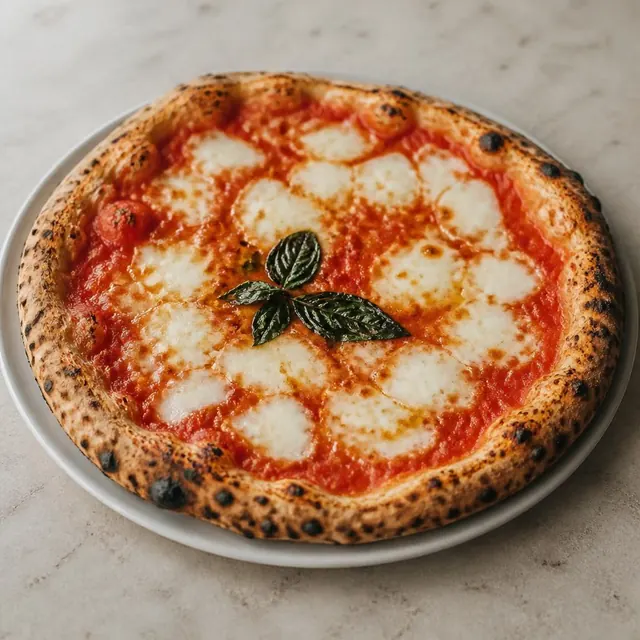
Pizza margherita
Neapolitan pizza with tomatoes, mozzarella, basil and olive oil; a complete main course.
Menu portion660 min921.9 kcal per menu portion
- Good for lunch
- Good for dinner
1Main course
Pizza margherita
922 kcal per menu portion · 1 × recipe portion per menu portion
Contains: Gluten, Milk
Quantities for the whole recipe (4 servings).
Ingredients
- 610 gWheat flour, white, all-purpose, unenriched
- 360 mlBeverages, water, tap, drinking
- 15 gSalt, table
- 1 gLeavening agents, yeast, baker's, compressed
- 280 gTomatoes, red, ripe, canned, packed in tomato juice, no salt added
- 360 gCheese, mozzarella, whole milk
- 24 gCheese, parmesan, grated
- 8 gBasil, fresh
- 2 15 ml tablespoonOil, olive, salad or cooking
Method
- Pour 360 ml of water at about 20 °C into a bowl and dissolve 15 g of salt in it. Stir in about a tenth of the flour, crumble 1 g of yeast into the water and gradually add the remaining flour, mixing constantly, until it comes together as a dough.
TipYeast doughYeast is only human: cosy warmth gets it working, real heat finishes it off, and in the cold it just dawdles.Why and howShow less
Why
The yeast cells break down sugars from the flour into carbon dioxide and alcohol; the gas, trapped in the gluten network, inflates the dough, while the by-products give it flavour. They work best at roughly 25–35 °C, slow down in the cold without dying, and begin to die from about 50–55 °C, so milk that is too hot kills the yeast before the dough ever reaches the oven. Salt slows fermentation and strengthens the gluten; plenty of sugar draws water away from the yeast and plenty of fat coats it, so sweet, buttery yeast doughs take longer to rise. A longer, cooler rise, such as overnight in the fridge, gives the dough more flavour, whereas over-proofed dough runs out of strength, collapses and smells sour and boozy.
How to do it
- Warm the milk or water only until lukewarm, about body temperature – it mustn't feel hot on your wrist.
- Stir fresh yeast with a little lukewarm liquid, a teaspoon of sugar and some flour, and let the starter get going.
- Mix the salt into the flour, not straight into the starter.
- Leave the dough to rise covered in a warm, draught-free spot until it has roughly doubled in size.
- Give sweet doughs rich in butter and sugar more time to rise, or add a little more yeast.
- Check the rise with a finger: the dent should spring back slowly; if it stays, the dough is over-proofed.
If it goes wrong
If the starter didn't bubble, the yeast was old or scalded – make a new one with fresh yeast. Dough that won't rise should go somewhere warmer (not directly on a radiator) and be given time. Knock back over-proofed dough briefly, shape it and let it rise again for a short while; it will be a little denser, but it will still bake.
- Knead the dough by hand or with a dough hook on low speed for 15–20 minutes until smooth, elastic and no longer sticky.
TipKneading and glutenGluten is the dough's gym: give bread a proper workout, and let sponge cakes and pancakes put their feet up.Why and howShow less
Why
When wheat flour meets water, its proteins gliadin and glutenin link up into gluten, and kneading stretches and aligns these chains into a springy, extensible network. In bread and yeast doughs a strong network is exactly what you want: it traps the gas from fermentation, the dough rises and the crumb is springy. In shortcrust pastry, sponge cake, pancakes or muffins the same network does damage – the result is tough and rubbery, muffins develop tunnels and pastry shrinks in the oven. Fat coats the flour particles and sugar holds on to water, so both hold back gluten formation; that's why such mixtures are only briefly combined and small lumps are left in. Resting relaxes the gluten, so the dough then rolls out more easily and shrinks less.
How to do it
- Knead bread dough by hand for about 10 minutes, until smooth and elastic and it stretches into a thin membrane without tearing.
- Stir pancake and muffin batters only briefly, until no dry flour remains – small lumps are fine.
- Bring shortcrust together quickly, with cold butter and cool hands, and simply press it into a ball.
- Fold the flour into a sponge mixture last and gently with a spatula, lifting from the bottom.
- If dough springs back as you roll it, cover it and let it rest for 10–20 minutes.
If it goes wrong
Wrap overworked pastry and chill it for at least half an hour: the gluten relaxes and the fat firms up, so it shrinks less in the oven, though it will be a little tougher. Let overmixed pancake batter rest for 15–30 minutes before cooking; that will at least ease the toughness. A tough baked sponge or muffin can't be fixed – mix less next time.
- Cover the dough with a damp cloth or film and let it rise in one piece for 2 hours at about 23 °C.
- Divide the dough into 4 pieces of about 247 g and shape each into a smooth, taut ball. Place the balls in a lightly floured box with a lid and leave them to rise for another 6–8 hours at about 23 °C until puffy and soft. Depending on temperature, the total rise can take 8–24 hours.
- At least 45 minutes before baking, put a baking stone or steel in the upper third of the oven and heat the oven to its maximum (250–300 °C). Meanwhile cut the mozzarella into strips and leave it to drain in a sieve for at least 30 minutes.
- Place a dough ball on a floured board and press it out with your fingertips from the centre towards the edge into a disc 30–35 cm across, leaving an untouched rim of 1–2 cm (the cornicione). Stretch it by hand only and never use a rolling pin.
- Spread 70 g of hand-crushed peeled tomatoes over each disc with a spoon in a spiral, leaving the rim bare. Scatter 90 g of the drained mozzarella, sprinkle with 6 g of grated hard cheese, add a few basil leaves and drizzle with 1½ tsp of olive oil.
- Slide the pizza onto the hot stone with a peel and bake for 6–8 minutes until the rim has risen and shows dark blisters and the mozzarella has melted. Bake the other pizzas the same way and serve at once.
Allergens
Contains: Gluten, Milk
Derived from ingredients – check the package label.
Nutrition, allergens and calories are for the default choice – the first alternative of every slot.
Nutrition per menu portion
Per serving
- Protein38 g17%
- Fat30.1 g30%
- Total carbohydrate (by difference)121.9 g53%
Share of energy from protein, fat and carbohydrate (4 / 9 / 4 kcal per g), not share by weight.
- Energy
- 921.9 kcal
- Protein
- 38 g
- Fat
- 30.1 g
- Total carbohydrate (by difference)
- 121.9 g
- Total dietary fibre (USDA)
- 5.5 g
- Saturated fatty acids
- 14.6 g
- Sodium
- 2,013 mg
- Salt (sodium × 2.5)
- 5 g
Per 100 g
- Energy
- 263.4 kcal
- Protein
- 10.9 g
- Fat
- 8.6 g
- Total carbohydrate (by difference)
- 34.8 g
- Total dietary fibre (USDA)
- 1.6 g
- Saturated fatty acids
- 4.2 g
- Sodium
- 575.1 mg
- Salt (sodium × 2.5)
- 1.4 g
A dash means the value is unknown, not zero. Salt is calculated from sodium (g salt = mg sodium × 2.5 / 1000) and includes sodium from all ingredients.
Calculation limitations
- Nutrition is a calculated estimate, not a laboratory measurement.
- Some ingredient quantities use documented estimates or household-measure assumptions.
- The number of servings is an editorial estimate (midpoint of the source range or based on the dish type and energy).
- Some specific ingredients are represented by the closest generic food with the same culinary function.
- Fibre, saturated fat and sodium of cooked ingredients are estimated from the consumed ingredient amounts; for drained ingredients, sodium is included only where the retained amount is an explicit editorial estimate.
- Some process effects could not be resolved in this calculation.
- Menu nutrition is the sum of its component recipes, each scaled to one menu portion.