Menu · 1 component
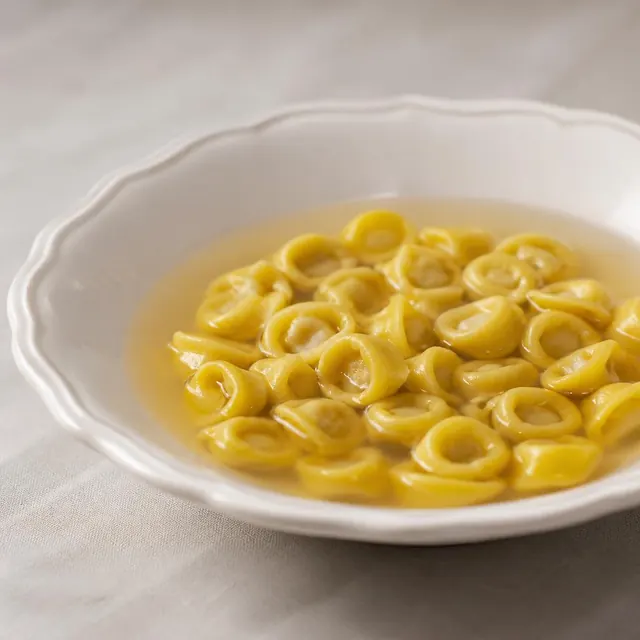
Tortellini in brodo
Bolognese tortellini filled with pork, prosciutto, mortadella and Parmesan, served in capon and beef broth; a complete course.
Menu portion4540 min465.6 kcal per menu portion
- Good for lunch
- Good for dinner
1Main course
Tortellini in brodo
466 kcal per menu portion · 1 × recipe portion per menu portion
- Low in lactose
Contains: Gluten, Egg, Milk, Celery · May contain: Soy, Tree nuts, Mustard
Quantities for the whole recipe (6 servings).
Ingredients
- 300 gWheat flour, white, all-purpose, unenriched
- 3 pieces · largeEgg, whole, raw, fresh
- 1 gSalt, table
- 60 gPork, fresh, loin, top loin (chops), boneless, separable lean and fat, raw
- 1.5 gSalt, table
- 2 gRosemary, fresh not counted – removed
- 3 gGarlic, raw not counted – removed
- 5 gButter, without salt
- 60 gHam, prosciutto
- 60 gMortadella, beef, pork
- 90 gCheese, parmesan, hard
- 30 gEgg, whole, raw, fresh
- 0.3 gSpices, nutmeg, ground
- 1.8 lSoup, stock, chicken, home-prepared
Method
- Two days ahead, finely chop 2 g of rosemary and 3 g of garlic with 1.5 g of salt. Coat 60 g of pork loin with the mixture, wrap it in film and leave it in the fridge for 2 days.
- Melt 10 g of butter in a small pan and cook the meat in it with its herb coating, covered, over low heat for 20–25 minutes, turning it now and then, until cooked through with at least 68 °C at the centre. Take it out of the pan, scrape off the herb mixture and let it cool.
TipInternal temperature of meatThe colour of meat likes to lie; the thermometer is the only witness you can trust.Why and howShow less
Why
Safety depends on the temperature in the thickest part of the piece, not on the recipe's timing or the colour: minced meat can turn brown before it reaches a safe temperature, while lean meat may stay pink even when cooked through. US authorities (USDA, CDC) give minimum core temperatures of 74 °C for all poultry, 71 °C for minced meat and 63 °C for whole cuts of beef, pork, veal and lamb, which should then rest for at least 3 minutes. European authorities work with a holding time: the UK FSA and the German BfR give 70 °C in the core for 2 minutes, and the FSA advises cooking poultry, pork and minced meat right through, with no pink. According to the FSA, a whole cut of beef or lamb may be served pink because the bacteria sit on the surface, which gets seared; culinary levels such as rare (around 52–55 °C) or medium rare (around 55–60 °C) lie below the US threshold, though, so they are a matter of personal choice, and for pregnant women, young children, older people and anyone with weakened immunity it is safer to cook the meat through.
How to do it
- Measure with a probe thermometer in the thickest part, away from bone and fat; push it into a thin patty from the side.
- Cook poultry until the core reads at least 74 °C, including the thighs and stuffing.
- Cook minced meat, sausages and stuffed rolls to at least 71 °C, with no pink inside.
- Take whole cuts of beef and lamb off at 63 °C at the earliest and rest them for at least 3 minutes; cook pork through to 70 °C, as in European practice.
- If you choose a pink steak, always sear it well on all sides, and serve it cooked through to vulnerable groups.
If it goes wrong
If the thermometer reads too low, put the meat back in the oven or pan and measure again after a few minutes; finish cut slices in the pan. Overcooked, dry meat won't turn juicy again – slice it thinly and serve it with a sauce; next time take it off a few degrees earlier and allow for carryover cooking.
- Chop the pork, 60 g of prosciutto and 60 g of mortadella very finely (or mince twice through the finest plate). Add 90 g of grated Parmigiano Reggiano, 30 g of beaten egg and a pinch of nutmeg and knead at length until the filling is completely uniform.
- Cover the filling and leave it to rest in the fridge for at least 24 hours.
- Heap 300 g of flour on a board, make a well in the centre and crack 3 eggs into it. Add a pinch of salt; if the dough is too stiff, add at most 1–2 tbsp of water. Gradually work in the flour with a fork, then knead for 10–15 minutes until the dough is smooth, elastic and free of air bubbles when cut. Wrap it in film and leave it to rest for 30 minutes at room temperature.
TipKneading and glutenGluten is the dough's gym: give bread a proper workout, and let sponge cakes and pancakes put their feet up.Why and howShow less
Why
When wheat flour meets water, its proteins gliadin and glutenin link up into gluten, and kneading stretches and aligns these chains into a springy, extensible network. In bread and yeast doughs a strong network is exactly what you want: it traps the gas from fermentation, the dough rises and the crumb is springy. In shortcrust pastry, sponge cake, pancakes or muffins the same network does damage – the result is tough and rubbery, muffins develop tunnels and pastry shrinks in the oven. Fat coats the flour particles and sugar holds on to water, so both hold back gluten formation; that's why such mixtures are only briefly combined and small lumps are left in. Resting relaxes the gluten, so the dough then rolls out more easily and shrinks less.
How to do it
- Knead bread dough by hand for about 10 minutes, until smooth and elastic and it stretches into a thin membrane without tearing.
- Stir pancake and muffin batters only briefly, until no dry flour remains – small lumps are fine.
- Bring shortcrust together quickly, with cold butter and cool hands, and simply press it into a ball.
- Fold the flour into a sponge mixture last and gently with a spatula, lifting from the bottom.
- If dough springs back as you roll it, cover it and let it rest for 10–20 minutes.
If it goes wrong
Wrap overworked pastry and chill it for at least half an hour: the gluten relaxes and the fat firms up, so it shrinks less in the oven, though it will be a little tougher. Let overmixed pancake batter rest for 15–30 minutes before cooking; that will at least ease the toughness. A tough baked sponge or muffin can't be fixed – mix less next time.
- Roll the dough out in portions into a very thin sheet, keeping the rest covered. Let the sheet dry slightly for just a few minutes, without letting it turn brittle, and cut it into squares of 4–4.5 cm.
- Place about 2 g of filling (a ball the size of a hazelnut) in the centre of each square. Fold the square into a triangle, press the edges together, wrap it around the tip of your index finger and pinch the two corners firmly together. You will get about 150 tortellini of about 5 g; spread them out on a floured tray.
TipFilled dumplings: momo, wonton, Maultaschen, pierogiA dumpling holds when the dough is supple, the edge clean and no air inside; then it wants a gentle simmer or steam, not a hard boil.Why and howShow less
Why
Thin dough is held together by a gluten network (Kneading and gluten card), and two edges only join when they are supple and clean: dried-out dough will no longer stick, and fat or juice from the filling on the edge keeps the seam apart. Air sealed in with the filling expands during cooking and balloons or tears the dumpling, and the same happens to a dumpling holding more filling than the dough can take. A wet filling, such as raw cabbage or spinach, releases water, soaks the dough from inside and makes sealing harder, so vegetables that make up much of the filling are squeezed or softened in the pan beforehand (Watery vegetables: courgette, cucumber, cabbage card). A rolling boil tosses the dumplings so they knock against each other and the bottom and burst, while the filling in the centre heats more slowly than the dough, so floating to the surface does not yet mean a meat filling is cooked through; it should reach at least 71 °C at the core, 74 °C with poultry (Internal temperature of meat card).
How to do it
- Rest the kneaded dough covered so it relaxes and rolls out thinly; keep rolled rounds and finished dumplings under a towel so they do not dry out.
- The filling should be cohesive and moist, not wet: when vegetables dominate, squeeze cabbage or spinach first, let fried onion cool and do not add liquid fat from the pan.
- Put only so much filling on each round that a clean edge remains; brush a dry edge with water, press the air out away from the filling as you close it and pinch the edge firmly.
- Cook in small batches in a wide pot at a gentle boil; when the water boils hard, add a little cold water, as northern Chinese cooks do.
- Boil or steam meat-filled dumplings until the filling reaches at least 71 °C, 74 °C with poultry; cut open the first of each batch or check it with a probe thermometer.
- Line the steamer insert with paper or cabbage leaves, or brush it with water or oil, and space the dumplings apart; lift boiled ones out with a slotted spoon.
If it goes wrong
A burst dumpling is edible: finish cooking it, and if the filling has spilled into the water, serve it all as soup. Brush an edge that will not seal with water and pinch it again; cover dried dough with a damp towel. Drain soggy, stuck-together dumplings, separate them and fry them briefly in a pan with a little oil. Finish a raw centre at a gentle boil or in steam and measure again; next time use less filling or cook the dumplings longer and more gently.
- Bring 1.8 l of strained capon and beef broth, made in advance, to the boil. Add the tortellini and simmer gently for 2–4 minutes until they float and the dough at the joins is tender. Serve at once in the broth, about 25 tortellini per plate.
Allergens
Contains: Celery, Egg, Gluten, Milk
May contain: Mustard, Soy, Tree nuts
Derived from ingredients – check the package label.
Nutrition, allergens and calories are for the default choice – the first alternative of every slot.
Nutrition per menu portion
Per serving
- Protein28.5 g25%
- Fat15.5 g31%
- Total carbohydrate (by difference)50 g44%
Share of energy from protein, fat and carbohydrate (4 / 9 / 4 kcal per g), not share by weight.
- Energy
- 465.6 kcal
- Protein
- 28.5 g
- Fat
- 15.5 g
- Total carbohydrate (by difference)
- 50 g
- Total dietary fibre (USDA)
- 1.4 g
- Saturated fatty acids
- 6.1 g
- Sodium
- 1,215.5 mg
- Salt (sodium × 2.5)
- 3 g
Per 100 g
- Energy
- 114 kcal
- Protein
- 7 g
- Fat
- 3.8 g
- Total carbohydrate (by difference)
- 12.2 g
- Total dietary fibre (USDA)
- 0.33 g
- Saturated fatty acids
- 1.5 g
- Sodium
- 297.7 mg
- Salt (sodium × 2.5)
- 0.74 g
A dash means the value is unknown, not zero. Salt is calculated from sodium (g salt = mg sodium × 2.5 / 1000) and includes sodium from all ingredients.
Calculation limitations
- Nutrition is a calculated estimate, not a laboratory measurement.
- Some ingredient quantities use documented estimates or household-measure assumptions.
- The number of servings is an editorial estimate (midpoint of the source range or based on the dish type and energy).
- Some specific ingredients are represented by the closest generic food with the same culinary function.
- Fibre, saturated fat and sodium of cooked ingredients are estimated from the consumed ingredient amounts; for drained ingredients, sodium is included only where the retained amount is an explicit editorial estimate.
- Some process effects could not be resolved in this calculation.
- Menu nutrition is the sum of its component recipes, each scaled to one menu portion.