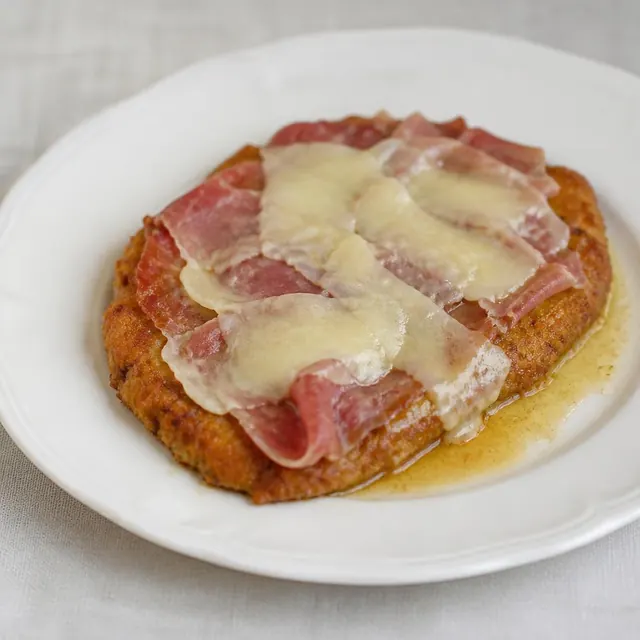
Cotoletta alla bolognese
A breaded veal cutlet from the leg, fried in butter, topped with prosciutto and shavings of Parmigiano Reggiano and briefly steamed under a lid with a little broth and meat juices until the cheese melts; following the recipe lodged by the Accademia Italiana della Cucina with the Bologna Chamber of Commerce on 14 October 2004. 4 servings of one cutlet each.
Total time: 40 min4 servingsFinal yield 900 g
Ingredients
- 480 gVeal, leg, top round, cap off, cutlet, boneless, raw
- 25 gWheat flour, white, all-purpose, unenriched
- 2 pieces · largeEgg, whole, raw, fresh
- 15 gCheese, parmesan, hard
- 0.5 5 ml teaspoonLemon juice, raw
- 1.5 gSalt, table
- 0.3 gSpices, pepper, black
- 80 gBread, crumbs, dry, grated, plain
- 60 gButter, without salt
- 60 gHam, prosciutto
- 105 gCheese, parmesan, hard
- 2 15 ml tablespoonSoup, stock, beef, home-prepared
- 3 15 ml tablespoonMeat jus (sugo di carne)
- 40 gTomato products, canned, puree, without salt added
Allergens
Contains: Gluten, Egg, Milk, Celery
May contain: Soy, Mustard, Sesame
Derived from ingredients – check the package label.
Method
- Trim the veal slices of any membrane and scraps. Pound them between sheets of film to about 5 mm thick, into a neat shape that is wider in the middle and narrower at the ends.
TipSchnitzel: pounding and coatingA schnitzel pounded to an even thickness cooks through all at once, so the thin edge doesn't dry out before the centre is done.Show less
Why
Pounding thins the slice and evens it out, so it fries evenly within a few minutes and the thin edge does not dry out before the thicker centre is cooked. The strip of fat and connective tissue at the edge of a pork chop shrinks differently from the lean meat in hot fat and makes the slice curl; a few short cuts through that strip prevent it. Wiener Schnitzel, which under Austrian and German food standards must be made from veal (the pork version is called Schnitzel Wiener Art), is fried floating in plenty of lard or clarified butter while the pan is swirled so that the fat also washes over the top; the coating, which is not pressed on, then lifts away from the meat in waves. Czech pork schnitzel is usually fried in a somewhat shallower layer of fat, about 1 cm, without swirling the pan, and its coating stays close to the meat; both styles are correct. Salt and coat the meat just before frying, because a salted slice releases juice to its surface within minutes, which soaks the coating from the inside.
How to do it
- Pound the slices between two sheets of cling film to an even thickness, about 4–5 mm for a classic schnitzel, without tearing them.
- On pork, make several short cuts through the strip of fat and connective tissue at the edge, but don't cut through the slice from edge to edge.
- Salt and coat the meat only just before frying, and don't leave coated schnitzels lying around.
- For a wavy coating, don't press on the crumbs, fry in enough fat for the schnitzel to float and keep swirling the pan.
- Cut chicken breasts into thinner slices before pounding and check doneness with a thermometer (see the Internal temperature of meat card).
If it goes wrong
A coating that has come away won't stick again; finish frying the schnitzel and serve it, and next time dry the meat and coat it just before frying. A tough schnitzel was thick or unevenly pounded and fried too long; dried-out meat can't be fixed, but a sauce or cutting it into strips helps. Finish a schnitzel that is dark outside and raw inside in the oven for a few minutes.
- Beat 2 eggs with 15 g of grated Parmesan, ½ tsp of lemon juice (a few drops), 1.5 g of salt and pepper. Dredge the slices in flour and shake off the excess, dip them in the egg and finally coat them in breadcrumbs, pressing the crumbs on well.
- In a large frying pan heat 60 g of butter over medium heat until it foams. Fry the cutlets in it for 2–3 minutes on each side until golden.
- Lay a slice of prosciutto on each cutlet and top it with Parmesan shavings (105 g in all). Pour 2 tablespoons of hot broth and 3 tbsp of meat juices (sugo di carne) into the pan, cover and leave over low heat for 4–5 minutes until the cheese has melted.
- Transfer the cutlets to warmed plates, spoon the pan juices over them and, just before serving, add a small dab of tomato sauce (about 10 g) to each.
Recipe tradition
Not yet verified
This recipe has not been checked against a documented culinary reference.
Food data sources
- USDA FoodData Central SR Legacy (2018-04) · USDA Agricultural Research Service, FoodData Central SR Legacy. · CC0 1.0 Universal
- USDA FoodData Central FNDDS (2021-2023) · USDA Agricultural Research Service, FoodData Central FNDDS. · CC0 1.0 Universal
Nutrition
Calculated from the selected ingredients; not a laboratory measurement.
Whole recipe
- Energy
- 2,107.6 kcal
- Protein
- 194 g
- Fat
- 107.8 g
- Total carbohydrate (by difference)
- 86.3 g
- Total dietary fibre (USDA)
- 5.1 g
- Saturated fatty acids
- 57.8 g
- Sodium
- 4,917.8 mg
- Salt (sodium × 2.5)
- 12.3 g
Per serving
- Protein48.5 g37%
- Fat26.9 g46%
- Total carbohydrate (by difference)21.6 g17%
Share of energy from protein, fat and carbohydrate (4 / 9 / 4 kcal per g), not share by weight.
- Energy
- 526.9 kcal
- Protein
- 48.5 g
- Fat
- 26.9 g
- Total carbohydrate (by difference)
- 21.6 g
- Total dietary fibre (USDA)
- 1.3 g
- Saturated fatty acids
- 14.5 g
- Sodium
- 1,229.4 mg
- Salt (sodium × 2.5)
- 3.1 g
Per 100 g of finished food
- Energy
- 234.2 kcal
- Protein
- 21.6 g
- Fat
- 12 g
- Total carbohydrate (by difference)
- 9.6 g
- Total dietary fibre (USDA)
- 0.57 g
- Saturated fatty acids
- 6.4 g
- Sodium
- 546.4 mg
- Salt (sodium × 2.5)
- 1.4 g
Salt is calculated from sodium (g salt = mg sodium × 2.5 / 1000) and includes sodium from all ingredients.
A dash means the value is unknown, not zero.
Calculation limitations
- Nutrition is a calculated estimate, not a laboratory measurement.
- The final yield is an editorial estimate.
- Some ingredient quantities use documented estimates or household-measure assumptions.
- Some specific ingredients are represented by the closest generic food with the same culinary function.
- Fibre, saturated fat and sodium of cooked ingredients are estimated from the consumed ingredient amounts; for drained ingredients, sodium is included only where the retained amount is an explicit editorial estimate.
- Some process effects could not be resolved in this calculation.