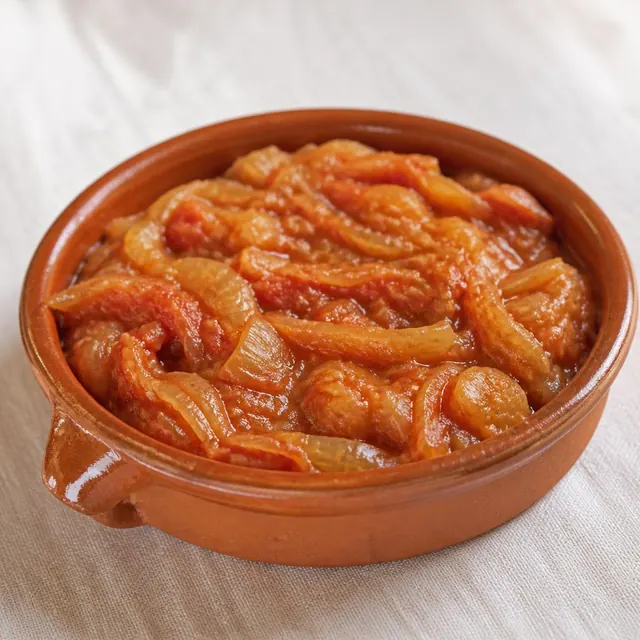
Bolognese stewed onions with tomatoes (friggione)
Thinly sliced white onions, first macerated with sugar and salt and then cooked slowly for hours in their own juice with lard and a little tomato until hazelnut-coloured and creamy. Following the Bolognese recipe of 1886 registered by the Accademia Italiana della Cucina (Bologna dei Bentivoglio delegation) on 19 November 2003, made as a quarter batch. One side serving is about 85 g for one serving of boiled meat (bollito).
Total time: 355 min4 servingsFinal yield 340 g
Ingredients
- 1,000 gOnions, raw
- 75 gTomatoes, red, ripe, raw, year round average
- 1 gSugars, granulated
- 1.5 gSalt, table
- 6 gLard
Allergens
Contains none of the 14 main allergens.
Derived from ingredients – check the package label.
Method
- Peel and halve the onions and slice them as thinly as possible, ideally on a mandoline. Toss them in a bowl with the sugar and the coarse salt.
- Leave the onions to macerate at room temperature for at least 2 hours; they will release plenty of juice. Meanwhile scald, peel and finely dice the tomatoes.
- Put the onions with the juice they have released and the lard into a wide, heavy pan (the original recipe prescribes aluminium). Cook over very low heat for about 2 hours, stirring often with a wooden spoon so that they never catch, until soft and hazelnut-coloured.
TipSweating and caramelising onionsOnions refuse to be hurried: rush them and they blacken, give them time and they turn golden and sweet.Show less
Why
Onions are mostly water, and until it has evaporated the surface of the slices can't get much above 100 °C: over gentle heat they simply soften, turn translucent and lose their sharp bite – that is sweating. Only once the water has gone do the sugars start reacting with amino acids in the Maillard reaction and caramelising on their own, producing a golden-brown colour and a sweet, deep flavour. Properly caramelised onions take roughly half an hour to an hour over low to medium heat, depending on the amount; over high heat the edges brown and burn before the centre has softened, and burnt onion turns bitter. A pinch of salt at the start draws water out of the cells by osmosis, so the onions release their juice and soften faster.
How to do it
- To sweat onions, use gentle heat and a little fat, and stir until soft and translucent but not browned.
- Add a pinch of salt right at the start so the onions give up their water faster.
- For golden onions, allow half an hour or more, and raise the heat only once the water has evaporated.
- Dissolve the brown film on the bottom of the pan with a spoonful of water and stir it back in – it's flavour, not burning.
- Use a wide pan so the water has room to evaporate, and stir more often the darker the onions get.
If it goes wrong
Pick out a few burnt bits; if the whole batch tastes bitter, it can't be saved – neither sugar nor cream will reliably mask it, so start again over lower heat. Onions that won't colour are still wet: uncover the pan and let the water cook off.
- Add the tomatoes and cook for about 1.5 hours more, stirring constantly. The friggione is ready when the onions and tomatoes have become a thick cream and the lard forms pinkish bubbles on the surface. Serve warm with boiled meats (bollito misto).
Recipe tradition
Not yet verified
This recipe has not been checked against a documented culinary reference.
Food data sources
- USDA FoodData Central SR Legacy (2018-04) · USDA Agricultural Research Service, FoodData Central SR Legacy. · CC0 1.0 Universal
Nutrition
Calculated from the selected ingredients; not a laboratory measurement.
Whole recipe
- Energy
- 471.5 kcal
- Protein
- 11.7 g
- Fat
- 7.2 g
- Total carbohydrate (by difference)
- 97.3 g
- Total dietary fibre (USDA)
- 17.9 g
- Saturated fatty acids
- 2.8 g
- Sodium
- 625.1 mg
- Salt (sodium × 2.5)
- 1.6 g
Per serving
- Protein2.9 g9%
- Fat1.8 g13%
- Total carbohydrate (by difference)24.3 g78%
Share of energy from protein, fat and carbohydrate (4 / 9 / 4 kcal per g), not share by weight.
- Energy
- 117.9 kcal
- Protein
- 2.9 g
- Fat
- 1.8 g
- Total carbohydrate (by difference)
- 24.3 g
- Total dietary fibre (USDA)
- 4.5 g
- Saturated fatty acids
- 0.7 g
- Sodium
- 156.3 mg
- Salt (sodium × 2.5)
- 0.39 g
Per 100 g of finished food
- Energy
- 138.7 kcal
- Protein
- 3.4 g
- Fat
- 2.1 g
- Total carbohydrate (by difference)
- 28.6 g
- Total dietary fibre (USDA)
- 5.3 g
- Saturated fatty acids
- 0.82 g
- Sodium
- 183.9 mg
- Salt (sodium × 2.5)
- 0.46 g
Salt is calculated from sodium (g salt = mg sodium × 2.5 / 1000) and includes sodium from all ingredients.
A dash means the value is unknown, not zero.
Calculation limitations
- Nutrition is a calculated estimate, not a laboratory measurement.
- The final yield is an editorial estimate.
- The number of servings is an editorial estimate (midpoint of the source range or based on the dish type and energy).
- Fibre, saturated fat and sodium of cooked ingredients are estimated from the consumed ingredient amounts; for drained ingredients, sodium is included only where the retained amount is an explicit editorial estimate.
- Some process effects could not be resolved in this calculation.