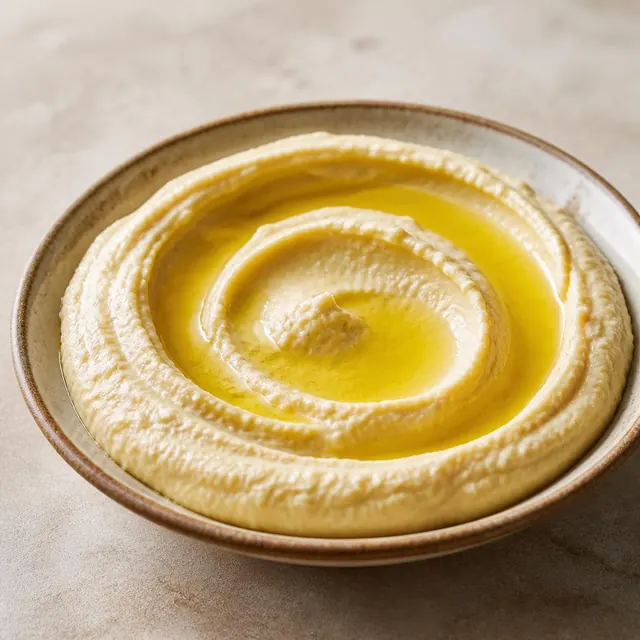
Hummus
Homemade hummus from soaked and cooked chickpeas blended with tahini, lemon juice, garlic, ice-cold water and olive oil; makes 12 portions of 60 g.
Total time: 860 min12 servingsFinal yield 720 g
Ingredients
- 500 gChickpeas (garbanzo beans, bengal gram), mature seeds, cooked, boiled, without salt
- 90 gSeeds, sesame butter, tahini, from roasted and toasted kernels (most common type)
- 45 gLemon juice, raw
- 6 gGarlic, raw
- 4 gSalt, table
- 45 gBeverages, water, tap, drinking
- 30 gOil, olive, salad or cooking
Allergens
Contains: Sesame
Derived from ingredients – check the package label.
Method
- Rinse the dried chickpeas and soak them overnight (about 12 hours) in three times their volume of cold water.
TipCooking pulsesBeans have no quarrel with salt; what makes them stubborn is acid, hard water and old age.Show less
Why
Dried pulses have sturdy cell walls cemented with pectin, and they only soften once they have taken up water and the heat has loosened that pectin. Soaking overnight (roughly 8–12 hours) supplies the water in advance, so cooking is shorter and the beans soften more evenly; lentils and split peas don't need soaking. The old advice not to salt because salt toughens beans is a myth: sodium from salted water actually replaces some of the calcium in the pectin of the skins, which then soften and split less. What really slows softening is acid (tomatoes, vinegar, wine) and the calcium and magnesium in hard water, which firm up pectin, while pulses that have been stored for a long time soften slowly or not at all. Raw and undercooked beans, red kidney beans in particular, also contain a lectin, phytohaemagglutinin, which only a proper boil destroys; merely heating them below boiling point does not.
How to do it
- Soak beans, chickpeas and whole peas in plenty of cold water for 8–12 hours, then drain.
- Feel free to salt the soaking water; the skins will be softer and split less.
- Cover the beans with fresh water, boil them hard for at least 10 minutes, then simmer until tender, at least 30 minutes in total.
- A slow cooker won't destroy the lectin without a hard boil first, and undercooked beans can be more toxic than raw ones – always boil them first.
- Add tomatoes, vinegar or wine only once the pulses are tender.
- With very hard water, cook in filtered water or add a pinch of baking soda – no more, or they turn mushy and soapy.
If it goes wrong
Pulses that stay hard after long cooking are usually old or have met acid: lift them out of the acidic sauce and finish cooking them in water with a pinch of baking soda. Very old seeds may not soften even after hours; try a pressure cooker, blend the fully boiled pulses into a soup and buy a fresher pack next time.
- Drain, cover the chickpeas with fresh water and simmer without salt until very soft, 60–90 minutes; drain and let cool.
TipCooling and storing leftoversGoulash left on the hob overnight only matures in legends; in reality it's mostly the bacteria that mature.Show less
Why
Bacteria multiply quickly in food at roughly 5 to 60 °C – exactly the temperatures cooked food passes through as it cools. A large pot of goulash, sauce or stock cools slowly because its centre is far from the walls, and it can sit in the warm range for hours; Clostridium perfringens, a bacterium that forms tough spores, typically causes food poisoning from dishes cooked in large batches and kept warm. That is why cooked food should go into the fridge within 2 hours at the latest, divided into shallow containers where it cools faster. A fridge at 5 °C or below only slows bacteria down, it doesn't stop them, and many causes of food poisoning give nothing away in appearance or smell, so the sniff test tells you nothing about safety. Storage times differ between authorities: the UK FSA advises eating leftovers within 2 days, the US USDA gives 3–4 days.
How to do it
- Don't leave cooked food standing warm for more than 2 hours, or 1 hour at most when it's above 32 °C.
- Divide a large pot into shallow containers, or stand it in a sink of cold water and stir now and then.
- Don't wait for food to cool completely on the counter: put warm food in small containers straight into a fridge set to 5 °C or below.
- Eat leftovers ideally within 2 days, cooked rice within 1 day, otherwise freeze them in time; write the date on the container.
- Reheat only once, until piping hot all the way through, at least 74 °C in the centre; stir while reheating so no cold spots remain.
If it goes wrong
Food that has stood warm for more than 2 hours, say overnight on a switched-off hob, is best thrown away: boiling it again kills most bacteria, but not their tough spores or the toxins some of them have already produced in the food, and you can't smell it. Next time divide a large pot into smaller containers as soon as it's cooked and cool them in cold water.
- Blend the tahini with the lemon juice, crushed garlic and salt, then add the chickpeas and blend for 4–5 minutes, gradually adding the ice-cold water, until smooth.
- Finally stir in the olive oil, taste and serve in 60 g portions, or cover and refrigerate.
Recipe tradition
Not yet verified
This recipe has not been checked against a documented culinary reference.
Food data sources
- USDA FoodData Central SR Legacy (2018-04) · USDA Agricultural Research Service, FoodData Central SR Legacy. · CC0 1.0 Universal
Make at home or buy?
This recipe describes the homemade version. In menus and plans you can count on the ready-made product instead.
- Make at home (this recipe): 136.6 kcal per portion
- Buy ready-made: Hummus (shop-bought) · 142.2 kcal per portion
Contains: Sesame
Nutrition
Calculated from the selected ingredients; not a laboratory measurement.
Whole recipe
- Energy
- 1,639.5 kcal
- Protein
- 60.1 g
- Fat
- 91.5 g
- Total carbohydrate (by difference)
- 161.3 g
- Total dietary fibre (USDA)
- 46.6 g
- Saturated fatty acids
- 12.3 g
- Sodium
- 1,692.7 mg
- Salt (sodium × 2.5)
- 4.2 g
Per serving
- Protein5 g14%
- Fat7.6 g48%
- Total carbohydrate (by difference)13.4 g38%
Share of energy from protein, fat and carbohydrate (4 / 9 / 4 kcal per g), not share by weight.
- Energy
- 136.6 kcal
- Protein
- 5 g
- Fat
- 7.6 g
- Total carbohydrate (by difference)
- 13.4 g
- Total dietary fibre (USDA)
- 3.9 g
- Saturated fatty acids
- 1 g
- Sodium
- 141.1 mg
- Salt (sodium × 2.5)
- 0.35 g
Per 100 g of finished food
- Energy
- 227.7 kcal
- Protein
- 8.4 g
- Fat
- 12.7 g
- Total carbohydrate (by difference)
- 22.4 g
- Total dietary fibre (USDA)
- 6.5 g
- Saturated fatty acids
- 1.7 g
- Sodium
- 235.1 mg
- Salt (sodium × 2.5)
- 0.59 g
Salt is calculated from sodium (g salt = mg sodium × 2.5 / 1000) and includes sodium from all ingredients.
A dash means the value is unknown, not zero.
Calculation limitations
- Nutrition is a calculated estimate, not a laboratory measurement.
- The final yield is an editorial estimate.
- Fibre, saturated fat and sodium of cooked ingredients are estimated from the consumed ingredient amounts; for drained ingredients, sodium is included only where the retained amount is an explicit editorial estimate.
- Some process effects could not be resolved in this calculation.