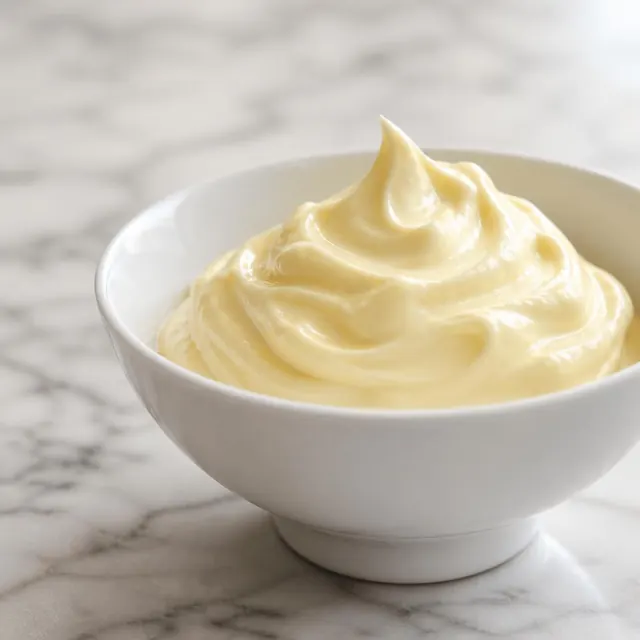
Mayonnaise
A cold emulsion of oil with raw egg yolks, salt, white pepper and vinegar, stabilised with a spoonful of boiling water; following A. Escoffier (Le Guide culinaire, 2nd ed. 1907), without mustard. 12 servings of about 30 g, one per serving of cold meat, fish, eggs or vegetables.
Total time: 20 min12 servingsFinal yield 360 g
Ingredients
- 34 gEgg, yolk, raw, fresh
- 3 gSalt, table
- 0.3 gSpices, pepper, white
- 0.5 15 ml tablespoonWhite wine vinegar
- 330 mlOil, sunflower, linoleic (less than 60%)
- 1 15 ml tablespoonBeverages, water, tap, drinking
Allergens
Contains: Egg, Sulphites
Derived from ingredients – check the package label.
Method
- Let all the ingredients come to room temperature beforehand; cold oil is the most common cause of splitting, and in winter it may even be warmed slightly. Remove the germinal discs from the yolks, put them into a bowl, add the salt, white pepper and a drop of vinegar and beat them with a whisk.
TipRaw and undercooked eggsSalmonella can be inside an intact egg; make raw-egg creams with pasteurised eggs, or hold the cream at 71 °C for 2 minutes.Show less
Why
Salmonella bacteria can be on the shell and inside the egg, according to BfR mainly in the yolk, and the US FDA warns that even a clean egg with an intact shell can carry them; few eggs are contaminated, but in a raw-egg dish left standing warm the bacteria multiply quickly. Heat destroys them: BfR states that they die from 70 °C, and the FDA wants egg dishes cooked to 71 °C, whereas tiramisu, homemade mayonnaise, yolk creams and mousses made with raw yolks or whites never pass through any heat. Pasteurised eggs are therefore the safer choice, or a cream in which the yolks are whisked over steam until a thermometer shows 71 °C, then for 2 more minutes. Most at risk are young children, pregnant women, older people and anyone with weakened immunity, who according to BfR and the FDA should eat eggs only when thoroughly cooked, with firm yolk and white, or dishes made with pasteurised eggs. A cracked or dirty shell and warmth raise the risk, which is why BfR advises keeping eggs and egg dishes in the fridge at no more than 7 °C.
How to do it
- For tiramisu, homemade mayonnaise, yolk creams and mousses that are not cooked further, use pasteurised eggs or pasteurised liquid yolk and white.
- Without pasteurised eggs, whisk the yolks with sugar or wine over steam until a thermometer shows 71 °C, keep whisking for 2 more minutes at 70–71 °C, then cool the cream at once in iced water.
- Buy eggs with clean, uncracked shells and keep them in the fridge; use an egg that cracked by accident only in a dish you will cook thoroughly.
- Serve a raw-egg dish straight away, or keep it covered in the fridge at no more than 7 °C and eat it within 24 hours, like mayonnaise (Mayonnaise and dressings card).
- Give young children, pregnant women, older people and anyone with weakened immunity only eggs with firm yolk and white, or dishes made with pasteurised eggs.
- Do not taste raw dough or raw-egg cream; after handling raw eggs wash your hands, and wash bowls and whisk with detergent.
If it goes wrong
Throw away a cream, mousse or mayonnaise made with raw eggs that has stood warm for more than 2 hours; taste and smell give no sign of salmonella, and the cream can no longer be heated. Serve finished tiramisu made with raw yolks only to healthy adults, keep it in the fridge and eat it within 24 hours. If diarrhoea, fever and stomach cramps appear after eating, drink plenty of fluids; young children, pregnant women, older people and anyone with weakened immunity, or anyone with blood in the stool or a high fever, should see a doctor.
- Whisking constantly, add the 330 ml of oil drop by drop at first; as soon as the sauce starts to bind, pour it in a thin stream. The mayonnaise gradually thickens and turns glossy.
TipMayonnaise and dressingsOil and water can't stand each other; egg yolk is the diplomat that keeps them at the same table.Show less
Why
Mayonnaise is an emulsion: millions of tiny oil droplets dispersed in the little water that comes from the yolk and the lemon juice or vinegar. To stop the droplets merging again, they get coated with emulsifiers from the yolk – lecithin and other phospholipids together with proteins; mustard helps a little too. At the start there is so little water that it can't break a big splash of oil into droplets or coat them, so the oil goes in drop by drop at first and faster only once the emulsion has thickened. Cold ingredients come together a little less readily, so it helps if the yolk and oil are at the same temperature, ideally room temperature – and a mayonnaise that is very stiff with a greasy sheen is short of water, not of yolk. An oil-and-vinegar dressing is only a temporary emulsion: mustard or honey hold it together for a while, but sooner or later it separates.
How to do it
- Take the yolk, oil and mustard out of the fridge about half an hour ahead – at room temperature the emulsion forms more readily. Don't leave raw yolk standing any longer.
- Whisk the yolk with a teaspoon of mustard and a little vinegar or lemon juice before any oil goes in.
- Add the oil literally drop by drop at first, whisking constantly; speed up only once it thickens.
- If the mayonnaise is stiff and looks greasy, whisk in a teaspoon of water or lemon juice.
- Raw yolk can carry salmonella even from a fresh egg: pasteurised yolk is safest, and never serve raw-yolk mayonnaise to pregnant women, young children, older people or the immunocompromised.
- Put the finished mayonnaise straight in the fridge and eat it within 24 hours; shake or whisk a dressing again just before serving.
If it goes wrong
Broken mayonnaise can be saved: put a fresh yolk, or a spoonful of water or mustard, into a clean bowl and whisk in the broken mixture drop by drop, as if it were oil. Once the emulsion takes, add the rest faster. Never the other way round – stirring a new yolk into the broken sauce won't help.
- When the sauce becomes too thick, loosen it with the rest of the vinegar (½ tbsp in total) and carry on with the oil.
- Finally stir in 1 tbsp of boiling water; it holds the sauce together and keeps it from separating if it has to wait. If it splits all the same, put a fresh yolk with a few drops of vinegar into a clean bowl and whisk the split mayonnaise into it a teaspoon at a time.
- Cover and refrigerate; use within 2 days.
Recipe tradition
Not yet verified
This recipe has not been checked against a documented culinary reference.
Food data sources
- USDA FoodData Central SR Legacy (2018-04) · USDA Agricultural Research Service, FoodData Central SR Legacy. · CC0 1.0 Universal
Nutrition
Calculated from the selected ingredients; not a laboratory measurement.
Whole recipe
- Energy
- 2,799.8 kcal
- Protein
- 5.4 g
- Fat
- 313.1 g
- Total carbohydrate (by difference)
- 1.4 g
- Total dietary fibre (USDA)
- 0.08 g
- Saturated fatty acids
- 34 g
- Sodium
- 1,180.3 mg
- Salt (sodium × 2.5)
- 3 g
Per serving
- Protein0.45 g1%
- Fat26.1 g99%
- Total carbohydrate (by difference)0.12 g0%
Share of energy from protein, fat and carbohydrate (4 / 9 / 4 kcal per g), not share by weight.
- Energy
- 233.3 kcal
- Protein
- 0.45 g
- Fat
- 26.1 g
- Total carbohydrate (by difference)
- 0.12 g
- Total dietary fibre (USDA)
- 0.01 g
- Saturated fatty acids
- 2.8 g
- Sodium
- 98.4 mg
- Salt (sodium × 2.5)
- 0.25 g
Per 100 g of finished food
- Energy
- 777.7 kcal
- Protein
- 1.5 g
- Fat
- 87 g
- Total carbohydrate (by difference)
- 0.4 g
- Total dietary fibre (USDA)
- 0.02 g
- Saturated fatty acids
- 9.4 g
- Sodium
- 327.9 mg
- Salt (sodium × 2.5)
- 0.82 g
Salt is calculated from sodium (g salt = mg sodium × 2.5 / 1000) and includes sodium from all ingredients.
A dash means the value is unknown, not zero.
Calculation limitations
- Nutrition is a calculated estimate, not a laboratory measurement.
- The final yield is an editorial estimate.
- Some ingredient quantities use documented estimates or household-measure assumptions.
- The number of servings is an editorial estimate (midpoint of the source range or based on the dish type and energy).
- Some ingredients use a generic food profile; exact product composition may differ.
- Some specific ingredients are represented by the closest generic food with the same culinary function.
- Fibre, saturated fat and sodium of cooked ingredients are estimated from the consumed ingredient amounts; for drained ingredients, sodium is included only where the retained amount is an explicit editorial estimate.
- Some process effects could not be resolved in this calculation.