Pasta shapes · Italian cuisine
Cavatelli
Small southern Italian shells of semolina and water, shaped by a drag of knife or finger.
At a glance
- Origin
- Southern Italy.
- Dough
- Durum wheat semolina and water, no eggs.
- Production
- By hand, dragged with knife or finger; also industrially.
- Pairs with
- Thick vegetable and meat sauces.
- Cooking time
- Fresh: depends on thickness; dried: per packet.
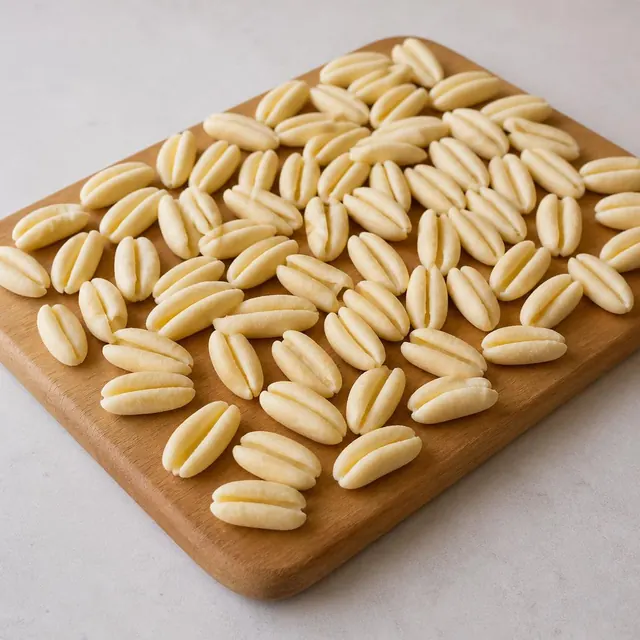
Cavatelli are small elongated pieces of dough with a hollow in the middle, typical of southern Italy. Traditionally made by hand, they are now also sold factory-made.
The base is just durum semolina and cold water, kneaded long and hard into a smooth, firm dough. After resting it is rolled into pencil-thick ropes and cut into pieces of about 1 cm. Each is pressed and dragged across the board with a blunt knife (sferre) or a finger, so that it curls and forms a groove. In the south flour from fava beans was once added, in Puglia flour from toasted grain (grano arso). Unlike orecchiette, the piece is not turned over a fingertip, so it stays elongated.
The groove holds thick sauces.