Pasta shapes · Italian cuisine
Orecchiette
Apulian “little ears” of semolina and water, shaped with knife and thumb – eaten with cime di rapa.
At a glance
- Origin
- Puglia (around Bari).
- Dough
- Durum semolina, type 0 flour and water, no eggs.
- Production
- By hand: a piece dragged with a knife and turned over a fingertip.
- Pairs with
- Cime di rapa, vegetable and tomato sauces.
- Cooking time
- Fresh 3–6 min, depending on size; dried 10–13 min, depending on the maker.
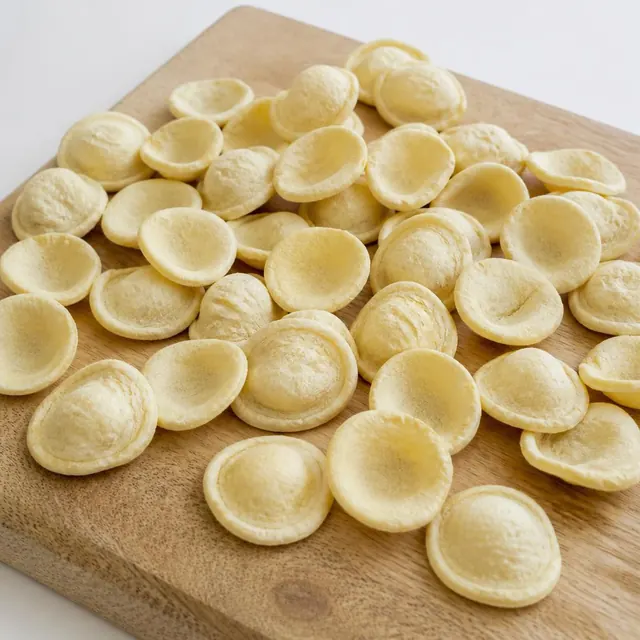
Orecchiette, “little ears”, are small domed discs with a rough surface, typical of the traditional cooking of Puglia. They are made by hand, without eggs.
Durum semolina is mixed with type 0 flour and lukewarm water, often with a little wholemeal flour. After resting, the dough is rolled into pencil-thick ropes, cut into pieces of about 1.5 cm, and each piece is dragged across the board with a blunt knife and turned inside out over a fingertip – forming the hollow ear. Around Bari a blunt knife called a sferre is used. As a hand-shaped “peasant” form they are thicker than extruded pasta, so they are best fresh.
The classic is orecchiette con cime di rapa.
Techniques and tips
Related entries
Sources
- Oretta Zanini De Vita: Encyclopedia of Pasta (2009), heslo Orecchiette
- Treccani, Vocabolario on line: orecchietta
- Caz Hildebrand, Jacob Kenedy: The Geometry of Pasta (2010), recept Orecchiette con cime di rapa
- Caz Hildebrand, Jacob Kenedy: The Geometry of Pasta (2010), kapitola Semolina Pasta
- Divella: Orecchiette (čerstvé), údaj doby vaření
- Giovanni Rana: Orecchiettine (čerstvé), údaj doby vaření
- Divella: 86b Orecchiette, údaj doby vaření
- Pasta Garofalo: N° 5-14 Orecchiette, údaj doby vaření
- Granoro: Orecchiette Dedicato n. 91, údaj doby vaření