Bread · Italian cuisine
Ciabatta
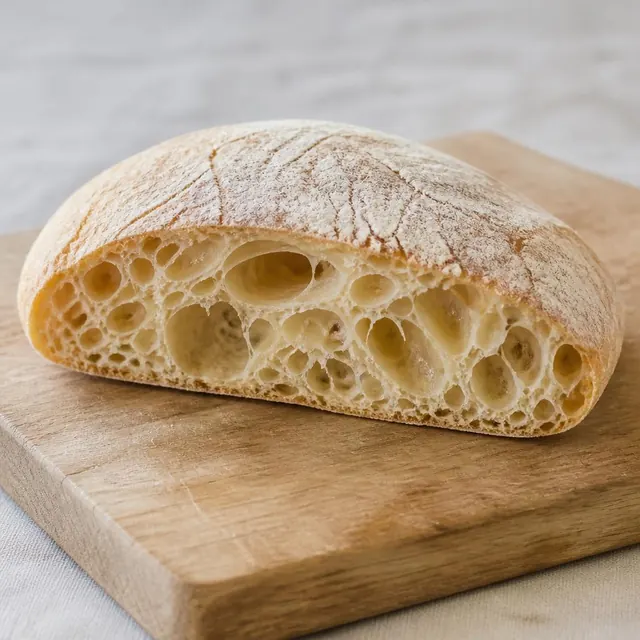
A flat Italian white loaf made from a very wet dough, with a crusty outside and an airy crumb with large holes.
At a glance
- Origin
- According to the usual version Adria, northern Italy, 1982 (Arnaldo Cavallari); the origin is disputed.
- Dough
- Wheat flour, plenty of water and yeast; a very soft, sticky dough.
- Production
- Long, multi-stage fermentation, shaping into low, flat loaves.
- Use
- Created as a bread for Italian sandwiches (panini) instead of the baguette.
Ciabatta is not an ancient bread but a modern one. According to the most often told version, former rally driver Arnaldo Cavallari created it with bakers in 1982 in Adria in northern Italy, as an Italian answer to the French baguette, which then dominated Italian sandwiches; they looked for a loaf with more water than a baguette. Francesco Favaron, owner of the Molini Adriani mill, is also named as its originator, and the American author Carol Field cites accounts of ciabatta around Lake Como as early as the 1940s. Cavallari dismissed these claims as unproven.
The dough is therefore very soft, wet and sticky. Besides the high water content, a long fermentation in several stages produces the large holes. The low, flat loaf reminded the bakers of a slipper – ciabatta in Italian – and that gave it its name. Cavallari licensed the recipe to bakers abroad; ciabatta reached British shops in 1985 and the United States in the late 1980s.