Bread · French cuisine
Baguette
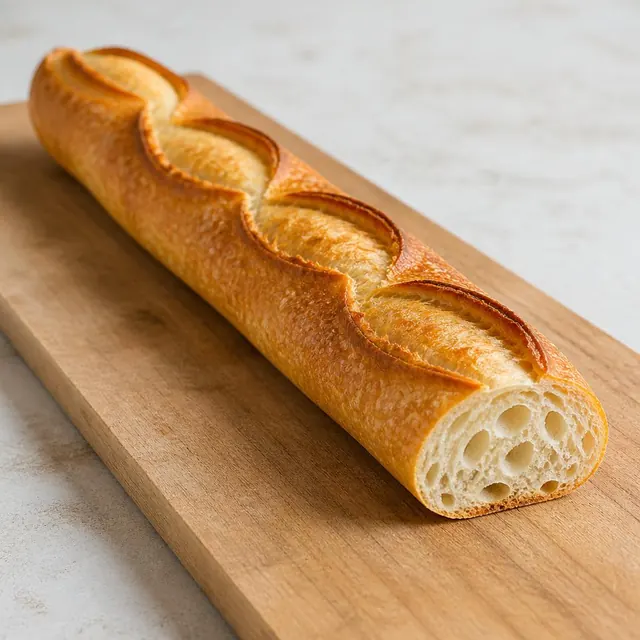
The long French white loaf with a crisp crust; as ‘pain de tradition française’ it may contain essentially only flour, water, salt and leaven or yeast.
At a glance
- Origin
- France; the know-how and culture of the baguette on the UNESCO list since 2022.
- Dough
- Wheat flour, water, salt and leaven or yeast; no additives for ‘tradition’.
- Production
- Hand shaped, second rise, shallow scoring, baked in small batches through the day; never frozen for ‘tradition’.
- Ratio
- ‘Tradition’: at most 2% broad-bean, 0.5% soya and 0.3% malted wheat flour, relative to the flour weight.
The baguette is France’s favourite bread and is baked all day long in small batches. In 2022 the artisanal know-how and culture of baguette bread were inscribed on UNESCO’s Representative List of the Intangible Cultural Heritage. The traditional process covers weighing and mixing, kneading, fermentation, dividing, resting, hand shaping, a second rise, shallow scoring – the baker’s signature – and baking.
For the name ‘pain de tradition française’ the French Décret n° 93-1074 of 1993 sets strict rules: the dough may contain only bread-making wheat flour, drinking water and cooking salt, it is raised with baker’s yeast, leaven (levain) or both, and the bread must not be frozen at any stage or contain additives. Only small amounts of broad-bean, soya and malted wheat flour are allowed. The rule applies whatever the shape, but the baguette is its best-known form.