Bread
Sourdough (kvas, kvásek)
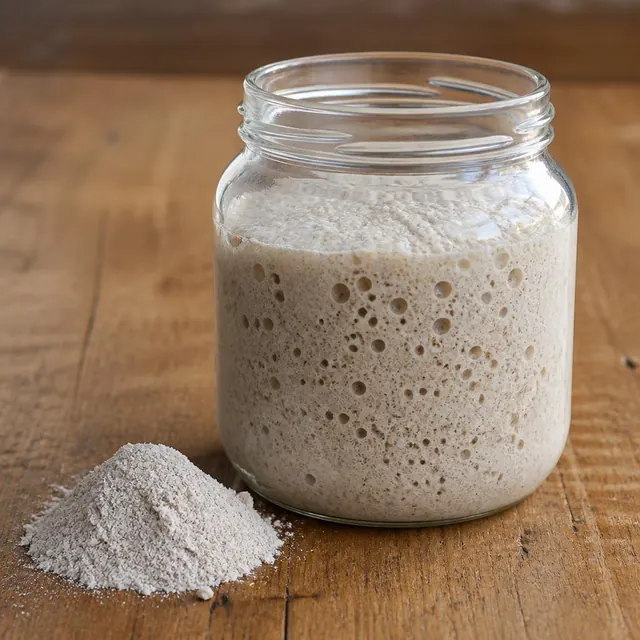
Sourdough – a fermented mix of flour and water with lactic acid bacteria and yeasts that both raises and sours bread dough.
At a glance
- Production
- Spontaneous fermentation of flour and water, then repeated inoculation of a new batch with part of the mature starter.
- Ratio
- Lactic acid bacteria outnumber yeasts by 1–2 orders of magnitude; traditional rye sourdough makes up 50–60% of the recipe; French bread ‘au levain’ has a pH of at most 4.3 and at least 900 ppm acetic acid in the crumb.
- Use
- Raising and souring rye and mixed breads; levain and lievito madre in French and Italian bread.
- Substitutes
- Stable (dried) sourdough, or the shortened method: a lactic starter of lactobacilli with yeast for leavening.
Under Czech Decree No. 18/2020 sourdough (kvas or kvásek) is a fermented semi-product of flour, water and a starter culture (rye flour for rye sourdough) whose microorganisms are active enough to acidify the dough. Mature sourdough can be propagated repeatedly, is made without additives or enzymes, and its acids arise from fermentation alone. So-called stable sourdough, by contrast, is dried or concentrated and may be additionally acidified.
Sourdough is a community of lactic acid bacteria and yeasts in which the bacteria dominate and yeasts are one to two orders of magnitude fewer. The bacteria produce mainly lactic and acetic acid, the yeasts produce the carbon dioxide that raises the dough, and both groups shape aroma and flavour. It is kept going by inoculating fresh flour and water with part of the previous batch.
In Bohemia traditional sourdough was made of water and mostly rye flour and built up in stages until it formed 50–60% of the recipe. Longer fermentation gives a fuller but sourer bread. The French counterpart is levain, the Italian lievito madre. Czech home recipes also use kvásek for a yeast sponge, which is not sourdough.
Techniques and tips
Related entries
Sources
- Sbírka zákonů ČR: Vyhláška č. 18/2020 Sb., o požadavcích na mlýnské obilné výrobky, těstoviny, pekařské výrobky a cukrářské výrobky a těsta (2020)
- Frontiers in Microbiology, Pérez-Alvarado et al.: Role of lactic acid bacteria and yeasts in sourdough fermentation (2022), PMC9524358
- Ministerstvo zemědělství ČR, J. Příhoda, M. Sluková, J. Dřízal (VŠCHT Praha): Jak poznáme kvalitu? Chléb a pečivo
- République française: Décret n° 93-1074 du 13 septembre 1993 (décret pain), konsolidované znění, FAO FAOLEX (2020)
- EU eAmbrosia: Disciplinare di produzione della DOP „Pane di Altamura“ (Reg. CE 1291/2003)