Bread · Italian cuisine
Pane Toscano
Pane Toscano PDO – Tuscan sourdough bread without salt, with a crunchy crust and an unsalted crumb, the base of Tuscany’s stale-bread dishes.
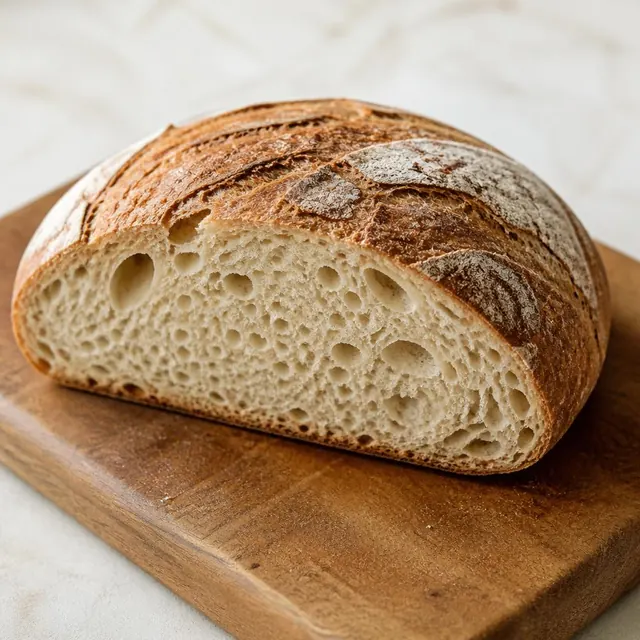
At a glance
- Origin
- The whole of Tuscany; PDO under Regulation (EU) 2016/303.
- Dough
- Wheat flour with its natural germ, water and sourdough; no salt.
- Production
- Long sourdough process, loaves of 500 g to 2 kg, about 5–10 cm high.
- Use
- With savoury food; stale bread for panzanella, ribollita, bruschetta and pappa al pomodoro.
Pane Toscano is a Tuscan bread protected as a PDO since 2016. Its defining feature is the absence of salt – the bread is ‘sciapo’ or ‘sciocco’, unsalted. Tradition links this to the twelfth century, when Pisa, in its conflicts with Florence, blocked the salt trade inland and salt became too costly.
It is made with sourdough and wheat flour that keeps its natural germ after milling; the long sourdough process gives the bread its typical flavour and keeping quality. The loaf is rectangular, oval or round, about 5–10 cm high and weighs 500 g to 2 kg. The crust is reddish brown and crunchy, the crumb white to ivory with irregular holes and an aroma of roasted hazelnuts. Wheat, flour, starter and baking must all be Tuscan.
Its neutral taste balances Tuscany’s strongly seasoned cooking, and stale bread is the base of panzanella, bruschetta (fettunta), ribollita and pappa al pomodoro.