Flours and grains · Czech cuisine
Rye flour
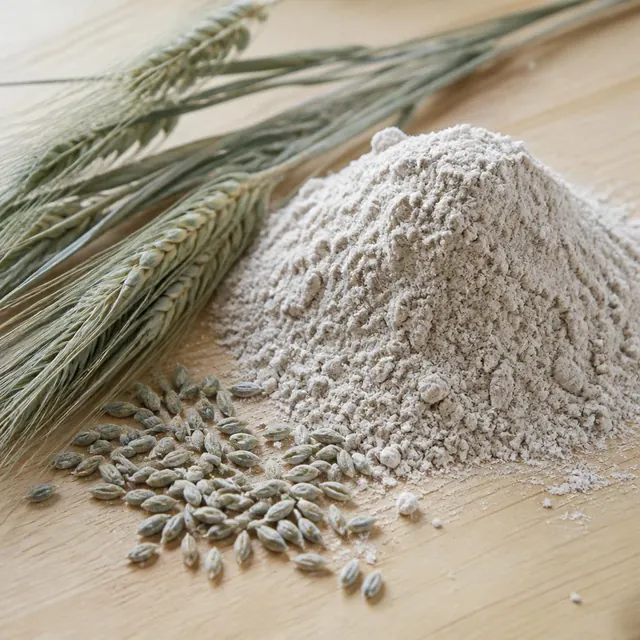
Flour milled from rye – light, dark bread flour or wholemeal; without souring it will not make a good loaf.
At a glance
- Origin
- Rye breads are typical of Central, Northern and Eastern Europe.
- Production
- Milled into light, dark (bread) and wholemeal flour; Austria grades Roggenvorschussmehl, Roggenbrotmehl and Schwarzroggenmehl.
- Ratio
- Ash in dry matter (CZ): light ≤ 0.65 %, dark ≤ 1.10 %. Austria: Type 500 (0.43–0.57 %), 960 (0.88–1.12 %), 2500 (2.0–3.0 %). Dough soured to about pH 4.2.
- Use
- Sourdough bread; in the Czech Republic a loaf labelled “traditional sourdough” must be raised and soured solely with rye sourdough.
The Czech Decree 18/2020 recognises light rye flour (výražková) with at most 0.65 % ash in dry matter and dark bread rye flour (chlebová) with at most 1.10 %; the light one is white, the dark one greyish white with a green-blue tinge. A product may be called rye bread only if rye milling products make up at least 90 % of the flour used.
Rye cannot build a gluten network like wheat, because it contains far fewer of the necessary proteins. The dough is held together mainly by pentosans (arabinoxylans), of which rye flour has about twice as much as wheat and which bind large amounts of water. Souring to around pH 4.2 improves the swelling of proteins and pentosans and also inhibits amylases, which would otherwise break down so much starch that no crumb could form. Doughs with about 20 % rye or more therefore need sourdough or an acidifier.
Pentosans do not denature during baking, which is why rye bread stays moister and fresh for longer.
Techniques and tips
Related entries
Sources
- Ministerstvo zemědělství ČR: Vyhláška č. 18/2020 Sb. o požadavcích na mlýnské obilné výrobky, těstoviny, pekařské výrobky a cukrářské výrobky a těsta (2020)
- Ernährungs Umschau 9/2010: Claudia Weiß, Brot und Backwaren – Teil 1
- Spektrum.de, Lexikon der Ernährung: heslo Sauerteig
- Österreichisches Lebensmittelbuch, IV. Auflage: Codexkapitel B 20 Mahl- und Schälprodukte (2022)