Flours and grains
Wholemeal flour
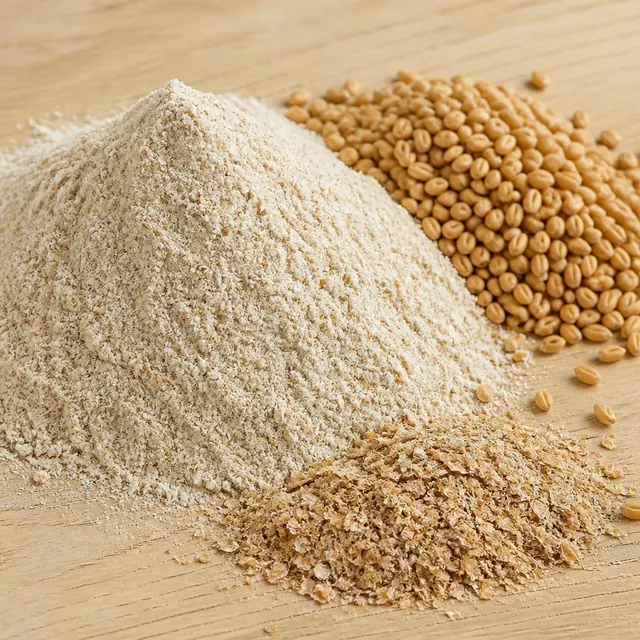
Flour from the whole grain including bran and germ – darker and richer in fibre and minerals, but with a shorter shelf life than white flour.
At a glance
- Origin
- Defined in the Czech Decree 18/2020, the Austrian Codex B 20 and the Italian Presidential Decree 187/2001.
- Production
- Grinding the whole grain, or milling its parts and recombining them in their natural proportions.
- Ratio
- Ash in dry matter: CZ ≤ 1.90 %, IT 1.30–1.70 %, AT wheat 1.4–2.4 %. Granulation (CZ): at least 96 % passes a 1129 μm sieve.
- Use
- Bread and rolls (wholemeal with ≥ 80 % wholemeal flours in CZ), wholemeal pasta, flatbreads.
Under the Czech Decree 18/2020, wholemeal flour is made by grinding the whole grain or by milling its parts, and it contains endosperm, bran and germ in the same proportions as the original grain. The Austrian Codex explicitly allows separated parts to be recombined in their natural ratio and a small part of the outer bran layer (pericarp) – about 2 % as a guide – to be scoured off to remove contaminants. Czech graham flour is wholemeal wheat flour, or flour from grain with only the germ removed.
Because it contains the outer layers, it has the most ash: the Czech decree allows at most 1.90 % in dry matter, Italian farina integrale has 1.30–1.70 %. In Germany wholemeal flour is given no type number, because its mineral content varies with the origin of the grain.
The germ contains oil that can turn rancid, so wholemeal flour keeps less well than white. Wholemeal bread must contain at least 80 % wholemeal flours in the Czech Republic and at least 90 % wholegrain products in Germany.
Recipes
Techniques and tips
Related entries
Sources
- Ministerstvo zemědělství ČR: Vyhláška č. 18/2020 Sb. o požadavcích na mlýnské obilné výrobky, těstoviny, pekařské výrobky a cukrářské výrobky a těsta (2020)
- Österreichisches Lebensmittelbuch, IV. Auflage: Codexkapitel B 20 Mahl- und Schälprodukte (2022)
- Presidente della Repubblica: DPR 9 febbraio 2001, n. 187 – Regolamento per la revisione della normativa sulla produzione e commercializzazione di sfarinati e paste alimentari (2001)
- Ernährungs Umschau 9/2010: Claudia Weiß, Brot und Backwaren – Teil 1
- Verbraucherzentrale Südtirol: Was bedeuten die verschiedenen „Typen“ beim Mehl? (2020)