Flours and grains
Spelt flour
Flour from spelt, a hulled wheat with weaker, more extensible gluten – good for bread, rolls, pasta and crackers.
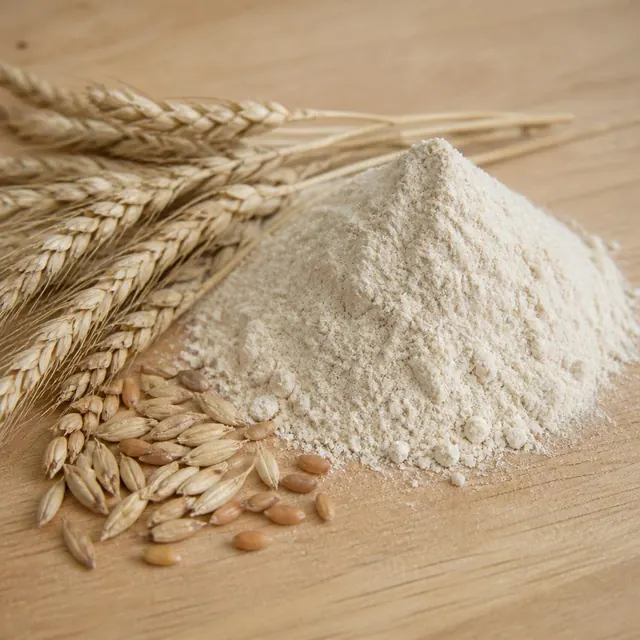
At a glance
- Origin
- An old European crop; traditionally Belgium, Germany, Austria, Slovenia and northern Italy, with small areas in the Czech Republic.
- Production
- The grain is dehulled, then milled like common wheat, including into wholemeal flour.
- Ratio
- Austrian spelt flour Type 700: ash 0.63–0.84 % in dry matter. German Dinkelbrot: at least 90 % spelt.
- Use
- Bread, rolls, pasta, crackers, biscuits; Grünkern in soups and sauces.
Spelt (Triticum spelta) is a hulled hexaploid wheat with the same genomes as common bread wheat, which is why some botanists classify it as a subspecies. It is an old European crop, grown mainly in Central Europe. The grain is harvested in its tough hulls, which protect it but must be removed at some cost before milling – one reason spelt flour costs more than wheat flour.
Spelt contains gluten and is not safe for people with coeliac disease. It often has more wet gluten than common wheat, but the gluten is weaker: the dough is less stable and elastic, more extensible, soft and sticky after kneading, and loaves usually have a smaller volume. To improve baking quality, spelt flour is often blended with wheat flour.
It is used for bread and rolls, pasta, crackers and breakfast cereals; spelt breads have a tradition in southern Germany. Grain harvested unripe and dried with heat becomes Grünkern, used mainly in soups and sauces.
Techniques and tips
Related entries
Sources
- Z. Kohajdová, J. Karovičová (STU Bratislava): Nutritional value and baking applications of spelt wheat, Acta Sci. Pol. Technol. Aliment. 7(3) (2008)
- Österreichisches Lebensmittelbuch, IV. Auflage: Codexkapitel B 20 Mahl- und Schälprodukte (2022)
- Ernährungs Umschau 9/2010: Claudia Weiß, Brot und Backwaren – Teil 1