Flours and grains
Flour types: what the number on the bag means
A flour's type number expresses its ash, i.e. mineral, content – and the countries that use it define it differently.
At a glance
- Origin
- Ash-based typing is used in Germany, Austria, France (since 1963) and Italy; Czech rules combine granulation with maximum ash.
- Production
- The type reflects how much of the outer grain layers goes into the flour; those layers carry most of the minerals.
- Ratio
- Ash in dry matter – IT: 00 ≤ 0.55 %, 0 ≤ 0.65 %, 1 ≤ 0.80 %, 2 ≤ 0.95 %, integrale 1.30–1.70 %. FR: T45 < 0.50 %, T55 0.50–0.60 %, T65 0.62–0.75 %, T80 0.75–0.90 %, T110 1.00–1.20 %, T150 > 1.40 %. AT: 480 = 0.33–0.58 %, 700 = 0.63–0.79 %, 1600 = 1.50–1.75 %.
- Substitutes
- Only as a rough guide: Italian 00 is close to German 405, 0 to 550, 1 to 812 and 2 to 1050.
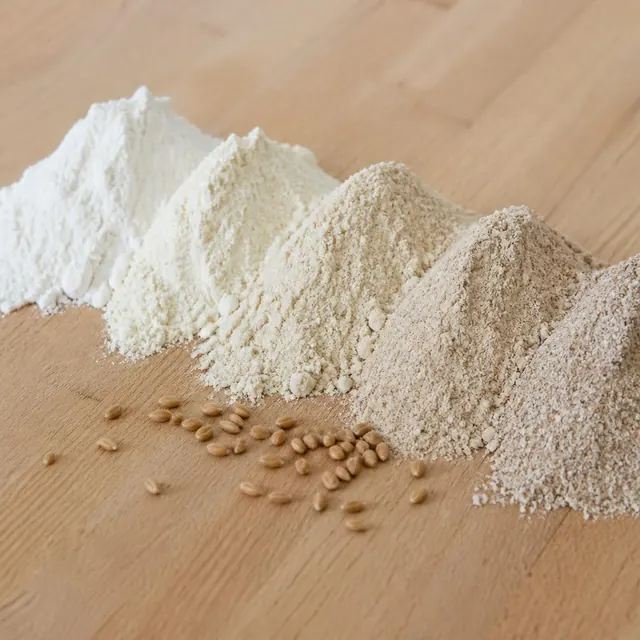
Ash is what remains when a flour sample is burned – essentially its minerals. These sit mainly in the outer layers of the grain, so the more bran ends up in the flour, the darker it is and the higher its type. In Germany and Austria alike, the type number is a thousand times the ash percentage in dry matter – milligrams of minerals per 100 g of dry matter – so Type 405 has about 405 mg. The German DIN standard lists wheat types 405, 550, 812, 1050 and 1600; Austria uses 480, 700 and 1600.
Since 1963 France has labelled types T45 to T150 by ash range. Italy's Presidential Decree 187/2001 sets types 00, 0, 1, 2 and integrale, adding a protein minimum to the ash maximum. The Czech Decree 18/2020 sets maximum ash but no type numbers; figures such as T 400 on Czech bags are not defined by the decree.
The systems cannot be converted one-to-one, because their limits and tolerances differ. Nor does the type say anything about coarseness, a separate axis in Czech grading, or about baking performance, which depends on gluten.
Techniques and tips
Related entries
Sources
- Österreichisches Lebensmittelbuch, IV. Auflage: Codexkapitel B 20 Mahl- und Schälprodukte (2022)
- Ernährungs Umschau 9/2010: Claudia Weiß, Brot und Backwaren – Teil 1
- Verbraucherzentrale Südtirol: Was bedeuten die verschiedenen „Typen“ beim Mehl? (2020)
- Confédération Nationale de la Boulangerie-Pâtisserie Française: La farine des farines, fiche 7 (2025)
- Presidente della Repubblica: DPR 9 febbraio 2001, n. 187 – Regolamento per la revisione della normativa sulla produzione e commercializzazione di sfarinati e paste alimentari (2001)
- Ministerstvo zemědělství ČR: Vyhláška č. 18/2020 Sb. o požadavcích na mlýnské obilné výrobky, těstoviny, pekařské výrobky a cukrářské výrobky a těsta (2020)