Flours and grains · Czech cuisine
Czech wheat flours: hladká, polohrubá, hrubá and krupice
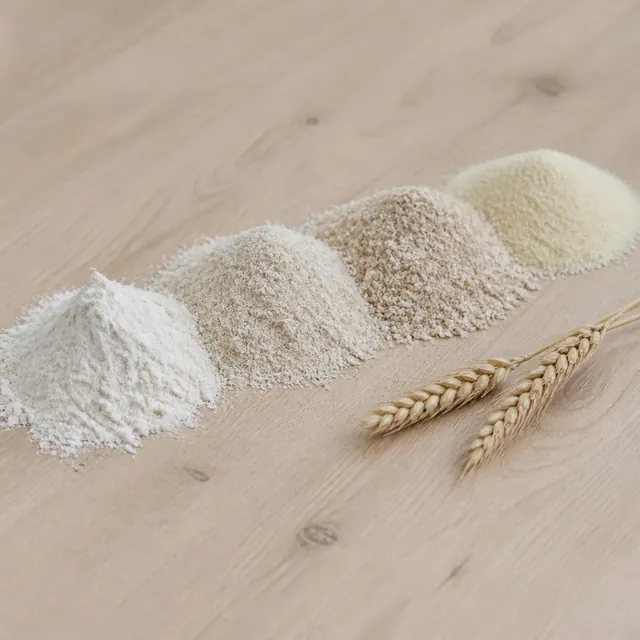
A Czech peculiarity: wheat flour is graded by particle size into fine, semi-coarse and coarse, alongside fine and coarse semolina (krupice).
At a glance
- Origin
- Czech Republic; the grades are set by Decree No. 18/2020, in force since 1 February 2020.
- Production
- Wheat is milled in stages and the streams are sieved by particle size.
- Ratio
- Passing a 162 μm sieve: fine ≥ 75 %, semi-coarse ≤ 75 %, coarse ≤ 15 %. Fine krupice: ≤ 15 % through 257 μm; coarse: ≤ 15 % through 446 μm. Ash in dry matter: fine light ≤ 0.60 %, semi-light ≤ 0.75 %, bread ≤ 1.15 %, semi-coarse and coarse ≤ 0.50 %.
- Use
- Semi-coarse: dumplings, Bundt cakes, creamed and whisked batters, vánočka.
Czech Decree No. 18/2020 divides flour into hladká (fine), polohrubá (semi-coarse), hrubá (coarse), wholemeal and graham; krupice (semolina) forms a separate group in fine and coarse grades. What counts is granulation – the share of particles that pass through a sieve of a given mesh. At least 75 % of a fine flour must pass a 162 μm sieve, at most 75 % of a semi-coarse one and at most 15 % of a coarse one.
The second axis is ash (mineral) content. Fine wheat flour comes as light, with no more than 0.60 % ash in dry matter, semi-light (0.75 %) and bread flour (1.15 %); semi-coarse and coarse flours may contain at most 0.50 %.
Such fine grading by coarseness is unusual elsewhere. Semi-coarse flour is used for dumplings, Bundt cakes, creamed and whisked batters and the plaited vánočka; if milled too fine it does not suit dumplings. Austria's glatt and griffig also describe coarseness but are measured differently, so the categories cannot be equated. German type numbers such as 405 or 550 measure minerals and have nothing to do with the Czech grades.
Recipes
Menus
Techniques and tips
Related entries
Sources
- Ministerstvo zemědělství ČR: Vyhláška č. 18/2020 Sb. o požadavcích na mlýnské obilné výrobky, těstoviny, pekařské výrobky a cukrářské výrobky a těsta (2020)
- Novinky.cz: Velký test polohrubých mouk (laboratorní rozbory VŠCHT Praha)
- Novinky.cz: Není mouka jako mouka (2016)
- Österreichisches Lebensmittelbuch, IV. Auflage: Codexkapitel B 20 Mahl- und Schälprodukte (2022)