Bread · Czech cuisine
Houska
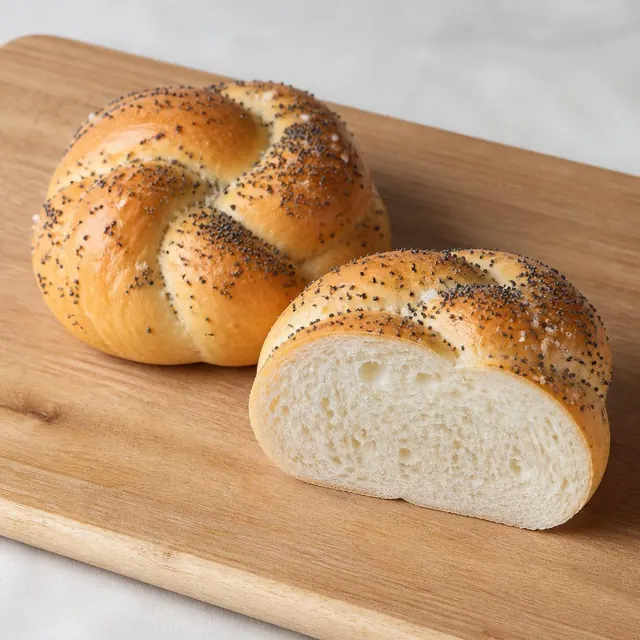
Houska – a small round Czech wheat roll, plaited into a knot and topped with coarse salt, caraway or poppy seeds.
At a glance
- Origin
- Czech Republic; an everyday wheat roll.
- Dough
- Wheat flour, water, yeast, salt.
- Production
- Plaited and shaped into a round knot, topped with coarse salt, caraway or poppy seeds.
- Ratio
- Limit for ordinary bakery ware: less than 8% anhydrous fat and less than 5% sugar on flour weight.
- Use
- For breakfast with butter, marmalade and spreads.
The houska is a small round roll of wheat flour, water, yeast and salt. Before baking it is plaited and shaped into a plump round knot and topped with coarse salt, caraway or poppy seeds. Baked, it is pale, with a crisp crust and a soft inside, and is often eaten for breakfast with butter, marmalade or spreads. Czech Decree No. 18/2020 does not name it; ordinary bakery ware (běžné pečivo), where such rolls usually belong, is defined there by less than 8% anhydrous fat and less than 5% sugar on flour weight.
In Bohemia the word houska also had a second meaning: according to the Czech Language Atlas it (and the variant husce) was used there for the vánočka, which is plaited in a similar way but larger and richer.
The houska differs in shape from the Austrian Kaisersemmel. The Kaisersemmel is a round wheat roll with a five-part star; as ‘Handsemmel’ the Austrian Codex defines it as hand-shaped with a dough time of at least two hours; the minimum baked weight of 46 g applies to all Semmeln.
Recipes
Menus
Techniques and tips
Related entries
Sources
- Expats.cz: Czechia’s humble houska ranked among world’s top 100 bread products (2023)
- Živa (Akademie věd ČR), A. Černá: Voňavý jazykový koutek – o perníku, koření, vánočkách a rozinkách
- Bundesministerium für Land- und Forstwirtschaft (Österreich): Register Traditionelle Lebensmittel – Kaisersemmel
- Sbírka zákonů ČR: Vyhláška č. 18/2020 Sb., o požadavcích na mlýnské obilné výrobky, těstoviny, pekařské výrobky a cukrářské výrobky a těsta (2020)