Bread · Czech cuisine
Czech bread
Czech bread – a mixed rye and wheat loaf raised with sourdough or yeast, often with caraway; its types are set by Decree No. 18/2020.
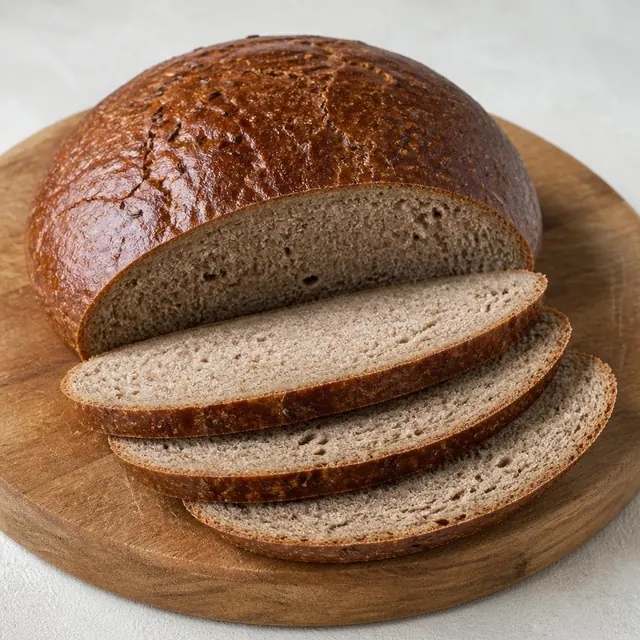
At a glance
- Origin
- Czech Republic; bread types and groups are set by Decree No. 18/2020.
- Dough
- Rye and wheat flour, water, rye sourdough or yeast; often with caraway.
- Production
- Raised with sourdough, yeast or both; shaped as a long loaf, round loaf or tin loaf.
- Ratio
- Wheat-rye: at least 50% wheat and over 10% rye; rye-wheat: over 50% rye and over 10% wheat; bread at least 400 g.
Czech Decree No. 18/2020 defines bread as a bakery product raised with sourdough, yeast or both, shaped as a long loaf, a round loaf or baked in a tin, weighing at least 400 g (sliced and non-traditional breads excepted). By flour share it distinguishes wheat and rye bread (at least 90% wheat or rye milled products respectively), rye-wheat bread (žitnopšeničný; more than 50% rye and more than 10% wheat) and wheat-rye bread (pšeničnožitný; at least 50% wheat and more than 10% rye).
Under the centrally planned economy uniform standards applied, and the basic loaf was sold as ‘konzumní’, ‘konzumní s kmínem’ (with caraway) or ‘šumava’, made of about 45% rye and 55% wheat flour – wheat-rye bread under today’s rules. The names survive, but recipes are no longer uniform. Only bread raised and soured exclusively with rye sourdough may be labelled ‘traditional sourdough’, and ‘farmhouse bread’ (selský chléb) is a round loaf of at least 2 kg with at least 45% rye flour.
Only unpackaged bread whose production was never interrupted by freezing may be sold as ‘fresh bread’, for at most 24 hours after baking.