Bread · French cuisine
Croissant
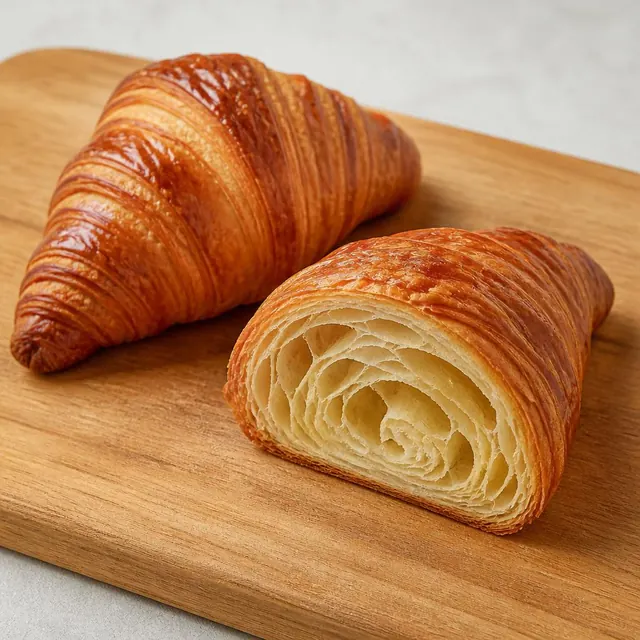
A crescent of laminated yeast dough whose layers of dough and fat bake into crisp, flaky leaves.
At a glance
- Origin
- France; from the Viennese kipferl (in Paris since the late 1830s), today’s laminated-dough form from the early 20th century.
- Dough
- Yeast-raised wheat dough laminated with butter or margarine.
- Production
- Repeated folding and rolling (tourage), chilling, shaping into crescents, proving and baking.
- Ratio
- Technical sheet: two double folds, pieces of 60 g; Czech practice for Danish-type dough: about 10% fat in the dough and 30% for laminating, on flour weight.
A croissant is made from laminated yeast dough (pâte levée feuilletée). A yeast-raised dough is wrapped around a sheet of fat and repeatedly folded and rolled out, building up many alternating layers of dough and fat. A French miller’s technical sheet for this work specifies two double folds and notes that the dough must be colder when laminating with butter; the fat can be butter or margarine. The sheet works with pieces of 60 g.
The croissant descends from the Viennese kipferl. In the late 1830s August Zang, an Austrian artillery officer, opened a Viennese bakery (Boulangerie Viennoise) on rue de Richelieu in Paris; it sold the kipferl and inspired French bakers. The modern croissant was developed by French bakers in the 19th and early 20th centuries; early printed recipes date from 1906 (Auguste Colombié) and 1915 (Sylvain Claudius Goy), who is credited with switching from brioche dough to laminated yeast dough. The story that the kipferl celebrated the Ottoman defeat at Vienna in 1683 is regarded as a legend.
In Czech law such products are fine bakery wares (jemné pečivo) and may be labelled ‘made from laminated yeast dough’.
Techniques and tips
Related entries
Sources
- Europeana: The history of the croissant
- Grands Moulins de Paris: Croissant PLF, mélange pour pâte levée feuilletée, fiche technique réf. 10008
- Ministerstvo zemědělství ČR, J. Příhoda, M. Sluková, J. Dřízal (VŠCHT Praha): Jak poznáme kvalitu? Chléb a pečivo
- Sbírka zákonů ČR: Vyhláška č. 18/2020 Sb., o požadavcích na mlýnské obilné výrobky, těstoviny, pekařské výrobky a cukrářské výrobky a těsta (2020)