Pasta shapes · Italian cuisine
Farfalle
Butterflies or bow ties – in sizes from tiny farfalline for broth to large farfalloni.
At a glance
- Origin
- Italy; known in Bologna as stricchetti.
- Dough
- Industrially durum wheat semolina and water.
- Production
- By hand: strips cut with a toothed wheel into pieces about 4 cm long, pinched in the middle; today mostly industrially.
- Pairs with
- Cream and tomato sauces; small sizes in broth.
- Cooking time
- Dried 10–14 min, depending on the maker.
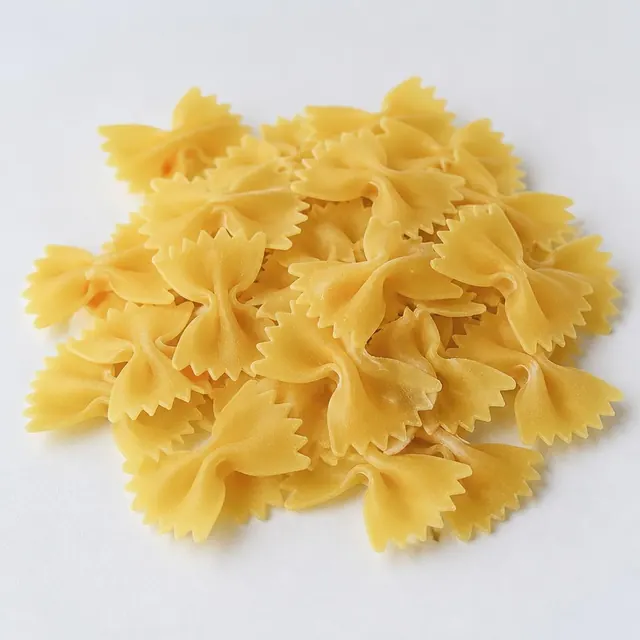
Farfalle are shaped like butterflies and are known in English as bow ties. They come in several sizes: the smallest, farfalline and farfallette, go into broth, while large farfalloni are served with a sauce. In Bologna the medium size is called stricchetti.
Small shapes such as farfalline were among those that women in pasta workshops went on shaping by hand even after the first machines arrived. Today farfalle are made mostly industrially as dried pasta. By hand, the dough is cut with a toothed pasta wheel into wide strips and then into pieces about 4 cm long, each pinched in the middle into a little bow; factory-made farfalle usually have scalloped edges.
Large farfalle traditionally go with cream and tomato sauces, the tiniest with broth.
Techniques and tips
Related entries
Sources
- Fred Plotkin: The Authentic Pasta Book, heslo Farfalle
- Alan Davidson: The Oxford Companion to Food, heslo Pasta shapes
- Oretta Zanini De Vita: Encyclopedia of Pasta (2009), kapitola From Homemade Pasta to the Maccheronaio
- Divella: 85 Farfalle, údaj doby vaření
- Pasta Garofalo: N° 78 Farfalle, údaj doby vaření
- Granoro: Farfalle Dedicato n. 198, údaj doby vaření
- Oretta Zanini De Vita: Encyclopedia of Pasta (2009), heslo Farfalle