Bread · Italian cuisine
Grissini
Grissini – thin, crisp breadsticks from Turin and Piedmont, either stretched (stirato) or hand-rolled (rubatà).
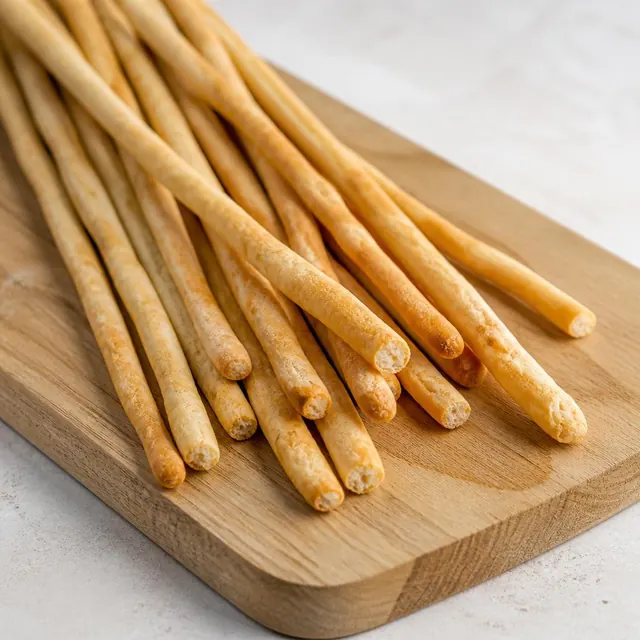
At a glance
- Origin
- Turin and Piedmont; tradition dates them to about 1679 (a handed-down story).
- Dough
- Rubatà: wheat flour, yeast, water, malt, olive oil, lard, salt.
- Production
- Rubatà rolled by hand on a board, stirato stretched lengthwise by the baker.
- Ratio
- Rubatà up to 60 cm long.
Grissini are long, thin, crisp sticks of yeast-raised wheat dough, typical of Turin and Piedmont. According to tradition they were invented around 1679 by the Turin baker Antonio Brunero for the young Victor Amadeus II of Savoy, who reportedly could not digest bread crumb; this is a handed-down story rather than a documented origin.
The Piedmont region lists two kinds among its traditional food products: grissino robatà (rubatà) and grissino stirato. Rubatà, associated above all with Chieri, is rolled by hand on the work surface, which makes it irregular and knobbly; it can be up to 60 cm long. The dough holds wheat flour, yeast, water, malt, olive oil, lard and salt. Stirato, younger according to Chieri tradition, is not rolled: the baker stretches a piece of dough lengthwise.