Kitchen terms · French cuisine
Confit
Preserving food in fat, sugar or another preserving medium, for meat combined with slow cooking in fat; confit is the result.
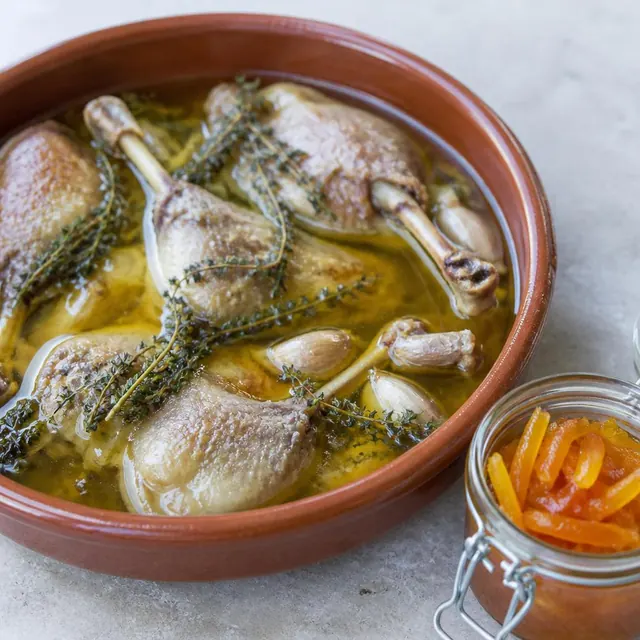
At a glance
- Origin
- French confire from Latin conficere, to finish, to prepare; meat confit recorded in 1900.
- Production
- Meat is cooked slowly in fat and kept in it; fruit is impregnated with sugar.
- Use
- Goose and duck confit; candied fruit (fruits confits).
- Substitutes
- Meat confit in fat and fruit candied in sugar share only the name and the aim of preservation.
According to the Trésor de la langue française, French confire comes from Latin conficere, from cum and facere, literally “to make completely, to finish”, hence “to prepare”. From 1226 it is recorded in the sense of treating fruit with a liquid or with sugar so that it keeps. The dictionary lists fruit in sugar, brandy or honey, gherkins in vinegar, olives in oil, vegetables in salt and pork in fat.
In today’s kitchen one word covers two different things. Confit as a noun is, according to the TLFi, meat cooked and preserved in its own fat, such as confit of goose, where the quarters are cooked in the bird’s melted fat; in this sense it is recorded from 1900 and was adopted from Gascon and Languedocien. The Cambridge Dictionary describes confit as meat cooked slowly in its own fat. Fruits confits, by contrast, are candied fruit, impregnated with sugar while keeping their shape.