Pasta shapes · Italian cuisine
Tagliatelle
Bologna’s egg ribbons, their width guarded by a golden sample since 1972 – and ragù’s true partner.
At a glance
- Origin
- Bologna, Emilia-Romagna.
- Dough
- Soft 00 flour and eggs.
- Production
- Sheet rolled with a pin, rolled up and knife-cut.
- Pairs with
- Ragù alla bolognese; also mushrooms, butter and delicate sauces.
- Cooking time
- Fresh 1–3 min, depending on thickness; dried egg pasta 5–6 min, depending on the maker.
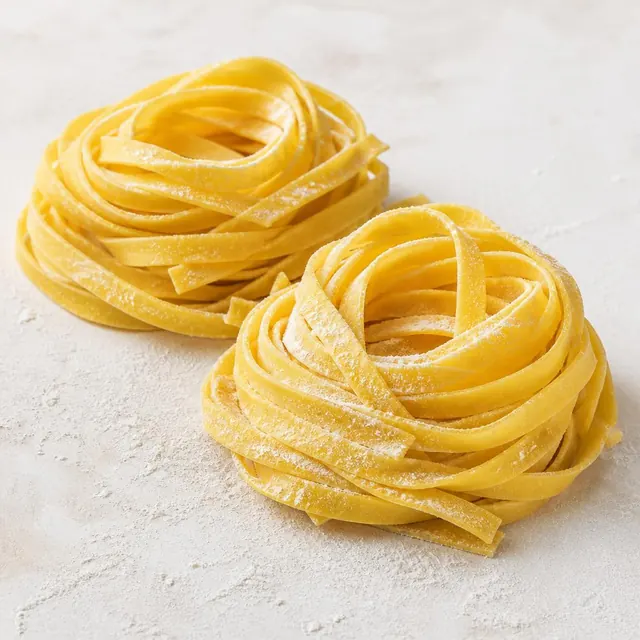
Tagliatelle are long flat ribbons of egg dough, typical of Bologna and Emilia. On 16 April 1972 the Bologna delegation of the Accademia Italiana della Cucina lodged the recipe and the measure with the Bologna Chamber of Commerce: a cooked tagliatella should be 8 mm wide – said to be 1/12,270 of the height of the Asinelli tower – so about 7 mm when raw. Other sources give around 10 mm and a thickness under 1 mm.
Dough of soft 00 flour and eggs (roughly 100 g of flour per egg) is rested and rolled out with a pin; the sheet is left to dry a little, then rolled up and cut with a knife. Fettuccine is the Roman name for a similar, slightly narrower noodle; pappardelle are much wider. Green tagliatelle with spinach are an Emilian classic.
Bolognese tradition serves them with ragù, whose recipe the Accademia lodged in 1982 – not as “spaghetti bolognese”.
Recipes
Menus
Techniques and tips
Related entries
Sources
- Comune di Bologna (Cultura Bologna): Tagliatella al ragù bolognese (2022), ricette depositate presso la Camera di Commercio di Bologna
- Accademia Italiana della Cucina, Delegazione di Bologna: Ricettario (2015), úvod o uložených receptech
- Oretta Zanini De Vita: Encyclopedia of Pasta (2009), heslo Tagliatelle, Tagliolini
- Caz Hildebrand, Jacob Kenedy: The Geometry of Pasta (2010), heslo Tagliatelle
- Marcella Hazan: Marcella Cucina (1997), Other Noodle Cuts
- Divella: 95 Egg Tagliatelle, údaj doby vaření
- Granoro: Tagliatelle all'uovo Dedicato n. 116, údaj doby vaření
- Divella: Egg Fresh Tagliatelle, údaj doby vaření
- Giovanni Rana: Tagliatelle (čerstvé), údaj doby vaření