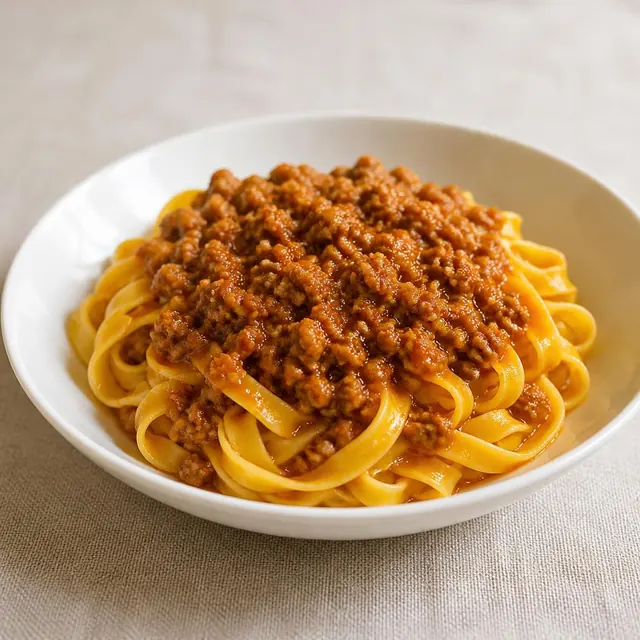
Bolognese ragù (ragù alla bolognese)
Bolognese meat ragù of coarsely minced beef, unsmoked pancetta, finely chopped vegetables, wine, tomatoes and milk, simmered covered over very low heat for 2 hours; no garlic or herbs. Following the recipe deposited by the Accademia Italiana della Cucina with the Bologna Chamber of Commerce (2023 version); about 1 kg, 6 servings. Traditionally served with egg tagliatelle or in lasagne, not with spaghetti.
Total time: 165 min6 servingsFinal yield 1,000 g
Ingredients
- 400 gBeef, ground, 85% lean meat / 15% fat, raw (Includes foods for USDA's Food Distribution Program)
- 150 gPork, cured, bacon, unprepared
- 60 gOnions, raw
- 60 gCarrots, raw
- 60 gCelery, raw
- 2 15 ml tablespoonOil, olive, salad or cooking
- 100 mlAlcoholic beverage, wine, table, red
- 20 gTomato products, canned, paste, without salt added (Includes foods for USDA's Food Distribution Program)
- 200 gTomato products, canned, puree, without salt added
- 100 mlMilk, whole, 3.25% milkfat, with added vitamin D
- 300 mlSoup, stock, beef, home-prepared
- 3 gSalt, table
- 0.6 gSpices, pepper, black
Allergens
Contains: Milk, Celery, Sulphites
May contain: Soy
Derived from ingredients – check the package label.
Method
- Chop the pancetta finely with a knife. Chop the onion, carrot and celery as finely as possible with a knife (not in a food processor, which would make the vegetables watery and mushy).
- In a heavy-based pot (ideally cast iron or earthenware) heat the oil with the pancetta and let it melt over low heat for about 5 minutes. Add the vegetables and soften them slowly for 8–10 minutes, stirring now and then; they must not brown.
- Add the minced beef, raise the heat and cook, stirring constantly, for about 10 minutes until the released juices have evaporated and the meat sizzles and browns lightly.
- Pour in the wine and let it evaporate completely, stirring, for about 5 minutes.
TipReducing a sauceReduction boils off the water but keeps the salt: a sauce that was just right can easily end up as brine.Show less
Why
When you reduce a sauce, simmering it uncovered, water evaporates while flavour compounds, sugars, gelatin from meat and bones and salt stay in the pan, so they become concentrated and the sauce thickens. If you salt it at the start and then reduce it by half, it will be roughly twice as salty – which is why seasoning is adjusted at the end. The brown bits stuck to the bottom of the pan or roasting tin after searing or roasting (the fond) are among the tastiest parts of a sauce: poured over with stock, wine or water and scraped up, they dissolve into the sauce – this is called deglazing. A gentle simmer is enough; at a hard boil the sauce easily scorches at the edges and on the bottom, and if it contains a lot of sugar or gelatin it reduces into a sticky mass.
How to do it
- Cook uncovered in a wider pan so the water evaporates faster.
- Salt only at the end, once the sauce has the thickness you want.
- Pour hot stock, wine or water over the fond and scrape it off the bottom with a wooden spoon; leave out black, burnt bits, they would make the sauce bitter.
- Keep only a gentle simmer and stir now and then, especially at the bottom and the edges.
- Test the thickness on a spoon: the sauce should coat it thinly; bear in mind it will thicken further as it cools.
If it goes wrong
An oversalted sauce can only be saved by diluting it: add unsalted stock, water or cream and bring the thickness back with a short simmer. Thin a sauce that is too thick or sticky with a little hot water. Pour a scorched sauce into a clean pan at once without scraping the bottom; if it already tastes burnt, it can't be saved.
- Stir in the tomato paste and the passata, cover with a lid and let the ragù barely bubble over very low heat for 2 hours (up to 3 hours if you like). Whenever it starts to dry out, add a ladleful of stock. After about an hour, stir in the milk and let it be absorbed and evaporate during the rest of the cooking. Finally season with salt and pepper. The finished ragù is thick and dark reddish brown, with fat on the surface.
TipTomatoes, tomato paste and acidityTomatoes have character: raw paste is sharp and sour, but a few minutes in fat give it a rounded flavour.Show less
Why
Tomato paste is concentrated tomato flesh with plenty of sugars and acids; briefly fried in fat, some of the sugars brown and the raw, sharply sour taste turns full and rounded, but it must be stirred, because it scorches easily on a dry pan base. Long simmering, fat, cream or a little sugar soften a sharp sauce; sugar doesn't neutralise the acid, though, it only balances it on the palate. Baking soda really does neutralise acid, but in tests it made the sauce taste flat, and larger amounts foam and taste soapy, so a pinch at most. Acid firms up the cell walls of vegetables and pulses, so beans, chickpeas and potatoes soften more slowly in tomato sauce. Acidic food doesn't belong in uncoated aluminium: the German BfR advises against cooking or storing acidic and salty food, such as tomato purée, in uncoated aluminium pots, because aluminium migrates into it; with cast iron, manufacturers say long cooking of acidic food strips the protective seasoning.
How to do it
- Stir the paste into hot fat and fry it for a few minutes, stirring constantly, until it darkens and smells sweet; then add liquid at once.
- Simmer a sour sauce for longer and round it off with fat or cream; add sugar little by little and taste.
- Use baking soda only as an exception, a pinch per pot at most, and let it fizz out before tasting.
- Cook beans, chickpeas and potatoes until tender first, or allow longer cooking in the sauce – see the Cooking pulses card.
- Cook and store tomato sauces in stainless steel, enamel or glass, not in uncoated aluminium or new, lightly seasoned cast iron.
If it goes wrong
Paste that has scorched on the base won't lose that taste: pour the sauce into a clean pot without scraping and start again with a fresh batch. An overly sour sauce is saved by longer simmering, a knob of butter or a spoonful of cream. Dilute a sauce that tastes soapy after soda with canned tomatoes and leave the soda out next time.
Recipe tradition
Not yet verified
This recipe has not been checked against a documented culinary reference.
Food data sources
- USDA FoodData Central SR Legacy (2018-04) · USDA Agricultural Research Service, FoodData Central SR Legacy. · CC0 1.0 Universal
Nutrition
Calculated from the selected ingredients; not a laboratory measurement.
Whole recipe
- Energy
- 1,962.2 kcal
- Protein
- 110 g
- Fat
- 147.5 g
- Total carbohydrate (by difference)
- 46.5 g
- Total dietary fibre (USDA)
- 8.4 g
- Saturated fatty acids
- 47.8 g
- Sodium
- 3,364.4 mg
- Salt (sodium × 2.5)
- 8.4 g
Per serving
- Protein18.3 g23%
- Fat24.6 g68%
- Total carbohydrate (by difference)7.7 g9%
Share of energy from protein, fat and carbohydrate (4 / 9 / 4 kcal per g), not share by weight.
- Energy
- 327 kcal
- Protein
- 18.3 g
- Fat
- 24.6 g
- Total carbohydrate (by difference)
- 7.7 g
- Total dietary fibre (USDA)
- 1.4 g
- Saturated fatty acids
- 8 g
- Sodium
- 560.7 mg
- Salt (sodium × 2.5)
- 1.4 g
Per 100 g of finished food
- Energy
- 196.2 kcal
- Protein
- 11 g
- Fat
- 14.8 g
- Total carbohydrate (by difference)
- 4.6 g
- Total dietary fibre (USDA)
- 0.84 g
- Saturated fatty acids
- 4.8 g
- Sodium
- 336.4 mg
- Salt (sodium × 2.5)
- 0.84 g
Salt is calculated from sodium (g salt = mg sodium × 2.5 / 1000) and includes sodium from all ingredients.
A dash means the value is unknown, not zero.
Calculation limitations
- Nutrition is a calculated estimate, not a laboratory measurement.
- The final yield is an editorial estimate.
- Some ingredient quantities use documented estimates or household-measure assumptions.
- The number of servings is an editorial estimate (midpoint of the source range or based on the dish type and energy).
- Some specific ingredients are represented by the closest generic food with the same culinary function.
- Fibre, saturated fat and sodium of cooked ingredients are estimated from the consumed ingredient amounts; for drained ingredients, sodium is included only where the retained amount is an explicit editorial estimate.
- Alcohol remaining after cooking is estimated from USDA retention factors by cooking method and time; energy excludes the evaporated alcohol.
- Some process effects could not be resolved in this calculation.