Menu · 2 components
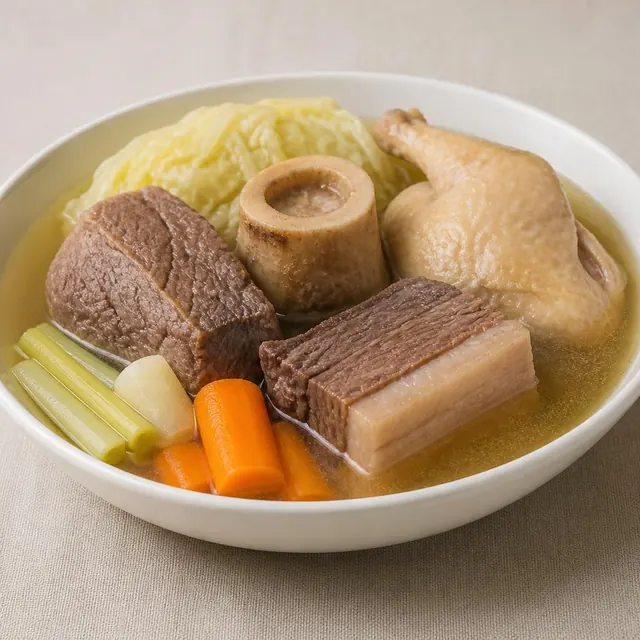
Pot-au-feu (petite marmite) with baguette
Beef and half a hen simmered in white stock with carrots, turnips, leeks, celery and cabbage, the broth served first, with a quarter of a baguette (about 65 g); boiled potatoes are the further choice.
Menu portion251 min669.4 kcal per menu portion
- Good for lunch
Less suited for dinner.
1Main course
Pot-au-feu (petite marmite)
493 kcal per menu portion · 1 × recipe portion per menu portion
- Lactose free
- Gluten free
Contains: Celery
Quantities for the whole recipe (6 servings).
Ingredients
- 300 gBeef, chuck, arm pot roast, separable lean and fat, trimmed to 1/8" fat, choice, raw
- 300 gBeef, brisket, whole, separable lean and fat, trimmed to 1/8" fat, all grades, raw
- 400 gChicken, stewing, meat and skin, raw
- 1.8 lSoup, stock, beef, home-prepared
- 3 gSalt, table
- 120 gCarrots, raw
- 120 gTurnips, raw
- 90 gLeeks, (bulb and lower leaf-portion), raw
- 48 gCelery, raw
- 150 gCabbage, common (danish, domestic, and pointed types), freshly harvest, raw
- 200 gBeef marrow bone not counted – removed
- 300 gChicken, stewing, meat and skin, raw not counted – removed
Method
- Tie the beef with string so that it keeps its shape and put it into a large (ideally earthenware) pot with the marrow bone tied in muslin. Cover with 1.8 litres of cold white stock and bring slowly to the boil over moderate heat (about 40 minutes). Skim the scum carefully as it rises.
TipStock and brothStock is a discipline of patience: rush it at a boil and you get a cloudy, greasy soup instead of a clear one.Why and howShow less
Why
Bones and meat go into cold water and are heated slowly, so the soluble proteins have time to leach into the water and coagulate on the surface as foam that can be skimmed off. When stock boils hard, the agitation breaks up the coagulated proteins and the rendered fat into tiny particles and disperses them through the liquid; the stock turns cloudy and greasy, whereas at a gentle simmer the scum and impurities sink to the bottom or stay on the surface. Body comes from bones, joints, skin and wings: their collagen turns into gelatin with long heating, which is why good stock sets to a jelly when chilled. Salt goes in only at the end, because stock evaporates as it cooks and is reduced further in sauces and risotto, so stock salted early easily ends up too salty. A big pot of hot stock cools slowly; how to chill it quickly is covered by the Cooling and storing leftovers card.
How to do it
- Cover bones and meat with cold water so they are submerged and bring it slowly to a boil.
- Before it boils, skim the foam off the surface with a slotted spoon.
- Then turn the heat down so the surface only trembles now and then, and let the stock simmer without boiling hard.
- For more body, add bones with joints, skin or wings; add vegetables only in the second half of cooking.
- Strain the stock, lift the fat off the surface or once it has set after chilling, and salt only for its next use.
- Divide a large batch into smaller shallow containers and refrigerate it within 2 hours of cooking.
If it goes wrong
Cloudy stock can be used as normal, it just won't be clear; muslin or a fine sieve catches the coarser sediment, but only clarifying with egg white gives a truly clear stock, and don't let it bubble next time. Chill greasy stock and lift off the set fat. Dilute oversalted stock with water or unsalted stock; in a soup, more vegetables or noodles help as well. Stock that doesn't set when chilled needed more collagen-rich bones, but it still tastes good.
- Wipe the rim of the pot and cook very gently, with the surface barely trembling in one spot, half covered, for 1 hour. A rolling boil would cloud the broth.
- Add the half hen, bring back almost to the boil, skim and keep cooking just as gently for another hour.
- Meanwhile, turn the carrots and turnips into olive shapes, tie the leeks into a bundle and halve the celery heart. Blanch the cabbage in boiling water for 5 minutes and drain.
- Add the carrots, turnips, leeks and celery to the pot and keep cooking just as gently for 1 hour, until the beef and hen are tender (a fork slides in without resistance) and the vegetables are done.
- At the same time, braise the cabbage, covered, in a small saucepan with 2 ladles of the broth and a spoonful of fat from its surface for about 40 minutes until tender.
- Taste the broth and only adjust the salt; do not skim off all the fat, it is served slightly fatty. Serve the marrow from the bone on small toasts. Slice the beef and hen and serve them with the vegetables and cabbage.
2Side dish
Baguette (shop-bought) traditional
177 kcal per menu portion · 1 × recipe portion per menu portion
- Vegetarian
- Low in lactose
Contains: Gluten · May contain: Egg, Soy, Milk, Sesame
Quantities for the whole recipe (1 serving).
Shown: ready-made product Baguette (shop-bought).
or:
- Boiled potatoes without butter · 158 kcal per menu portion
Ingredients
- 65 gBread, French or Vienna
Method
- Cut the baguette into quarters and serve fresh.
Alternative: Boiled potatoes without butter
Ingredients
- 800 gPotatoes, russet, flesh and skin, raw (Includes foods for USDA's Food Distribution Program)
Method
- Wash skin-on potatoes and cut into even pieces.
- Cover with water, bring to a boil and cook 18 minutes until tender.
- Drain and serve without butter.
Allergens
Contains: Celery, Gluten
May contain: Egg, Milk, Sesame, Soy
Derived from ingredients – check the package label.
Nutrition, allergens and calories are for the default choice – the first alternative of every slot.
Nutrition per menu portion
Per serving
- Protein44.4 g27%
- Fat34.4 g46%
- Total carbohydrate (by difference)44.6 g27%
Share of energy from protein, fat and carbohydrate (4 / 9 / 4 kcal per g), not share by weight.
- Energy
- 669.4 kcal
- Protein
- 44.4 g
- Fat
- 34.4 g
- Total carbohydrate (by difference)
- 44.6 g
- Total dietary fibre (USDA)
- 3.3 g
- Saturated fatty acids
- 11.8 g
- Sodium
- 1,342.1 mg
- Salt (sodium × 2.5)
- 3.4 g
Per 100 g
- Energy
- 136.6 kcal
- Protein
- 9.1 g
- Fat
- 7 g
- Total carbohydrate (by difference)
- 9.1 g
- Total dietary fibre (USDA)
- 0.68 g
- Saturated fatty acids
- 2.4 g
- Sodium
- 273.9 mg
- Salt (sodium × 2.5)
- 0.68 g
A dash means the value is unknown, not zero. Salt is calculated from sodium (g salt = mg sodium × 2.5 / 1000) and includes sodium from all ingredients.
Calculation limitations
- Nutrition is a calculated estimate, not a laboratory measurement.
- Some ingredient quantities use documented estimates or household-measure assumptions.
- The number of servings is an editorial estimate (midpoint of the source range or based on the dish type and energy).
- Some specific ingredients are represented by the closest generic food with the same culinary function.
- Fibre, saturated fat and sodium of cooked ingredients are estimated from the consumed ingredient amounts; for drained ingredients, sodium is included only where the retained amount is an explicit editorial estimate.
- Some process effects could not be resolved in this calculation.
- Menu nutrition is the sum of its component recipes, each scaled to one menu portion.