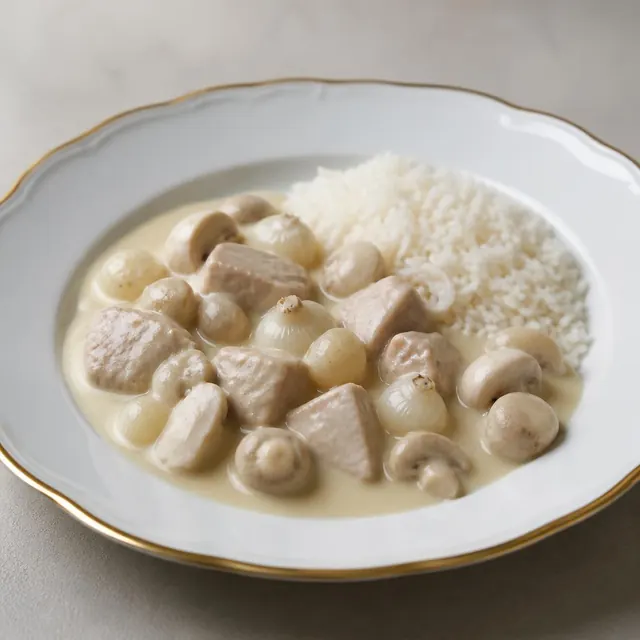
Blanquette de veau
Veal gently simmered in white stock with aromatic vegetables and served in a velouté made from a pale roux and the cooking liquor, bound with egg yolks and cream with lemon and nutmeg, with small onions and mushrooms; following A. Escoffier (Le Guide culinaire, 2nd ed. 1907, à l’ancienne). 5 servings; the meat is not browned. Served with rice.
Total time: 150 min5 servingsFinal yield 2,000 g
Ingredients
- 900 gVeal, shoulder, whole (arm and blade), separable lean and fat, raw
- 1.2 lSoup, stock, chicken, home-prepared
- 2 gSalt, table
- 60 gCarrots, raw not counted – removed
- 110 gOnions, raw not counted – removed
- 0.1 gSpices, cloves, ground not counted – removed
- 80 gLeeks, (bulb and lower leaf-portion), raw not counted – removed
- 5 gParsley, fresh not counted – removed
- 0.5 gThyme, fresh not counted – removed
- 0.2 gSpices, bay leaf not counted – removed
- 30 gButter, without salt
- 30 gWheat flour, white, all-purpose, unenriched
- 20 gMushrooms, white, raw not counted – removed
- 180 gOnions, raw
- 120 gMushrooms, white, raw
- 2 5 ml teaspoonLemon juice, raw
- 51 gEgg, yolk, raw, fresh
- 60 mlCream, fluid, heavy whipping
- 0.2 gSpices, nutmeg, ground
- 2 gParsley, fresh
- 350 mlSoup, stock, chicken, home-prepared not counted – removed
Allergens
Contains: Gluten, Egg, Milk, Celery
Derived from ingredients – check the package label.
Method
- Cut the veal into pieces of about 60 g, put them into a pot and cover with white stock (about 1.5 litres). Salt very lightly and bring slowly to the boil, stirring the meat often; skim with great care.
- Add the carrot, the onion studded with the clove and a bundle of leek, parsley stalks, thyme and bay leaf. Cook gently for 1½ hours until the meat is tender.
- Meanwhile, put the peeled small onions in a pan with about 100 ml of the cooking liquor and braise them, covered, for about 20 minutes until tender without letting them colour. Halfway through, add the mushrooms and 1 tsp of lemon juice so that they stay white.
- Melt the butter in a saucepan, stir in the flour and cook for 2–3 minutes, stirring constantly, without letting it colour (white roux). Gradually whisk in 1050 ml of strained cooking liquor, add a small handful of mushroom peelings and simmer the velouté for 15 minutes, stirring now and then and skimming off any skin and foam.
TipRouxWith roux, colour costs muscle: the darker it gets, the better it smells and the less it thickens.Show less
Why
A roux is flour cooked in fat, usually in a ratio of roughly 1 : 1 by weight. The fat coats each flour particle, so it disperses in the liquid on its own instead of clumping; the starch then swells and thickens fully only close to boiling point. Lumps form when flour meets hot liquid too suddenly: the outside of a clump gelatinises instantly and seals dry flour inside – which is why you combine cool roux with hot liquid or hot roux with cool liquid, and add the liquid gradually. The longer and darker a roux cooks, the more the heat breaks its starch into shorter pieces that thicken less: a dark roux smells nutty, but you need more of it for the same thickness. Once thickened, let the sauce simmer gently for a while so the starch swells completely and the raw-flour taste disappears.
How to do it
- Weigh out fat and plain flour in a ratio of roughly 1:1.
- Stir the flour into the fat over low heat; a light roux takes a few minutes, a dark one needs time and attention.
- Pour cool or lukewarm (not ice-cold) liquid into hot roux, or hot liquid into roux that has cooled.
- Add the liquid gradually, the first splash carefully and at arm's length: hot roux, especially a dark one, spatters and the steam burns. Whisk it in at once, not with a wooden spoon.
- Then simmer the sauce or soup gently, usually for 10–20 minutes, stirring often and tasting until the floury taste is gone.
- Use more flour for a dark roux; it thickens less than a light one.
If it goes wrong
Whisk out lumps, blitz them with a stick blender or pass the sauce through a sieve. A floury taste disappears with longer gentle simmering. A burnt roux with black specks and a bitter smell can't be saved – throw it out and start again, next time over lower heat and stirring constantly.
- Drain the pieces of meat, trim them if necessary and put them into another saucepan with the onions and mushrooms; discard the vegetables and herb bundle from the liquor. The remaining liquor is not needed (use it for soup).
- Just before serving, mix the yolks with 60 ml of cream, 1 tsp of lemon juice and a pinch of grated nutmeg, stir in a few spoonfuls of the hot velouté and then pour everything into the velouté off the heat. Strain the sauce over the meat and garnish and heat through, but do not boil (no more than about 85 °C), or the yolks will curdle.
TipTempering egg yolksEgg yolk is an introvert: it can handle hot soup, but only if the soup comes over a spoonful at a time.Show less
Why
Egg yolk proteins start to thicken at roughly 65 °C and set at around 70 °C; diluted with liquid and protected by starch or sugar they can take more – a thick custard with flour or starch can even take a brief boil – but in a soup, boiling is almost always too much for the yolk. Pour a yolk straight into boiling soup and its edges cook before it can disperse, leaving the pot full of flecks of scrambled egg. To enrich a soup with yolk, you therefore first mix the yolk with cream or lukewarm liquid and add the hot soup to it a spoonful at a time – the yolk is diluted gradually and warms evenly. Only then does this mixture go into the pot, which is no longer boiling, to be heated through while stirring constantly; boiling it again would tighten the proteins and make the soup or sauce grainy.
How to do it
- Mix the yolks in a bowl with cream or a little lukewarm liquid.
- Take the pot off the heat and let the soup or sauce stop bubbling.
- Stirring constantly, add the hot liquid to the yolks a spoonful at a time, at least one ladleful in total.
- Only then pour the mixture into the pot and stir straight away.
- From now on just heat it through over low heat and don't let it boil.
- When reheating soup enriched with yolk, never bring it back to the boil.
If it goes wrong
Strain out fine flecks through a sieve or blitz them with a stick blender. A badly curdled soup won't become smooth again, but it is perfectly edible – next time temper the yolk and don't boil the pot once it is in.
- Transfer to a deep dish, sprinkle lightly with chopped parsley and serve at once with rice.
Recipe tradition
Not yet verified
This recipe has not been checked against a documented culinary reference.
Food data sources
- USDA FoodData Central SR Legacy (2018-04) · USDA Agricultural Research Service, FoodData Central SR Legacy. · CC0 1.0 Universal
Nutrition
Calculated from the selected ingredients; not a laboratory measurement.
Whole recipe
- Energy
- 2,386.1 kcal
- Protein
- 221.8 g
- Fat
- 122.2 g
- Total carbohydrate (by difference)
- 89.3 g
- Total dietary fibre (USDA)
- 5.2 g
- Saturated fatty acids
- 56.4 g
- Sodium
- 3,321.5 mg
- Salt (sodium × 2.5)
- 8.3 g
Per serving
- Protein44.4 g38%
- Fat24.4 g47%
- Total carbohydrate (by difference)17.9 g15%
Share of energy from protein, fat and carbohydrate (4 / 9 / 4 kcal per g), not share by weight.
- Energy
- 477.2 kcal
- Protein
- 44.4 g
- Fat
- 24.4 g
- Total carbohydrate (by difference)
- 17.9 g
- Total dietary fibre (USDA)
- 1 g
- Saturated fatty acids
- 11.3 g
- Sodium
- 664.3 mg
- Salt (sodium × 2.5)
- 1.7 g
Per 100 g of finished food
- Energy
- 119.3 kcal
- Protein
- 11.1 g
- Fat
- 6.1 g
- Total carbohydrate (by difference)
- 4.5 g
- Total dietary fibre (USDA)
- 0.26 g
- Saturated fatty acids
- 2.8 g
- Sodium
- 166.1 mg
- Salt (sodium × 2.5)
- 0.42 g
Salt is calculated from sodium (g salt = mg sodium × 2.5 / 1000) and includes sodium from all ingredients.
A dash means the value is unknown, not zero.
Calculation limitations
- Nutrition is a calculated estimate, not a laboratory measurement.
- The final yield is an editorial estimate.
- Some ingredient quantities use documented estimates or household-measure assumptions.
- The number of servings is an editorial estimate (midpoint of the source range or based on the dish type and energy).
- Some specific ingredients are represented by the closest generic food with the same culinary function.
- Fibre, saturated fat and sodium of cooked ingredients are estimated from the consumed ingredient amounts; for drained ingredients, sodium is included only where the retained amount is an explicit editorial estimate.
- Some process effects could not be resolved in this calculation.