Menu · 2 components
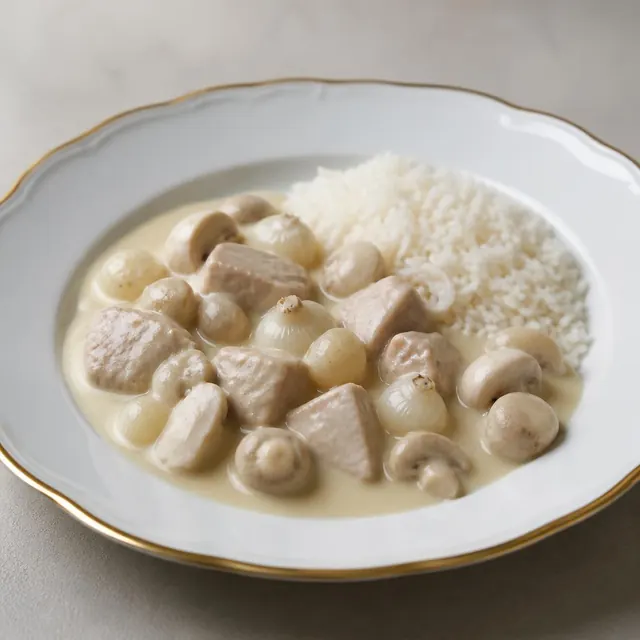
Blanquette de veau with pilaf rice
Veal in a white sauce thickened with egg yolks and cream, with baby onions and mushrooms, traditionally with pilaf rice; mashed potatoes are the further choice.
Menu portion185 min820.7 kcal per menu portion
- Good for lunch
Less suited for dinner.
1Main course
Blanquette de veau
477 kcal per menu portion · 1 × recipe portion per menu portion
Contains: Gluten, Egg, Milk, Celery
Quantities for the whole recipe (5 servings).
Ingredients
- 900 gVeal, shoulder, whole (arm and blade), separable lean and fat, raw
- 1.2 lSoup, stock, chicken, home-prepared
- 2 gSalt, table
- 60 gCarrots, raw not counted – removed
- 110 gOnions, raw not counted – removed
- 0.1 gSpices, cloves, ground not counted – removed
- 80 gLeeks, (bulb and lower leaf-portion), raw not counted – removed
- 5 gParsley, fresh not counted – removed
- 0.5 gThyme, fresh not counted – removed
- 0.2 gSpices, bay leaf not counted – removed
- 30 gButter, without salt
- 30 gWheat flour, white, all-purpose, unenriched
- 20 gMushrooms, white, raw not counted – removed
- 180 gOnions, raw
- 120 gMushrooms, white, raw
- 2 5 ml teaspoonLemon juice, raw
- 51 gEgg, yolk, raw, fresh
- 60 mlCream, fluid, heavy whipping
- 0.2 gSpices, nutmeg, ground
- 2 gParsley, fresh
- 350 mlSoup, stock, chicken, home-prepared not counted – removed
Method
- Cut the veal into pieces of about 60 g, put them into a pot and cover with white stock (about 1.5 litres). Salt very lightly and bring slowly to the boil, stirring the meat often; skim with great care.
- Add the carrot, the onion studded with the clove and a bundle of leek, parsley stalks, thyme and bay leaf. Cook gently for 1½ hours until the meat is tender.
- Meanwhile, put the peeled small onions in a pan with about 100 ml of the cooking liquor and braise them, covered, for about 20 minutes until tender without letting them colour. Halfway through, add the mushrooms and 1 tsp of lemon juice so that they stay white.
- Melt the butter in a saucepan, stir in the flour and cook for 2–3 minutes, stirring constantly, without letting it colour (white roux). Gradually whisk in 1050 ml of strained cooking liquor, add a small handful of mushroom peelings and simmer the velouté for 15 minutes, stirring now and then and skimming off any skin and foam.
TipRouxWith roux, colour costs muscle: the darker it gets, the better it smells and the less it thickens.Why and howShow less
Why
A roux is flour cooked in fat, usually in a ratio of roughly 1 : 1 by weight. The fat coats each flour particle, so it disperses in the liquid on its own instead of clumping; the starch then swells and thickens fully only close to boiling point. Lumps form when flour meets hot liquid too suddenly: the outside of a clump gelatinises instantly and seals dry flour inside – which is why you combine cool roux with hot liquid or hot roux with cool liquid, and add the liquid gradually. The longer and darker a roux cooks, the more the heat breaks its starch into shorter pieces that thicken less: a dark roux smells nutty, but you need more of it for the same thickness. Once thickened, let the sauce simmer gently for a while so the starch swells completely and the raw-flour taste disappears.
How to do it
- Weigh out fat and plain flour in a ratio of roughly 1:1.
- Stir the flour into the fat over low heat; a light roux takes a few minutes, a dark one needs time and attention.
- Pour cool or lukewarm (not ice-cold) liquid into hot roux, or hot liquid into roux that has cooled.
- Add the liquid gradually, the first splash carefully and at arm's length: hot roux, especially a dark one, spatters and the steam burns. Whisk it in at once, not with a wooden spoon.
- Then simmer the sauce or soup gently, usually for 10–20 minutes, stirring often and tasting until the floury taste is gone.
- Use more flour for a dark roux; it thickens less than a light one.
If it goes wrong
Whisk out lumps, blitz them with a stick blender or pass the sauce through a sieve. A floury taste disappears with longer gentle simmering. A burnt roux with black specks and a bitter smell can't be saved – throw it out and start again, next time over lower heat and stirring constantly.
- Drain the pieces of meat, trim them if necessary and put them into another saucepan with the onions and mushrooms; discard the vegetables and herb bundle from the liquor. The remaining liquor is not needed (use it for soup).
- Just before serving, mix the yolks with 60 ml of cream, 1 tsp of lemon juice and a pinch of grated nutmeg, stir in a few spoonfuls of the hot velouté and then pour everything into the velouté off the heat. Strain the sauce over the meat and garnish and heat through, but do not boil (no more than about 85 °C), or the yolks will curdle.
TipTempering egg yolksEgg yolk is an introvert: it can handle hot soup, but only if the soup comes over a spoonful at a time.Why and howShow less
Why
Egg yolk proteins start to thicken at roughly 65 °C and set at around 70 °C; diluted with liquid and protected by starch or sugar they can take more – a thick custard with flour or starch can even take a brief boil – but in a soup, boiling is almost always too much for the yolk. Pour a yolk straight into boiling soup and its edges cook before it can disperse, leaving the pot full of flecks of scrambled egg. To enrich a soup with yolk, you therefore first mix the yolk with cream or lukewarm liquid and add the hot soup to it a spoonful at a time – the yolk is diluted gradually and warms evenly. Only then does this mixture go into the pot, which is no longer boiling, to be heated through while stirring constantly; boiling it again would tighten the proteins and make the soup or sauce grainy.
How to do it
- Mix the yolks in a bowl with cream or a little lukewarm liquid.
- Take the pot off the heat and let the soup or sauce stop bubbling.
- Stirring constantly, add the hot liquid to the yolks a spoonful at a time, at least one ladleful in total.
- Only then pour the mixture into the pot and stir straight away.
- From now on just heat it through over low heat and don't let it boil.
- When reheating soup enriched with yolk, never bring it back to the boil.
If it goes wrong
Strain out fine flecks through a sieve or blitz them with a stick blender. A badly curdled soup won't become smooth again, but it is perfectly edible – next time temper the yolk and don't boil the pot once it is in.
- Transfer to a deep dish, sprinkle lightly with chopped parsley and serve at once with rice.
2Side dish
Pilaf rice (riz pilaf) traditional
343 kcal per menu portion · 1 × recipe portion per menu portion
- Low in lactose
- Gluten free
Contains: Milk, Celery
Quantities for the whole recipe (5 servings).
or:
- French mashed potatoes (pommes purée) · 394 kcal per menu portion
Ingredients
- 55 gOnions, raw
- 50 gButter, without salt
- 250 gRice, white, long-grain, regular, raw, unenriched
- 500 mlSoup, stock, beef, home-prepared
- 50 gButter, without salt
Method
- Heat the oven to 180 °C. Chop the onion finely. Bring the stock to the boil.
- Melt 50 g of butter in an ovenproof casserole and sweat the onion in it for 3–4 minutes until translucent. Add the unwashed rice and stir it over the heat for 2–3 minutes until every grain is coated in butter and translucent at the edges.
TipPilaf, paella and absorption-cooked riceIn pilaf and paella the rice absorbs exactly the liquid you give it; after that it needs peace, as stirring turns it to sticky mush.Why and howShow less
Why
In absorption cooking the rice takes up all the liquid, so the flavour of the stock, spices and fat stays in the grains, but any mistake in the ratio shows: too little liquid leaves the grains hard, too much makes them mushy (basic ratios and resting under the lid are covered in the Cooking rice card). Pilaf starts by frying the dry rice in fat, which coats the grains in fat and spices while the toasted surface adds a nutty aroma. How separate the rice turns out depends mainly on its type: long-grain rice and basmati usually contain more amylose and stay firm and separate, whereas medium-grain rice for paella and risotto releases more starch and sticks more easily. Stirring during cooking rubs the grains against each other and releases starch, which is why pilaf and paella are left undisturbed once the liquid is in. Paella cooks in a thin layer in a wide pan, the liquid evaporates from the large surface and towards the end the rice on the bottom toasts into a crisp layer called socarrat; leftover cooked rice must be cooled quickly (see the Cooling and storing leftovers card).
How to do it
- Measure the rice and liquid exactly as the recipe says and add the liquid all at once; topping up during cooking should not be needed and is only a rescue.
- Rinse long-grain rice and basmati, do not rinse paella rice; for biryani, basmati is par-boiled, drained and finished in steam.
- Fry the rice in fat for 1–2 minutes until the grains are translucent at the edges, then pour in hot liquid and stir once to spread the grains out.
- Once it boils, stop stirring: cook pilaf covered over the lowest heat and paella in an open pan, turning it now and then on a smaller burner.
- You can tell socarrat by a quiet crackling and the smell of toasting rice from the bottom; raise the heat for the last 1–2 minutes, but take the pan off as soon as you smell burning.
- After switching off, let pilaf rest covered for 5–10 minutes and paella covered with a towel, then fluff the pilaf with a fork.
If it goes wrong
If the liquid is absorbed and the grains on top are still hard, sprinkle the dry patches with a few spoonfuls of hot stock, cover with a lid or foil and leave over low heat for 5 minutes; do not stir, or the bottom layer will turn mushy. If liquid is left in the paella at the end, let it evaporate over higher heat, uncovered and without stirring. Do not scrape up a black, bitter paella bottom; serve the rice above it.
- Pour in 500 ml of boiling stock, stir once, bring back to the boil and cover with a lid. Put it in the oven and cook at 180 °C for exactly 18 minutes without stirring.
- As soon as the rice is done, transfer it to another dish so that it does not keep cooking on the hot base, and lightly fork in 50 g of butter cut into small pieces. Serve at once.
Alternative: French mashed potatoes (pommes purée)
Ingredients
- 1,000 gPotatoes, flesh and skin, raw
- 200 gButter, without salt
- 250 mlMilk, whole, 3.25% milkfat, with added vitamin D
- 8 gSalt, table
- 2 lBeverages, water, tap, drinking not counted – removed
- 2 gSalt, table editorial addition
Method
- Wash potatoes of even size, put them in a pot in their skins, cover with 2 litres of cold water with 20 g of salt and bring to the boil. Simmer for about 25 minutes until a knife slides in without resistance.
- Drain the potatoes and peel them while still hot, holding them in a cloth. Immediately pass them through a food mill with a fine disc or a potato ricer into a saucepan. Never use a blender: broken cells release starch and the purée turns gluey.
- Set the pan over low heat and stir the purée with a wooden spoon for 4–5 minutes to drive off moisture; it must not catch. Meanwhile bring 250 ml of milk to the boil.
- Vigorously work 200 g of cold diced butter into the purée a little at a time and add 8 g of salt. Then pour in the boiling milk in a thin stream while stirring constantly, and finally whisk the purée until smooth. Heat it through without boiling and serve at once.
Allergens
Contains: Celery, Egg, Gluten, Milk
Derived from ingredients – check the package label.
Nutrition, allergens and calories are for the default choice – the first alternative of every slot.
Nutrition per menu portion
Per serving
- Protein50.2 g25%
- Fat41.1 g45%
- Total carbohydrate (by difference)60.1 g30%
Share of energy from protein, fat and carbohydrate (4 / 9 / 4 kcal per g), not share by weight.
- Energy
- 820.7 kcal
- Protein
- 50.2 g
- Fat
- 41.1 g
- Total carbohydrate (by difference)
- 60.1 g
- Total dietary fibre (USDA)
- 1.9 g
- Saturated fatty acids
- 21.5 g
- Sodium
- 870.3 mg
- Salt (sodium × 2.5)
- 2.2 g
Per 100 g
- Energy
- 144 kcal
- Protein
- 8.8 g
- Fat
- 7.2 g
- Total carbohydrate (by difference)
- 10.5 g
- Total dietary fibre (USDA)
- 0.33 g
- Saturated fatty acids
- 3.8 g
- Sodium
- 152.7 mg
- Salt (sodium × 2.5)
- 0.38 g
A dash means the value is unknown, not zero. Salt is calculated from sodium (g salt = mg sodium × 2.5 / 1000) and includes sodium from all ingredients.
Calculation limitations
- Nutrition is a calculated estimate, not a laboratory measurement.
- Some ingredient quantities use documented estimates or household-measure assumptions.
- The number of servings is an editorial estimate (midpoint of the source range or based on the dish type and energy).
- Some specific ingredients are represented by the closest generic food with the same culinary function.
- Fibre, saturated fat and sodium of cooked ingredients are estimated from the consumed ingredient amounts; for drained ingredients, sodium is included only where the retained amount is an explicit editorial estimate.
- Some process effects could not be resolved in this calculation.
- Menu nutrition is the sum of its component recipes, each scaled to one menu portion.