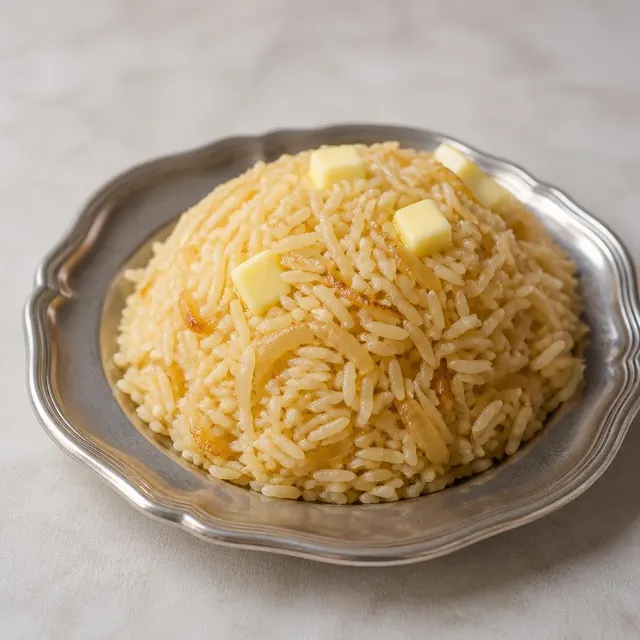
Pilaf rice (riz pilaf)
French side dish of long-grain rice fried with onion in butter, moistened with white stock, cooked covered in the oven and finished with pieces of butter; following A. Escoffier (Le Guide culinaire, 2nd ed. 1907). 5 servings of about 170 g, one per serving of a main dish.
Total time: 35 min5 servingsFinal yield 850 g
Ingredients
- 55 gOnions, raw
- 50 gButter, without salt
- 250 gRice, white, long-grain, regular, raw, unenriched
- 500 mlSoup, stock, beef, home-prepared
- 50 gButter, without salt
Allergens
Contains: Milk, Celery
Derived from ingredients – check the package label.
Method
- Heat the oven to 180 °C. Chop the onion finely. Bring the stock to the boil.
- Melt 50 g of butter in an ovenproof casserole and sweat the onion in it for 3–4 minutes until translucent. Add the unwashed rice and stir it over the heat for 2–3 minutes until every grain is coated in butter and translucent at the edges.
TipPilaf, paella and absorption-cooked riceIn pilaf and paella the rice absorbs exactly the liquid you give it; after that it needs peace, as stirring turns it to sticky mush.Show less
Why
In absorption cooking the rice takes up all the liquid, so the flavour of the stock, spices and fat stays in the grains, but any mistake in the ratio shows: too little liquid leaves the grains hard, too much makes them mushy (basic ratios and resting under the lid are covered in the Cooking rice card). Pilaf starts by frying the dry rice in fat, which coats the grains in fat and spices while the toasted surface adds a nutty aroma. How separate the rice turns out depends mainly on its type: long-grain rice and basmati usually contain more amylose and stay firm and separate, whereas medium-grain rice for paella and risotto releases more starch and sticks more easily. Stirring during cooking rubs the grains against each other and releases starch, which is why pilaf and paella are left undisturbed once the liquid is in. Paella cooks in a thin layer in a wide pan, the liquid evaporates from the large surface and towards the end the rice on the bottom toasts into a crisp layer called socarrat; leftover cooked rice must be cooled quickly (see the Cooling and storing leftovers card).
How to do it
- Measure the rice and liquid exactly as the recipe says and add the liquid all at once; topping up during cooking should not be needed and is only a rescue.
- Rinse long-grain rice and basmati, do not rinse paella rice; for biryani, basmati is par-boiled, drained and finished in steam.
- Fry the rice in fat for 1–2 minutes until the grains are translucent at the edges, then pour in hot liquid and stir once to spread the grains out.
- Once it boils, stop stirring: cook pilaf covered over the lowest heat and paella in an open pan, turning it now and then on a smaller burner.
- You can tell socarrat by a quiet crackling and the smell of toasting rice from the bottom; raise the heat for the last 1–2 minutes, but take the pan off as soon as you smell burning.
- After switching off, let pilaf rest covered for 5–10 minutes and paella covered with a towel, then fluff the pilaf with a fork.
If it goes wrong
If the liquid is absorbed and the grains on top are still hard, sprinkle the dry patches with a few spoonfuls of hot stock, cover with a lid or foil and leave over low heat for 5 minutes; do not stir, or the bottom layer will turn mushy. If liquid is left in the paella at the end, let it evaporate over higher heat, uncovered and without stirring. Do not scrape up a black, bitter paella bottom; serve the rice above it.
- Pour in 500 ml of boiling stock, stir once, bring back to the boil and cover with a lid. Put it in the oven and cook at 180 °C for exactly 18 minutes without stirring.
- As soon as the rice is done, transfer it to another dish so that it does not keep cooking on the hot base, and lightly fork in 50 g of butter cut into small pieces. Serve at once.
Recipe tradition
Not yet verified
This recipe has not been checked against a documented culinary reference.
Food data sources
- USDA FoodData Central SR Legacy (2018-04) · USDA Agricultural Research Service, FoodData Central SR Legacy. · CC0 1.0 Universal
Nutrition
Calculated from the selected ingredients; not a laboratory measurement.
Whole recipe
- Energy
- 1,717.4 kcal
- Protein
- 29.3 g
- Fat
- 83.3 g
- Total carbohydrate (by difference)
- 211.2 g
- Total dietary fibre (USDA)
- 4.2 g
- Saturated fatty acids
- 51.1 g
- Sodium
- 1,030 mg
- Salt (sodium × 2.5)
- 2.6 g
Per serving
- Protein5.9 g7%
- Fat16.7 g44%
- Total carbohydrate (by difference)42.2 g49%
Share of energy from protein, fat and carbohydrate (4 / 9 / 4 kcal per g), not share by weight.
- Energy
- 343.5 kcal
- Protein
- 5.9 g
- Fat
- 16.7 g
- Total carbohydrate (by difference)
- 42.2 g
- Total dietary fibre (USDA)
- 0.84 g
- Saturated fatty acids
- 10.2 g
- Sodium
- 206 mg
- Salt (sodium × 2.5)
- 0.51 g
Per 100 g of finished food
- Energy
- 202.1 kcal
- Protein
- 3.4 g
- Fat
- 9.8 g
- Total carbohydrate (by difference)
- 24.8 g
- Total dietary fibre (USDA)
- 0.49 g
- Saturated fatty acids
- 6 g
- Sodium
- 121.2 mg
- Salt (sodium × 2.5)
- 0.3 g
Salt is calculated from sodium (g salt = mg sodium × 2.5 / 1000) and includes sodium from all ingredients.
A dash means the value is unknown, not zero.
Calculation limitations
- Nutrition is a calculated estimate, not a laboratory measurement.
- The final yield is an editorial estimate.
- Some ingredient quantities use documented estimates or household-measure assumptions.
- The number of servings is an editorial estimate (midpoint of the source range or based on the dish type and energy).
- Some specific ingredients are represented by the closest generic food with the same culinary function.
- Fibre, saturated fat and sodium of cooked ingredients are estimated from the consumed ingredient amounts; for drained ingredients, sodium is included only where the retained amount is an explicit editorial estimate.
- Some process effects could not be resolved in this calculation.