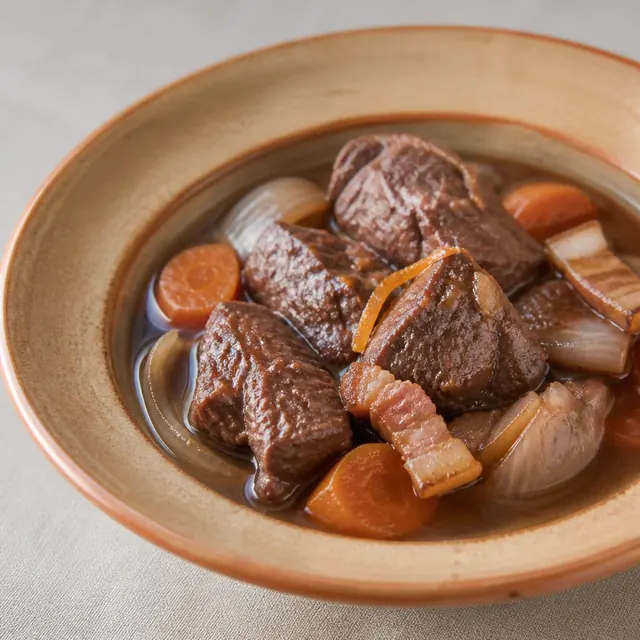
Daube provençale
Provençal beef marinated in red wine with vinegar and vegetables, browned in rendered pork fat and braised tightly covered for 5 hours with garlic, herbs and a strip of orange peel; following J.-B. Reboul (La Cuisinière provençale, no. 197), without olives or tomatoes. 6 servings.
Total time: 690 min6 servingsFinal yield 1,700 g
Ingredients
- 1,200 gBeef, chuck, arm pot roast, separable lean and fat, trimmed to 1/8" fat, choice, raw
- 130 gOnions, raw
- 90 gCarrots, raw
- 2 gThyme, fresh not counted – removed
- 0.4 gSpices, bay leaf not counted – removed
- 10 gParsley, fresh not counted – removed
- 8 gSalt, table
- 0.6 gSpices, pepper, black
- 0.2 gSpices, cloves, ground
- 450 mlAlcoholic beverage, wine, table, red
- 70 mlVinegar, red wine
- 120 gPork back fat (raw)
- 65 gOnions, raw
- 9 gGarlic, raw
- 3 gOrange peel, raw not counted – removed
- 300 mlBeverages, water, tap, drinking
Allergens
Contains: Sulphites
Derived from ingredients – check the package label.
Method
- Cut the beef into cubes of about 100 g and put them into a bowl with the quartered onion, the carrots in chunks, a bundle of herbs, the salt, pepper and a pinch of spice. Pour over 450 ml of wine and 70 ml of vinegar, cover and leave to marinate in a cool place for 5–6 hours, turning the meat now and then.
TipMarinades: acid, enzymes, yoghurtA marinade is a visit, not a move: it never gets further than the meat's front hall.Show less
Why
Most marinade ingredients penetrate only a few millimetres into the meat, even after many hours; both flavour and tenderising therefore work mainly on the surface, which is why marinating pays off most with thin slices and small pieces. Acid (lemon, vinegar, wine) and protein-splitting enzymes, for example from fresh pineapple or papaya, loosen proteins and connective tissue on the surface, but if they work too long the surface doesn't get tender – it turns mushy. Yoghurt and buttermilk are only mildly acidic and tend to be gentler on meat, while sugar and honey in a marinade help browning but burn easily on a grill or in a pan. Acid doesn't reliably kill bacteria, so marinate in the fridge, and a marinade that has been in contact with raw meat may only be used as a sauce after boiling.
How to do it
- Always marinate in the fridge, in a covered glass or stainless-steel container, or in a sealable bag.
- Leave fish and delicate meat in an acidic marinade for just 15–30 minutes, tougher cuts for a few hours, 24 hours at most.
- Let a marinade with fresh pineapple, papaya or kiwi work only briefly, never overnight.
- Set aside some marinade for a sauce before you put the raw meat in.
- Throw used marinade away, or bring it to the boil before serving.
- Pat the meat dry before cooking and wipe off a sweet marinade so it browns rather than burns.
If it goes wrong
A mushy surface after too long in an acidic or enzyme marinade can't be firmed up again; trim off the softest layer, or cut the meat into strips and stir-fry it briefly. Scrape off burnt sweet marinade and finish the meat over a gentler heat; next time add a sweet glaze only at the end.
- Drain the meat and vegetables thoroughly in a colander, catching the marinade. Reduce the marinade by half in a saucepan.
- In an earthenware daubière or a cast-iron pot, slowly melt the chopped pork fat and lift out the cracklings with a slotted spoon. Lightly brown the second onion, quartered, in the fat.
- Add the drained meat with the vegetables from the marinade and brown it well on all sides for about 15 minutes, tossing it from time to time.
TipSearing meatA seared crust seals in nothing but flavour – and for a crust, that's achievement enough.Show less
Why
The brown crust and aroma of seared meat come from the Maillard reaction, in which proteins and sugars on the surface turn into hundreds of aromatic compounds; it only gets going quickly above roughly 140 °C. As long as the surface of the meat is wet, the water holds it at around 100 °C and the meat steams instead of searing – which is why you dry the meat and get the pan and fat properly hot. Put too much meat in the pan and its temperature drops sharply, juices run out and the pieces simmer in them, grey and crustless. The idea that searing 'seals the pores' and keeps the juices in is a myth: the crust isn't watertight and seared meat loses as much juice or even more – you sear for flavour, not for juiciness.
How to do it
- Pat the surface of the meat thoroughly dry with kitchen paper.
- Heat the pan first, then add a fat that can take high heat, such as rapeseed oil or clarified butter; don't heat a non-stick pan empty on full power.
- Leave space between the pieces; if they don't fit, sear in batches.
- Leave the meat alone and don't move it until it releases by itself; if it sticks, it hasn't formed a crust yet.
- Deglaze the browned bits on the bottom of the pan with wine or stock – they are the base of a sauce.
If it goes wrong
If the meat has released its juices and is stewing, take it out, pour the juices aside, reheat the pan and sear the meat in smaller batches; then add the juices to the sauce. Grey meat that is already cooked through can't get a crust afterwards without overcooking – serve it with a sauce, and next time dry the meat and don't crowd the pan.
- Add the crushed garlic, a fresh bundle of herbs and the strip of orange peel. Pour in the reduced marinade and 300 ml of hot water, seal the pot tightly (if necessary seal the lid with foil) and braise over very low heat for 5 hours until the meat can be cut with a spoon.
TipBraising tough cutsCollagen won't be rushed: a gentle simmer turns it into gelatin, a rolling boil turns the meat into shoe leather.Show less
Why
Tough cuts such as shoulder, shin, neck or cheek contain a lot of connective tissue, and its main protein, collagen, slowly dissolves into gelatin under long, moist heat – noticeably from roughly 70 °C, and over hours, not minutes. Meanwhile the muscle fibres lose more water the hotter they get, and a hard boil tightens and wrings them out, so the meat ends up dry and stringy even while sitting in liquid. That is why you braise covered, just below the boil, with only the occasional bubble breaking the surface: the collagen has time to break down and the fibres are not heated more than they need to be. The gelatin then coats the fibres, making the meat succulent and the sauce glossy and rich; lean cuts with little connective tissue, such as pork tenderloin, only dry out with long braising because they lack the collagen that would rescue them.
How to do it
- Choose cuts with sinew and connective tissue for braising: shoulder, shin, neck, cheeks or oxtail.
- Brown the meat well first, then add liquid to come only about halfway up the meat.
- Keep it at a bare simmer, with the surface barely trembling; in a covered pot in the oven, about 140–160 °C is plenty.
- Test for doneness with a fork, not the clock: the meat is ready when it pulls apart easily.
- Let the cooked meat cool a little in its liquid: the surface won't dry out and the gelatin-rich juices will coat it.
If it goes wrong
Tough meat is almost always underbraised: add a splash of liquid and keep it at a gentle simmer until it softens. Meat that has boiled into dry strands won't become juicy again; shred it, moisten it with the sauce and serve it as a ragù or filling. Next time, lower heat and more time.
- Before serving, skim the fat off the surface and remove the herb bundles and orange peel. Serve hot straight from the pot.
Recipe tradition
Not yet verified
This recipe has not been checked against a documented culinary reference.
Food data sources
- USDA FoodData Central SR Legacy (2018-04) · USDA Agricultural Research Service, FoodData Central SR Legacy. · CC0 1.0 Universal
Nutrition
Calculated from the selected ingredients; not a laboratory measurement.
Whole recipe
- Energy
- 4,166.7 kcal
- Protein
- 237.2 g
- Fat
- 329.8 g
- Total carbohydrate (by difference)
- 42.2 g
- Total dietary fibre (USDA)
- 6.2 g
- Saturated fatty acids
- 128.7 g
- Sodium
- 3,977.5 mg
- Salt (sodium × 2.5)
- 9.9 g
Per serving
- Protein39.5 g23%
- Fat55 g73%
- Total carbohydrate (by difference)7 g4%
Share of energy from protein, fat and carbohydrate (4 / 9 / 4 kcal per g), not share by weight.
- Energy
- 694.4 kcal
- Protein
- 39.5 g
- Fat
- 55 g
- Total carbohydrate (by difference)
- 7 g
- Total dietary fibre (USDA)
- 1 g
- Saturated fatty acids
- 21.4 g
- Sodium
- 662.9 mg
- Salt (sodium × 2.5)
- 1.7 g
Per 100 g of finished food
- Energy
- 245.1 kcal
- Protein
- 14 g
- Fat
- 19.4 g
- Total carbohydrate (by difference)
- 2.5 g
- Total dietary fibre (USDA)
- 0.37 g
- Saturated fatty acids
- 7.6 g
- Sodium
- 234 mg
- Salt (sodium × 2.5)
- 0.58 g
Salt is calculated from sodium (g salt = mg sodium × 2.5 / 1000) and includes sodium from all ingredients.
A dash means the value is unknown, not zero.
Calculation limitations
- Nutrition is a calculated estimate, not a laboratory measurement.
- The final yield is an editorial estimate.
- Some ingredient quantities use documented estimates or household-measure assumptions.
- The number of servings is an editorial estimate (midpoint of the source range or based on the dish type and energy).
- Some specific ingredients are represented by the closest generic food with the same culinary function.
- Fibre, saturated fat and sodium of cooked ingredients are estimated from the consumed ingredient amounts; for drained ingredients, sodium is included only where the retained amount is an explicit editorial estimate.
- Alcohol remaining after cooking is estimated from USDA retention factors by cooking method and time; energy excludes the evaporated alcohol.
- Some process effects could not be resolved in this calculation.