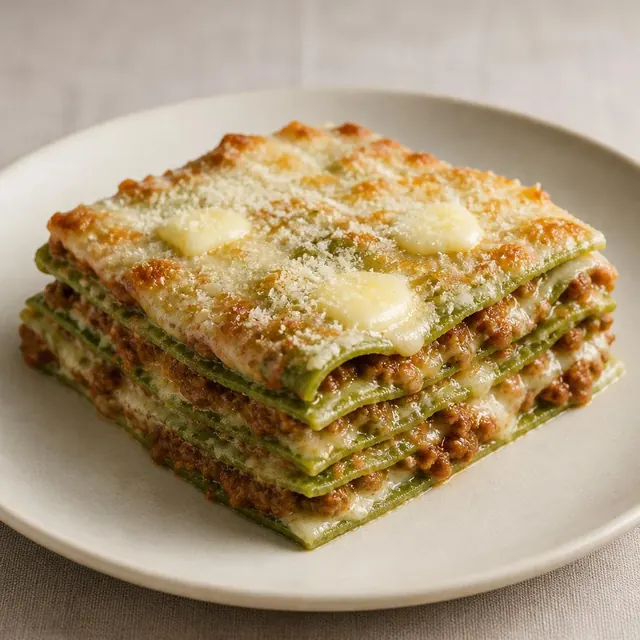
Lasagne verdi alla bolognese
Bolognese green lasagne: at least six layers of thin spinach pasta sheets, béchamel, Bolognese ragù, flakes of butter and Parmigiano Reggiano, baked for 25–30 minutes at 180 °C. Following the recipe deposited by the Accademia Italiana della Cucina (2003); dish about 25 × 35 cm, 10 servings.
Total time: 330 min10 servingsFinal yield 3,000 g
Ingredients
- 400 gBeef, ground, 85% lean meat / 15% fat, raw (Includes foods for USDA's Food Distribution Program) Make it at home: Bolognese ragù (ragù alla bolognese) (165 min)
- 150 gPork, cured, bacon, unprepared
- 60 gOnions, raw
- 60 gCarrots, raw
- 60 gCelery, raw
- 2 15 ml tablespoonOil, olive, salad or cooking
- 100 mlAlcoholic beverage, wine, table, red
- 20 gTomato products, canned, paste, without salt added (Includes foods for USDA's Food Distribution Program)
- 200 gTomato products, canned, puree, without salt added
- 100 mlMilk, whole, 3.25% milkfat, with added vitamin D
- 300 mlSoup, stock, beef, home-prepared
- 3 gSalt, table
- 0.6 gSpices, pepper, black
- 1 lMilk, whole, 3.25% milkfat, with added vitamin D Make it at home: Béchamel (besciamella) (20 min)
- 100 gButter, without salt
- 100 gWheat flour, white, all-purpose, unenriched
- 6 gSalt, table
- 0.4 gSpices, nutmeg, ground
- 350 gWheat flour, white, all-purpose, unenriched
- 2 pieces · smallEgg, whole, raw, fresh
- 400 gSpinach, raw
- 400 gCheese, parmesan, grated
- 40 gButter, without salt
- 60 mlBeverages, water, tap, drinking
- 2.9 lBeverages, water, tap, drinking not counted – removed
- 3 gSalt, table editorial addition
Nutrition and allergens are calculated with the ingredient as listed in the recipe.
Allergens
Contains: Gluten, Egg, Milk, Celery, Sulphites
May contain: Soy
Derived from ingredients – check the package label.
Method
- Make the Bolognese ragù following the Bolognese ragù (ragù alla bolognese) recipe, the whole batch of about 1 kg: soften the pancetta with the oil and the finely chopped vegetables, add the meat and brown it for 10 minutes, let the wine evaporate completely, add the tomato paste and passata and simmer covered over very low heat for 2 hours, adding stock as needed and stirring in the milk halfway. Season with salt and pepper.
- Meanwhile blanch the spinach in boiling water for 1–2 minutes, cool it in cold water, squeeze it out very thoroughly (about 175 g will remain) and chop it as finely as possible.
TipGreen vegetables and chlorophyllBroccoli only turns brilliant green once: at the start of cooking. After that it just waits to be rescued before it goes grey.Show less
Why
The green colour of vegetables comes from chlorophyll, which has a magnesium atom at its centre; in acidic conditions hydrogen pushes it out and the bright green pigment turns olive brown. The vegetable releases acid itself as heat damages its cells, so the longer it cooks, the more olive it gets; lemon juice or vinegar added to the water has the same effect. In tests a lid made no difference to the colour; what matters most is cooking time. Baking soda makes the water alkaline and keeps the colour, but it quickly softens vegetables to mush and destroys some vitamins, mainly vitamin C and thiamin, so it isn't worth it. Blanching means cooking briefly in plenty of boiling water until the vegetables turn bright green and are tender but firm, then plunging them straight into ice water to stop the cooking.
How to do it
- Cut the vegetables into evenly sized pieces and drop them into a large pot of rapidly boiling water.
- Cook for just a few minutes, until bright green and tender but firm; taste as you go.
- Drain them at once and plunge them into ice water; once cool, drain and pat dry.
- Add lemon juice, vinegar and sharp dressings only just before serving.
- Don't add baking soda to the water and don't worry about the lid; watch the time above all.
If it goes wrong
Olive colour can't be reversed; blend overcooked vegetables into a soup or purée where the colour matters less. In dishes where greens braise for a long time in a sauce, such as saag or Greek green beans, an olive colour is normal and belongs to them. Next time cook the vegetables for less time and cool them straight away.
- Pile the flour on a board, make a well, put the eggs and spinach in the middle and gradually work them in with a fork. Knead the dough for about 10 minutes until smooth, firm and elastic; wrap it in film and let it rest for 30 minutes.
TipKneading and glutenGluten is the dough's gym: give bread a proper workout, and let sponge cakes and pancakes put their feet up.Show less
Why
When wheat flour meets water, its proteins gliadin and glutenin link up into gluten, and kneading stretches and aligns these chains into a springy, extensible network. In bread and yeast doughs a strong network is exactly what you want: it traps the gas from fermentation, the dough rises and the crumb is springy. In shortcrust pastry, sponge cake, pancakes or muffins the same network does damage – the result is tough and rubbery, muffins develop tunnels and pastry shrinks in the oven. Fat coats the flour particles and sugar holds on to water, so both hold back gluten formation; that's why such mixtures are only briefly combined and small lumps are left in. Resting relaxes the gluten, so the dough then rolls out more easily and shrinks less.
How to do it
- Knead bread dough by hand for about 10 minutes, until smooth and elastic and it stretches into a thin membrane without tearing.
- Stir pancake and muffin batters only briefly, until no dry flour remains – small lumps are fine.
- Bring shortcrust together quickly, with cold butter and cool hands, and simply press it into a ball.
- Fold the flour into a sponge mixture last and gently with a spatula, lifting from the bottom.
- If dough springs back as you roll it, cover it and let it rest for 10–20 minutes.
If it goes wrong
Wrap overworked pastry and chill it for at least half an hour: the gluten relaxes and the fat firms up, so it shrinks less in the oven, though it will be a little tougher. Let overmixed pancake batter rest for 15–30 minutes before cooking; that will at least ease the toughness. A tough baked sponge or muffin can't be fixed – mix less next time.
- Roll the dough out with a rolling pin or pasta machine into thin sheets about 1 mm thick and cut them into rectangles of about 15 × 10 cm.
- Make a double batch of béchamel following the Béchamel (besciamella) recipe: cook 100 g of butter and 100 g of flour into a pale roux, take it off the heat, whisk in 1 litre of hot milk in portions, simmer gently for 5–6 minutes while stirring constantly and season with salt and nutmeg.
TipRouxWith roux, colour costs muscle: the darker it gets, the better it smells and the less it thickens.Show less
Why
A roux is flour cooked in fat, usually in a ratio of roughly 1 : 1 by weight. The fat coats each flour particle, so it disperses in the liquid on its own instead of clumping; the starch then swells and thickens fully only close to boiling point. Lumps form when flour meets hot liquid too suddenly: the outside of a clump gelatinises instantly and seals dry flour inside – which is why you combine cool roux with hot liquid or hot roux with cool liquid, and add the liquid gradually. The longer and darker a roux cooks, the more the heat breaks its starch into shorter pieces that thicken less: a dark roux smells nutty, but you need more of it for the same thickness. Once thickened, let the sauce simmer gently for a while so the starch swells completely and the raw-flour taste disappears.
How to do it
- Weigh out fat and plain flour in a ratio of roughly 1:1.
- Stir the flour into the fat over low heat; a light roux takes a few minutes, a dark one needs time and attention.
- Pour cool or lukewarm (not ice-cold) liquid into hot roux, or hot liquid into roux that has cooled.
- Add the liquid gradually, the first splash carefully and at arm's length: hot roux, especially a dark one, spatters and the steam burns. Whisk it in at once, not with a wooden spoon.
- Then simmer the sauce or soup gently, usually for 10–20 minutes, stirring often and tasting until the floury taste is gone.
- Use more flour for a dark roux; it thickens less than a light one.
If it goes wrong
Whisk out lumps, blitz them with a stick blender or pass the sauce through a sieve. A floury taste disappears with longer gentle simmering. A burnt roux with black specks and a bitter smell can't be saved – throw it out and start again, next time over lower heat and stirring constantly.
- Bring 3 litres of water with 30 g of salt to the boil and cook the sheets a few at a time for 30–60 seconds until they float. Transfer them to a bowl of cold water, then spread them on a clean cloth and pat dry. Preheat the oven to 180 °C.
- Butter a dish about 25 × 35 cm and at least 6 cm deep. Build up the layers: pasta sheets, a thin layer of béchamel, a generous layer of ragù, a few flakes of butter and a sprinkling of Parmesan. Repeat until you have at least 6 layers; finish the top layer with ragù and béchamel, Parmesan and flakes of butter.
- Bake in the middle of the oven at 180 °C for 25–30 minutes until the edges are bubbling and the top is golden. Let it rest for 5 minutes, then cut into 10 portions.
Recipe tradition
Not yet verified
This recipe has not been checked against a documented culinary reference.
Food data sources
- USDA FoodData Central SR Legacy (2018-04) · USDA Agricultural Research Service, FoodData Central SR Legacy. · CC0 1.0 Universal
Nutrition
Calculated from the selected ingredients; not a laboratory measurement.
Whole recipe
- Energy
- 7,112.1 kcal
- Protein
- 324.9 g
- Fat
- 419.3 g
- Total carbohydrate (by difference)
- 510.3 g
- Total dietary fibre (USDA)
- 29.5 g
- Saturated fatty acids
- 202.6 g
- Sodium
- 14,962.9 mg
- Salt (sodium × 2.5)
- 37.4 g
Per serving
- Protein32.5 g18%
- Fat41.9 g53%
- Total carbohydrate (by difference)51 g29%
Share of energy from protein, fat and carbohydrate (4 / 9 / 4 kcal per g), not share by weight.
- Energy
- 711.2 kcal
- Protein
- 32.5 g
- Fat
- 41.9 g
- Total carbohydrate (by difference)
- 51 g
- Total dietary fibre (USDA)
- 2.9 g
- Saturated fatty acids
- 20.3 g
- Sodium
- 1,496.3 mg
- Salt (sodium × 2.5)
- 3.7 g
Per 100 g of finished food
- Energy
- 237.1 kcal
- Protein
- 10.8 g
- Fat
- 14 g
- Total carbohydrate (by difference)
- 17 g
- Total dietary fibre (USDA)
- 0.98 g
- Saturated fatty acids
- 6.8 g
- Sodium
- 498.8 mg
- Salt (sodium × 2.5)
- 1.2 g
Salt is calculated from sodium (g salt = mg sodium × 2.5 / 1000) and includes sodium from all ingredients.
A dash means the value is unknown, not zero.
Calculation limitations
- Nutrition is a calculated estimate, not a laboratory measurement.
- The final yield is an editorial estimate.
- Some ingredient quantities use documented estimates or household-measure assumptions.
- The number of servings is an editorial estimate (midpoint of the source range or based on the dish type and energy).
- Some specific ingredients are represented by the closest generic food with the same culinary function.
- Fibre, saturated fat and sodium of cooked ingredients are estimated from the consumed ingredient amounts; for drained ingredients, sodium is included only where the retained amount is an explicit editorial estimate.
- Alcohol remaining after cooking is estimated from USDA retention factors by cooking method and time; energy excludes the evaporated alcohol.
- Some process effects could not be resolved in this calculation.