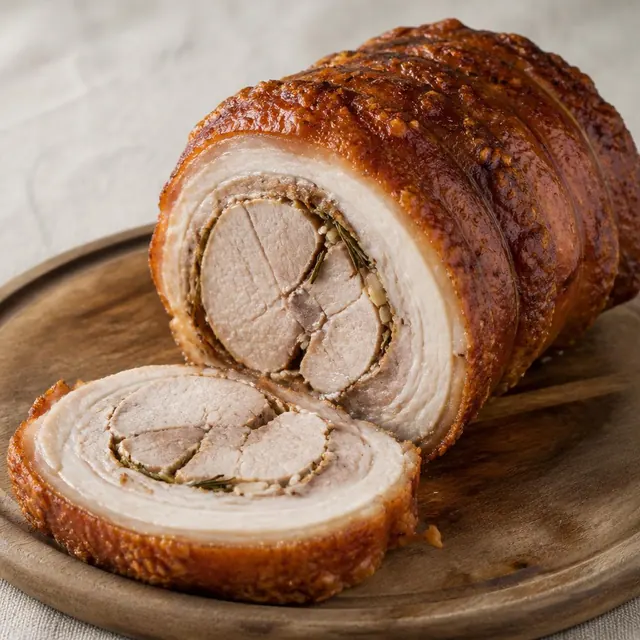
Porchetta
Skin-on pork belly rolled tightly around a pork loin, seasoned only with salt, black pepper, rosemary and garlic and slow-roasted until the crackling is crisp; a home version in the tradition of Porchetta di Ariccia PGI. 13 servings, eaten warm or cold, traditionally in bread. Energy and fat are an upper estimate: the rendered fat that drips off during roasting is not subtracted.
Total time: 1080 min13 servingsFinal yield 1,550 g
Ingredients
- 1,500 gPork, fresh, belly, raw
- 1,000 gPork, fresh, loin, top loin (chops), boneless, separable lean and fat, raw
- 50 gSalt, table
- 8 gSpices, pepper, black
- 15 gRosemary, fresh
- 25 gGarlic, raw
Allergens
Contains none of the 14 main allergens.
Derived from ingredients – check the package label.
Method
- Lay the belly skin side down and score the meat side in a crosshatch about 1 cm deep with a sharp knife. Turn it over and score the skin at intervals of about 1 cm, cutting only into the fat, not the meat.
- Finely chop the garlic and rosemary and mix with 8 g of coarsely crushed pepper. Salt the meat side of the belly and the loin on all sides (50 g of salt in total, i.e. 20 g per kilogram of meat, with only a thin layer on the skin) and rub in the herb mixture.
- Place the loin along one edge of the belly and roll the belly tightly around it, skin side out, so that the edges of the skin meet. Tie the roll firmly with kitchen string every 2–3 cm.
- Set the roll on a rack over a tray and leave it uncovered in the fridge for 12–24 hours so the skin dries out.
- Take the roll out of the fridge an hour beforehand. Heat the oven to 160 °C, set the roll on a rack over a roasting tin and roast for 3.5–4.5 hours until the internal temperature in the belly reaches about 85 °C. The rendered fat drips into the tin and is not served.
- Raise the temperature to 230 °C and roast for 10–15 minutes until the skin blisters and turns crisp. Watch it so that it does not start to blacken.
TipRoast pork and cracklingPork rind is like popcorn: it needs water inside, fierce heat and above all a break from basting.Show less
Why
Pork rind is largely tough collagen plus water: in high, dry heat the water in it evaporates rapidly and forms tiny bubbles, so the rind puffs up and crackles. The Bavarian tradition first softens the rind in moist heat, scalding it or roasting it rind-side down in a little water for a while, and only then roasts it rind-side up in dry heat; the British way instead dries it in the fridge beforehand, and in both cases scoring in a diamond pattern and salt help release fat and moisture. Adding liquid and basting with pan juices keep the meat moist but soften crackling that has started to crisp, so liquid belongs at the side of the tin, not on the rind – meat without rind can be basted. Shoulder and belly have enough fat and collagen for long roasting; lean leg or loin dries out in the same time and needs only a shorter roast to the required internal temperature.
How to do it
- Roast rind-side down in a little water or covered first, so the rind softens, then turn the meat rind-side up.
- Score the softened rind in a diamond pattern with a sharp knife, into the fat but not the meat, then pat it dry and salt it.
- From then on, pour no water or juices over the rind; if the bottom of the tin dries out and starts to burn, add liquid at the side.
- At the end, raise the oven to about 220–250 °C or switch on the oven grill and watch until the rind blisters; with the grill it usually takes 5–15 minutes.
- Check the internal temperature at the thickest point: the UK FSA gives 70 °C for 2 minutes, the US USDA 63 °C and 3 minutes of rest.
If it goes wrong
Rubbery crackling can be rescued: cut off the rind, lay it loose on a tray in a hot oven or under the oven grill and watch until it blisters; meanwhile let the meat rest, covered. Slice dried-out meat thinly and serve it with the pan juices. Next time don't baste the rind after turning.
- Let the porchetta rest on a board for at least 30 minutes. Remove the string and carve with a sharp knife into slices about 1 cm thick. Serve warm or cold, traditionally sliced in bread.
Recipe tradition
Not yet verified
This recipe has not been checked against a documented culinary reference.
Food data sources
- USDA FoodData Central SR Legacy (2018-04) · USDA Agricultural Research Service, FoodData Central SR Legacy. · CC0 1.0 Universal
Nutrition
Calculated from the selected ingredients; not a laboratory measurement.
Whole recipe
- Energy
- 9,397 kcal
- Protein
- 358.5 g
- Fat
- 865.8 g
- Total carbohydrate (by difference)
- 16.5 g
- Total dietary fibre (USDA)
- 4.7 g
- Saturated fatty acids
- 315 g
- Sodium
- 20,348.8 mg
- Salt (sodium × 2.5)
- 50.9 g
Per serving
- Protein27.6 g15%
- Fat66.6 g84%
- Total carbohydrate (by difference)1.3 g1%
Share of energy from protein, fat and carbohydrate (4 / 9 / 4 kcal per g), not share by weight.
- Energy
- 722.8 kcal
- Protein
- 27.6 g
- Fat
- 66.6 g
- Total carbohydrate (by difference)
- 1.3 g
- Total dietary fibre (USDA)
- 0.36 g
- Saturated fatty acids
- 24.2 g
- Sodium
- 1,565.3 mg
- Salt (sodium × 2.5)
- 3.9 g
Per 100 g of finished food
- Energy
- 606.3 kcal
- Protein
- 23.1 g
- Fat
- 55.9 g
- Total carbohydrate (by difference)
- 1.1 g
- Total dietary fibre (USDA)
- 0.3 g
- Saturated fatty acids
- 20.3 g
- Sodium
- 1,312.8 mg
- Salt (sodium × 2.5)
- 3.3 g
Salt is calculated from sodium (g salt = mg sodium × 2.5 / 1000) and includes sodium from all ingredients.
A dash means the value is unknown, not zero.
Calculation limitations
- Nutrition is a calculated estimate, not a laboratory measurement.
- The final yield is an editorial estimate.
- The number of servings is an editorial estimate (midpoint of the source range or based on the dish type and energy).
- Fibre, saturated fat and sodium of cooked ingredients are estimated from the consumed ingredient amounts; for drained ingredients, sodium is included only where the retained amount is an explicit editorial estimate.
- Some process effects could not be resolved in this calculation.