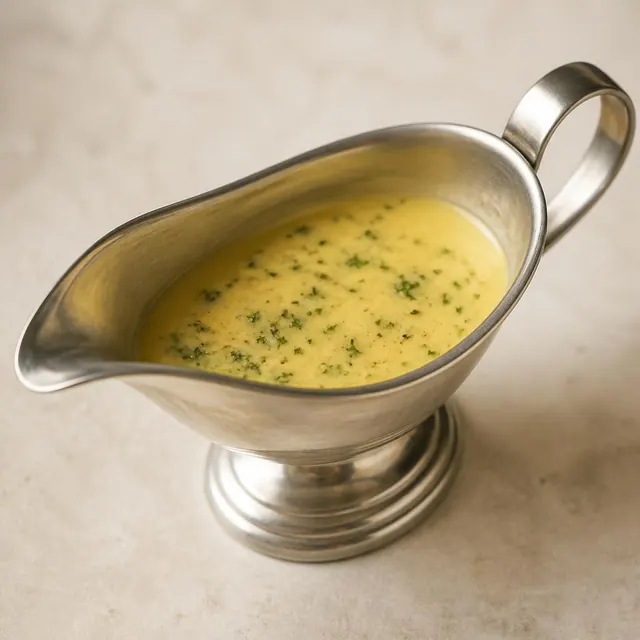
Béarnaise sauce
A warm butter sauce thickened with egg yolks over a reduction of white wine and tarragon vinegar with shallot, tarragon, chervil and crushed pepper, finished with chopped herbs and a pinch of cayenne; following A. Escoffier (Le Guide culinaire, 2nd ed. 1907). 6 servings of about 40 g, one per serving of grilled meat.
Total time: 35 min6 servingsFinal yield 245 g
Ingredients
- 65 mlAlcoholic beverage, wine, table, white
- 65 mlTarragon vinegar
- 13 gShallots, raw not counted – removed
- 17 gFresh tarragon not counted – removed
- 7 gFresh chervil not counted – removed
- 3.3 gSpices, pepper, black not counted – removed
- 0.4 gSalt, table
- 34 gEgg, yolk, raw, fresh
- 165 gButter, without salt
- 0.1 gSpices, pepper, red or cayenne
- 1 gFresh tarragon
- 0.5 gFresh chervil
Allergens
Contains: Egg, Milk, Sulphites
Derived from ingredients – check the package label.
Method
- Melt the butter and keep it warm (cold butter in pieces can also be used). Put 65 ml of white wine, 65 ml of tarragon vinegar, the chopped shallot, the coarsely chopped tarragon sprigs, the chervil, the crushed pepper and a pinch of salt into a small saucepan. Reduce by two thirds until about 3 tbsp of liquid remain.
TipReducing a sauceReduction boils off the water but keeps the salt: a sauce that was just right can easily end up as brine.Show less
Why
When you reduce a sauce, simmering it uncovered, water evaporates while flavour compounds, sugars, gelatin from meat and bones and salt stay in the pan, so they become concentrated and the sauce thickens. If you salt it at the start and then reduce it by half, it will be roughly twice as salty – which is why seasoning is adjusted at the end. The brown bits stuck to the bottom of the pan or roasting tin after searing or roasting (the fond) are among the tastiest parts of a sauce: poured over with stock, wine or water and scraped up, they dissolve into the sauce – this is called deglazing. A gentle simmer is enough; at a hard boil the sauce easily scorches at the edges and on the bottom, and if it contains a lot of sugar or gelatin it reduces into a sticky mass.
How to do it
- Cook uncovered in a wider pan so the water evaporates faster.
- Salt only at the end, once the sauce has the thickness you want.
- Pour hot stock, wine or water over the fond and scrape it off the bottom with a wooden spoon; leave out black, burnt bits, they would make the sauce bitter.
- Keep only a gentle simmer and stir now and then, especially at the bottom and the edges.
- Test the thickness on a spoon: the sauce should coat it thinly; bear in mind it will thicken further as it cools.
If it goes wrong
An oversalted sauce can only be saved by diluting it: add unsalted stock, water or cream and bring the thickness back with a short simmer. Thin a sauce that is too thick or sticky with a little hot water. Pour a scorched sauce into a clean pan at once without scraping the bottom; if it already tastes burnt, it can't be saved.
- Let the reduction cool for a few minutes, add the yolks and gradually work in the butter over gentle heat (or in a water bath), whisking lightly. Only the gradually cooking yolks bind the sauce, so gentle heat is essential; do not let the yolks get hotter than about 65 °C.
TipHollandaise and mounting with butterHollandaise lives in a narrow temperature window: let it cool and it sets, a few degrees too hot and it's scrambled eggs.Show less
Why
Hollandaise is a warm emulsion: droplets of melted butterfat dispersed in the water from the yolks, the butter and the lemon juice or reduction, coated with lecithin and proteins from the yolk. The yolks thicken the sauce once they reach roughly 65 °C, but above about 70 °C their proteins curdle into grains and the emulsion falls apart – which is why it is whisked over a water bath or on very gentle heat. If the sauce cools down instead, the butter firms up and the sauce thickens until it sets, and if too much butter meets too little water, the droplets merge and the sauce splits much like an overloaded mayonnaise. Mounting a sauce with butter works on the same principle without the yolk: cold butter whisked piece by piece into a hot but not boiling reduction disperses into tiny droplets that the butter's own proteins and emulsifiers hold in place – until you overheat the sauce or bring it to the boil.
How to do it
- Whisk the yolks with a little water, lemon juice or reduction over a water bath that is barely simmering and doesn't touch the bowl.
- Whisk until the mixture thickens and the whisk leaves a trail; lift the bowl off the steam now and then.
- Add warm, not hot, melted butter drop by drop at first, then in a thin stream.
- Keep the finished sauce in a bowl over warm water off the hob and serve it as soon as you can.
- To mount a sauce, take the reduction off the heat and whisk in cold butter cube by cube, adding the next once the last has melted; then don't let it boil.
- For children, pregnant women, older people and the immunocompromised, use pasteurised yolks: a sauce kept below 70 °C won't reliably kill salmonella.
If it goes wrong
If the sauce starts to turn grainy or greasy, take it off the heat at once and whisk in a spoonful of cold water. If it has split completely, put a fresh yolk with a spoonful of warm water in a clean bowl and whisk the broken sauce into it a teaspoon at a time. Warm a sauce that has cooled and set over a water bath, whisking constantly. Badly curdled lumps of yolk can't be fixed – strain the sauce or start again.
- Pass the sauce through a cloth or fine sieve (the shallot, herbs and pepper from the reduction stay behind). Season with a pinch of cayenne and salt and stir in the chopped tarragon and chervil.
- Serve lukewarm with grilled beef, veal or lamb; served hot it easily splits. If it starts to split, add a few drops of cold water and whisk vigorously.
Recipe tradition
Not yet verified
This recipe has not been checked against a documented culinary reference.
Food data sources
- USDA FoodData Central SR Legacy (2018-04) · USDA Agricultural Research Service, FoodData Central SR Legacy. · CC0 1.0 Universal
Nutrition
Calculated from the selected ingredients; not a laboratory measurement.
Whole recipe
- Energy
- 1,336.3 kcal
- Protein
- 7.2 g
- Fat
- 143 g
- Total carbohydrate (by difference)
- 4 g
- Total dietary fibre (USDA)
- 0.16 g
- Saturated fatty acids
- 86.6 g
- Sodium
- 199 mg
- Salt (sodium × 2.5)
- 0.5 g
Per serving
- Protein1.2 g2%
- Fat23.8 g97%
- Total carbohydrate (by difference)0.66 g1%
Share of energy from protein, fat and carbohydrate (4 / 9 / 4 kcal per g), not share by weight.
- Energy
- 222.7 kcal
- Protein
- 1.2 g
- Fat
- 23.8 g
- Total carbohydrate (by difference)
- 0.66 g
- Total dietary fibre (USDA)
- 0.03 g
- Saturated fatty acids
- 14.4 g
- Sodium
- 33.2 mg
- Salt (sodium × 2.5)
- 0.08 g
Per 100 g of finished food
- Energy
- 545.4 kcal
- Protein
- 2.9 g
- Fat
- 58.4 g
- Total carbohydrate (by difference)
- 1.6 g
- Total dietary fibre (USDA)
- 0.06 g
- Saturated fatty acids
- 35.3 g
- Sodium
- 81.2 mg
- Salt (sodium × 2.5)
- 0.2 g
Salt is calculated from sodium (g salt = mg sodium × 2.5 / 1000) and includes sodium from all ingredients.
A dash means the value is unknown, not zero.
Calculation limitations
- Nutrition is a calculated estimate, not a laboratory measurement.
- The final yield is an editorial estimate.
- Some ingredient quantities use documented estimates or household-measure assumptions.
- The number of servings is an editorial estimate (midpoint of the source range or based on the dish type and energy).
- Some specific ingredients are represented by the closest generic food with the same culinary function.
- Fibre, saturated fat and sodium of cooked ingredients are estimated from the consumed ingredient amounts; for drained ingredients, sodium is included only where the retained amount is an explicit editorial estimate.
- Alcohol remaining after cooking is estimated from USDA retention factors by cooking method and time; energy excludes the evaporated alcohol.
- Some process effects could not be resolved in this calculation.