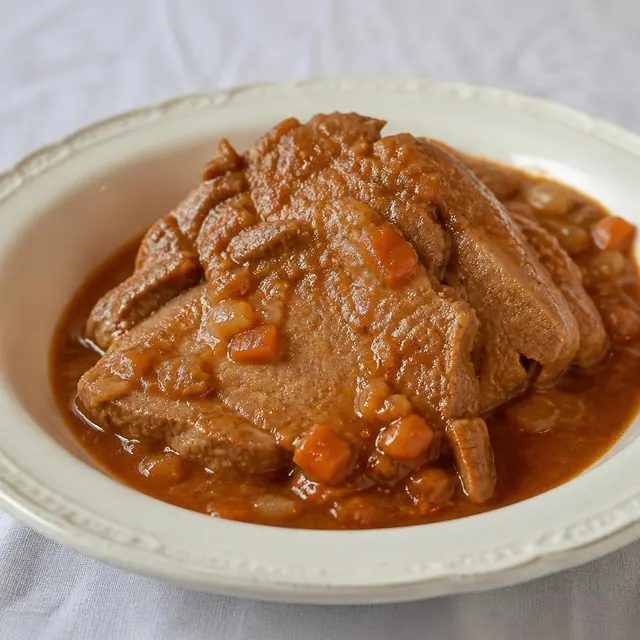
Stracotto di vitella
Florentine slow-braised veal with pancetta, butter and vegetables, dusted with flour, moistened with water a little at a time and seasoned with tomato paste; the juices are passed through a sieve. Following recipe no. 253 of Pellegrino Artusi’s La scienza in cucina e l’arte di mangiar bene. 4 servings of meat with its sauce; Florentine families also used the sauce to dress maccheroni as a first course.
Total time: 175 min4 servingsFinal yield 820 g
Ingredients
- 800 gVeal, leg, top round, cap off, cutlet, boneless, raw
- 80 gPork, cured, bacon, unprepared
- 48 gButter, without salt
- 100 gOnions, raw
- 80 gCarrots, raw
- 60 gCelery, raw
- 5 gWheat flour, white, all-purpose, unenriched
- 30 gTomato products, canned, paste, without salt added (Includes foods for USDA's Food Distribution Program)
- 600 mlBeverages, water, tap, drinking
- 2 gSalt, table
- 0.4 gSpices, pepper, black
Allergens
Contains: Gluten, Milk, Celery
May contain: Soy
Derived from ingredients – check the package label.
Method
- Roughly chop the onion, carrot and celery and cut the pancetta into small dice. Tie the piece of meat with kitchen string so that it keeps its shape while braising.
- Put the meat, butter, pancetta and vegetables all together into a heavy pot only slightly larger than the meat and season with salt and pepper. Over medium heat, turn the meat often for 15–20 minutes until it is golden brown on all sides and the vegetables have softened.
- Dust the meat with 5 g of flour and fry it for a minute, stirring; the flour may only turn golden, as burnt flour would give the sauce a bitter taste and an almost black colour. Stir in 30 g of tomato paste thinned with about 100 ml of water.
- Cover the pot with the lid slightly ajar and braise the meat over low heat for about 2 hours until tender. Add hot water only a little at a time (about 500 ml in total) whenever the liquid has almost cooked away, and turn the meat from time to time. It is done when a fork slides in without resistance.
TipBraising tough cutsCollagen won't be rushed: a gentle simmer turns it into gelatin, a rolling boil turns the meat into shoe leather.Show less
Why
Tough cuts such as shoulder, shin, neck or cheek contain a lot of connective tissue, and its main protein, collagen, slowly dissolves into gelatin under long, moist heat – noticeably from roughly 70 °C, and over hours, not minutes. Meanwhile the muscle fibres lose more water the hotter they get, and a hard boil tightens and wrings them out, so the meat ends up dry and stringy even while sitting in liquid. That is why you braise covered, just below the boil, with only the occasional bubble breaking the surface: the collagen has time to break down and the fibres are not heated more than they need to be. The gelatin then coats the fibres, making the meat succulent and the sauce glossy and rich; lean cuts with little connective tissue, such as pork tenderloin, only dry out with long braising because they lack the collagen that would rescue them.
How to do it
- Choose cuts with sinew and connective tissue for braising: shoulder, shin, neck, cheeks or oxtail.
- Brown the meat well first, then add liquid to come only about halfway up the meat.
- Keep it at a bare simmer, with the surface barely trembling; in a covered pot in the oven, about 140–160 °C is plenty.
- Test for doneness with a fork, not the clock: the meat is ready when it pulls apart easily.
- Let the cooked meat cool a little in its liquid: the surface won't dry out and the gelatin-rich juices will coat it.
If it goes wrong
Tough meat is almost always underbraised: add a splash of liquid and keep it at a gentle simmer until it softens. Meat that has boiled into dry strands won't become juicy again; shred it, moisten it with the sauce and serve it as a ragù or filling. Next time, lower heat and more time.
- Lift out the meat and keep it warm. Pass the juices together with the vegetables and pancetta through a sieve or food mill to make a smooth, lightly thickened sauce; if it is thin, boil it briefly.
- Remove the string, carve the meat against the grain into slices about 1 cm thick and pour the sauce over them. Serve with a vegetable or pulse side dish.
TipSlicing meat against the grainA slice cut across the fibres parts easily between the teeth; one cut along them chews like string, even when cooked just right.Show less
Why
Muscle is made of long muscle fibres grouped into bundles held together by connective tissue; the direction the fibres run shows on the meat as fine parallel lines, the grain. When you slice across the grain, each fibre in the slice is only as long as the slice is thick and your teeth separate it easily, whereas a slice cut along the grain keeps the fibres at full length and chews like string. In America's Test Kitchen's measurements, flank steak sliced against the grain needed more than four times less force to bite into than flank sliced with it, while for strip steak the difference was less than twofold. So it matters most for coarse-grained cuts such as flank, skirt, brisket or chuck, and less for tenderloin and other tender cuts. Slicing does not replace correct cooking, though: overcooked lean meat stays dry, and cuts rich in connective tissue only soften with long braising (see the Braising tough cuts card).
How to do it
- Find the lines of the grain and turn the meat so they run away from you; then move the knife from left to right, at a right angle to them.
- Slice coarse-grained cuts such as flank or skirt thinly; on a thin steak, angle the knife to get wider slices.
- Where the grain changes direction, as in skirt or brisket, first divide the meat along the grain into sections and then slice each one across separately.
- For stir-frying, slice raw meat across the grain into thin strips; after 15–20 minutes in the freezer it slices more easily, then use it at once or return it to the fridge.
- Let roast meat rest before carving (see the Resting meat card) and slice with a sharp knife in long strokes, without pressing down.
- On a T-bone steak, cut both parts, the strip and the tenderloin, off the bone and slice each across its own grain.
If it goes wrong
Slices cut along the grain can still be saved: cut them across into short strips or small cubes and serve them in a sauce, a salad or a flatbread. Slice overcooked meat across the grain as thinly as possible and pour juices or sauce over it; it won't be tender again, but it will be pleasant to eat. Braising cuts that are still tough are not a slicing problem but a matter of time – keep braising them.
Recipe tradition
Not yet verified
This recipe has not been checked against a documented culinary reference.
Food data sources
- USDA FoodData Central SR Legacy (2018-04) · USDA Agricultural Research Service, FoodData Central SR Legacy. · CC0 1.0 Universal
Nutrition
Calculated from the selected ingredients; not a laboratory measurement.
Whole recipe
- Energy
- 1,639.6 kcal
- Protein
- 192 g
- Fat
- 85.8 g
- Total carbohydrate (by difference)
- 28.6 g
- Total dietary fibre (USDA)
- 6.4 g
- Saturated fatty acids
- 40.9 g
- Sodium
- 2,218.3 mg
- Salt (sodium × 2.5)
- 5.5 g
Per serving
- Protein48 g46%
- Fat21.4 g47%
- Total carbohydrate (by difference)7.1 g7%
Share of energy from protein, fat and carbohydrate (4 / 9 / 4 kcal per g), not share by weight.
- Energy
- 409.9 kcal
- Protein
- 48 g
- Fat
- 21.4 g
- Total carbohydrate (by difference)
- 7.1 g
- Total dietary fibre (USDA)
- 1.6 g
- Saturated fatty acids
- 10.2 g
- Sodium
- 554.6 mg
- Salt (sodium × 2.5)
- 1.4 g
Per 100 g of finished food
- Energy
- 199.9 kcal
- Protein
- 23.4 g
- Fat
- 10.5 g
- Total carbohydrate (by difference)
- 3.5 g
- Total dietary fibre (USDA)
- 0.78 g
- Saturated fatty acids
- 5 g
- Sodium
- 270.5 mg
- Salt (sodium × 2.5)
- 0.68 g
Salt is calculated from sodium (g salt = mg sodium × 2.5 / 1000) and includes sodium from all ingredients.
A dash means the value is unknown, not zero.
Calculation limitations
- Nutrition is a calculated estimate, not a laboratory measurement.
- The final yield is an editorial estimate.
- Some ingredient quantities use documented estimates or household-measure assumptions.
- The number of servings is an editorial estimate (midpoint of the source range or based on the dish type and energy).
- Some specific ingredients are represented by the closest generic food with the same culinary function.
- Fibre, saturated fat and sodium of cooked ingredients are estimated from the consumed ingredient amounts; for drained ingredients, sodium is included only where the retained amount is an explicit editorial estimate.
- Some process effects could not be resolved in this calculation.