Menu · 2 components
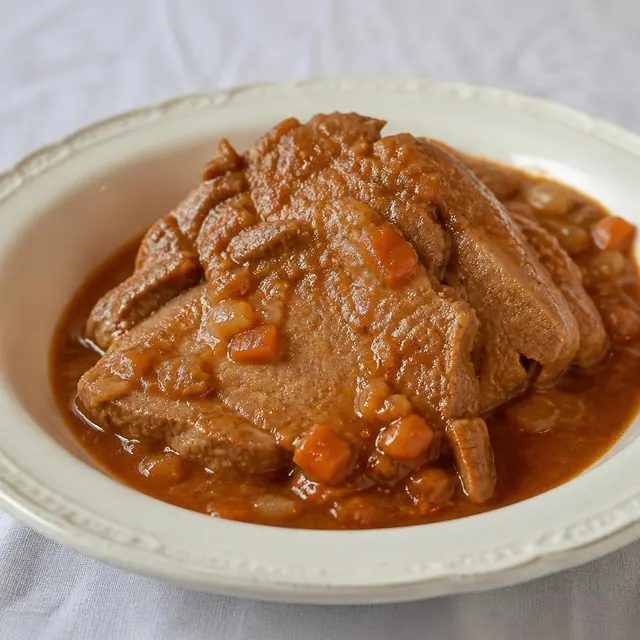
Stracotto di vitella with a side
Florentine slow-braised veal with pancetta and strained gravy, with polenta (half serving); mashed potatoes or potato gnocchi (half serving) are further choices.
Menu portion215 min594.9 kcal per menu portion
- Good for lunch
Less suited for dinner.
1Main course
Stracotto di vitella
410 kcal per menu portion · 1 × recipe portion per menu portion
- Low in lactose
Contains: Gluten, Milk, Celery · May contain: Soy
Quantities for the whole recipe (4 servings).
Ingredients
- 800 gVeal, leg, top round, cap off, cutlet, boneless, raw
- 80 gPork, cured, bacon, unprepared
- 48 gButter, without salt
- 100 gOnions, raw
- 80 gCarrots, raw
- 60 gCelery, raw
- 5 gWheat flour, white, all-purpose, unenriched
- 30 gTomato products, canned, paste, without salt added (Includes foods for USDA's Food Distribution Program)
- 600 mlBeverages, water, tap, drinking
- 2 gSalt, table
- 0.4 gSpices, pepper, black
Method
- Roughly chop the onion, carrot and celery and cut the pancetta into small dice. Tie the piece of meat with kitchen string so that it keeps its shape while braising.
- Put the meat, butter, pancetta and vegetables all together into a heavy pot only slightly larger than the meat and season with salt and pepper. Over medium heat, turn the meat often for 15–20 minutes until it is golden brown on all sides and the vegetables have softened.
- Dust the meat with 5 g of flour and fry it for a minute, stirring; the flour may only turn golden, as burnt flour would give the sauce a bitter taste and an almost black colour. Stir in 30 g of tomato paste thinned with about 100 ml of water.
- Cover the pot with the lid slightly ajar and braise the meat over low heat for about 2 hours until tender. Add hot water only a little at a time (about 500 ml in total) whenever the liquid has almost cooked away, and turn the meat from time to time. It is done when a fork slides in without resistance.
TipBraising tough cutsCollagen won't be rushed: a gentle simmer turns it into gelatin, a rolling boil turns the meat into shoe leather.Why and howShow less
Why
Tough cuts such as shoulder, shin, neck or cheek contain a lot of connective tissue, and its main protein, collagen, slowly dissolves into gelatin under long, moist heat – noticeably from roughly 70 °C, and over hours, not minutes. Meanwhile the muscle fibres lose more water the hotter they get, and a hard boil tightens and wrings them out, so the meat ends up dry and stringy even while sitting in liquid. That is why you braise covered, just below the boil, with only the occasional bubble breaking the surface: the collagen has time to break down and the fibres are not heated more than they need to be. The gelatin then coats the fibres, making the meat succulent and the sauce glossy and rich; lean cuts with little connective tissue, such as pork tenderloin, only dry out with long braising because they lack the collagen that would rescue them.
How to do it
- Choose cuts with sinew and connective tissue for braising: shoulder, shin, neck, cheeks or oxtail.
- Brown the meat well first, then add liquid to come only about halfway up the meat.
- Keep it at a bare simmer, with the surface barely trembling; in a covered pot in the oven, about 140–160 °C is plenty.
- Test for doneness with a fork, not the clock: the meat is ready when it pulls apart easily.
- Let the cooked meat cool a little in its liquid: the surface won't dry out and the gelatin-rich juices will coat it.
If it goes wrong
Tough meat is almost always underbraised: add a splash of liquid and keep it at a gentle simmer until it softens. Meat that has boiled into dry strands won't become juicy again; shred it, moisten it with the sauce and serve it as a ragù or filling. Next time, lower heat and more time.
- Lift out the meat and keep it warm. Pass the juices together with the vegetables and pancetta through a sieve or food mill to make a smooth, lightly thickened sauce; if it is thin, boil it briefly.
- Remove the string, carve the meat against the grain into slices about 1 cm thick and pour the sauce over them. Serve with a vegetable or pulse side dish.
TipSlicing meat against the grainA slice cut across the fibres parts easily between the teeth; one cut along them chews like string, even when cooked just right.Why and howShow less
Why
Muscle is made of long muscle fibres grouped into bundles held together by connective tissue; the direction the fibres run shows on the meat as fine parallel lines, the grain. When you slice across the grain, each fibre in the slice is only as long as the slice is thick and your teeth separate it easily, whereas a slice cut along the grain keeps the fibres at full length and chews like string. In America's Test Kitchen's measurements, flank steak sliced against the grain needed more than four times less force to bite into than flank sliced with it, while for strip steak the difference was less than twofold. So it matters most for coarse-grained cuts such as flank, skirt, brisket or chuck, and less for tenderloin and other tender cuts. Slicing does not replace correct cooking, though: overcooked lean meat stays dry, and cuts rich in connective tissue only soften with long braising (see the Braising tough cuts card).
How to do it
- Find the lines of the grain and turn the meat so they run away from you; then move the knife from left to right, at a right angle to them.
- Slice coarse-grained cuts such as flank or skirt thinly; on a thin steak, angle the knife to get wider slices.
- Where the grain changes direction, as in skirt or brisket, first divide the meat along the grain into sections and then slice each one across separately.
- For stir-frying, slice raw meat across the grain into thin strips; after 15–20 minutes in the freezer it slices more easily, then use it at once or return it to the fridge.
- Let roast meat rest before carving (see the Resting meat card) and slice with a sharp knife in long strokes, without pressing down.
- On a T-bone steak, cut both parts, the strip and the tenderloin, off the bone and slice each across its own grain.
If it goes wrong
Slices cut along the grain can still be saved: cut them across into short strips or small cubes and serve them in a sauce, a salad or a flatbread. Slice overcooked meat across the grain as thinly as possible and pour juices or sauce over it; it won't be tender again, but it will be pleasant to eat. Braising cuts that are still tough are not a slicing problem but a matter of time – keep braising them.
2Side dish
Polenta traditional
185 kcal per menu portion · 0.5 × recipe portion per menu portion
- Vegan
- Lactose free
- Gluten free
Contains none of the 14 main allergens.
Quantities for the whole recipe (4 servings).
or:
- French mashed potatoes (pommes purée) · 394 kcal per menu portion
- Potato gnocchi (gnocchi di patate) · 258 kcal per menu portion
Ingredients
- 400 gCornmeal, degermed, unenriched, yellow
- 1.4 lBeverages, water, tap, drinking
- 6 gSalt, table
Method
- Bring water and salt to a boil in a heavy-based pan.
- Pour cornmeal in a thin stream while stirring constantly so no lumps form.
TipGrain porridges: semolina, polenta, oats, milletPorridge looks thin in the pot, but on the plate it soon turns into a brick: cook it a little thinner than you want to eat it.Why and howShow less
Why
Semolina, cornmeal and oats are mostly starch, and when they are tipped into hot milk or water all at once, the surface of each clump gelatinises instantly and traps dry flour inside as a lump, just as in thickening (Thickening with starch card); that is why they are poured in a thin stream while whisking constantly. Fine semolina softens in a few minutes, classic polenta from coarse cornmeal needs half an hour to an hour depending on the grind, and porridge cooked too briefly tastes raw and floury. Oats make porridge creamy thanks to beta-glucans, a soluble fibre that thickens the liquid, and every porridge thickens considerably as it cools, because the starch sets again. Milk and starch easily scorch on the bottom, so porridge is cooked in a heavy-bottomed pot over gentle heat and stirred right down to the bottom. Spores of the bacterium Bacillus cereus can survive in cooked grains, and when porridge cools slowly in the warm, they germinate and can form a toxin that later reheating does not destroy.
How to do it
- Bring the liquid almost to the boil and pour in the semolina or cornmeal in a thin stream while whisking constantly.
- Cook over gentle heat in a heavy-bottomed pot and stir right down to the bottom; polenta only needs stirring every few minutes, semolina and oats more often.
- Cook porridge a little thinner than you want to serve it; it will thicken further on the plate.
- Rinse millet with hot water before cooking and taste it; throw out millet that is bitter or rancid when dry, rinsing won't fix it.
- Leftover polenta or semolina porridge can be poured into a tin, left to set, sliced and fried.
- Spread leftover porridge in a shallow container and refrigerate it within 2 hours; rice congee within 1 hour, like cooked rice.
If it goes wrong
Whisk out lumps or blend them with an immersion blender; push large lumps through a sieve. Loosen set porridge with a little hot milk or water and heat it until piping hot throughout, stirring constantly. Pour scorched porridge straight into a clean pot without scraping the bottom; if it already tastes burnt, it can't be saved. Porridge that tastes raw and floury just needs a few more minutes of cooking and a little liquid.
- Simmer 30 minutes at 90 °C and stir every 3 minutes; finished polenta releases from the pan sides.
TipGrain porridges: semolina, polenta, oats, milletPorridge looks thin in the pot, but on the plate it soon turns into a brick: cook it a little thinner than you want to eat it.Why and howShow less
Why
Semolina, cornmeal and oats are mostly starch, and when they are tipped into hot milk or water all at once, the surface of each clump gelatinises instantly and traps dry flour inside as a lump, just as in thickening (Thickening with starch card); that is why they are poured in a thin stream while whisking constantly. Fine semolina softens in a few minutes, classic polenta from coarse cornmeal needs half an hour to an hour depending on the grind, and porridge cooked too briefly tastes raw and floury. Oats make porridge creamy thanks to beta-glucans, a soluble fibre that thickens the liquid, and every porridge thickens considerably as it cools, because the starch sets again. Milk and starch easily scorch on the bottom, so porridge is cooked in a heavy-bottomed pot over gentle heat and stirred right down to the bottom. Spores of the bacterium Bacillus cereus can survive in cooked grains, and when porridge cools slowly in the warm, they germinate and can form a toxin that later reheating does not destroy.
How to do it
- Bring the liquid almost to the boil and pour in the semolina or cornmeal in a thin stream while whisking constantly.
- Cook over gentle heat in a heavy-bottomed pot and stir right down to the bottom; polenta only needs stirring every few minutes, semolina and oats more often.
- Cook porridge a little thinner than you want to serve it; it will thicken further on the plate.
- Rinse millet with hot water before cooking and taste it; throw out millet that is bitter or rancid when dry, rinsing won't fix it.
- Leftover polenta or semolina porridge can be poured into a tin, left to set, sliced and fried.
- Spread leftover porridge in a shallow container and refrigerate it within 2 hours; rice congee within 1 hour, like cooked rice.
If it goes wrong
Whisk out lumps or blend them with an immersion blender; push large lumps through a sieve. Loosen set porridge with a little hot milk or water and heat it until piping hot throughout, stirring constantly. Pour scorched porridge straight into a clean pot without scraping the bottom; if it already tastes burnt, it can't be saved. Porridge that tastes raw and floury just needs a few more minutes of cooking and a little liquid.
Alternative: French mashed potatoes (pommes purée)
Ingredients
- 1,000 gPotatoes, flesh and skin, raw
- 200 gButter, without salt
- 250 mlMilk, whole, 3.25% milkfat, with added vitamin D
- 8 gSalt, table
- 2 lBeverages, water, tap, drinking not counted – removed
- 2 gSalt, table editorial addition
Method
- Wash potatoes of even size, put them in a pot in their skins, cover with 2 litres of cold water with 20 g of salt and bring to the boil. Simmer for about 25 minutes until a knife slides in without resistance.
- Drain the potatoes and peel them while still hot, holding them in a cloth. Immediately pass them through a food mill with a fine disc or a potato ricer into a saucepan. Never use a blender: broken cells release starch and the purée turns gluey.
- Set the pan over low heat and stir the purée with a wooden spoon for 4–5 minutes to drive off moisture; it must not catch. Meanwhile bring 250 ml of milk to the boil.
- Vigorously work 200 g of cold diced butter into the purée a little at a time and add 8 g of salt. Then pour in the boiling milk in a thin stream while stirring constantly, and finally whisk the purée until smooth. Heat it through without boiling and serve at once.
Alternative: Potato gnocchi (gnocchi di patate)
Ingredients
- 1,000 gPotatoes, russet, flesh and skin, raw (Includes foods for USDA's Food Distribution Program)
- 350 gWheat flour, white, all-purpose, unenriched
- 50 mlBeverages, water, tap, drinking
- 4 lBeverages, water, tap, drinking not counted – removed
- 4 gSalt, table editorial addition
Method
- Boil the potatoes in their skins in unsalted water (or steam them) for 30–40 minutes until a knife slides in without resistance. Drain and let them steam dry for a minute.
- Peel the potatoes while still hot (hold them with a fork or cloth) and press them through a ricer onto a floured board. Spread them out and let the steam escape for 2–3 minutes.
- Sprinkle most of the flour over the potatoes and work it in briefly by hand just until you have a smooth, soft, slightly sticky dough; do not knead for long, or the dough will toughen and the gnocchi turn hard. Keep the rest of the flour for dusting.
TipPotato dough: dumplings, noky, gnocchiPotato dough wants dry, cooled potatoes, just enough flour to hold, and quick hands: kneading and standing make it slack and sticky.Why and howShow less
Why
A cooked potato is a cluster of cells full of swollen starch (see the Mashed potatoes card); when long kneading or blending ruptures the cells, the released starch forms a sticky mass with the water from the potatoes, more flour then gets added, and the dumpling turns out tough and gummy. Floury potatoes of cooking type C, or B, have more starch and less water and give a supple dough with less flour, whereas watery waxy potatoes of type A thin the dough; that is why the potatoes are boiled in their skins or baked and left to steam off and cool before use. Finished dough softens and gets sticky as it stands, and the more flour then goes in, the tougher the dumpling, so it is worked quickly and cooked at once. In the water it keeps its shape when the water only simmers and the surface sets quickly, whereas a hard boil and long cooking wear the surface away and the dumpling or gnocchi falls apart. Green patches, eyes and sprouts of potatoes contain bitter, toxic glycoalkaloids (solanine), so the German BfR advises removing them generously.
How to do it
- Choose floury potatoes of type C, or B; boil them in their skins or bake them, peel and let them steam off and cool, even a day ahead in the fridge.
- Cut out green patches and eyes generously; do not use green, shrivelled or heavily sprouted potatoes, or potatoes that taste bitter.
- Grate the potatoes finely or put them through a ricer, do not blend them; add egg, salt and flour and bring the dough together quickly, just until smooth and holding its shape.
- Add the flour gradually: first cook one small test dumpling or gnocchi and add more flour only if it falls apart.
- Cook shaped dumplings and gnocchi at once, in small batches, in salted, gently simmering water; lift gnocchi out shortly after they float.
- Take a cooked dumpling out at once, pierce it and slice it with thread or a sharp knife; move gnocchi straight into the sauce or melted butter so they do not stick together.
If it goes wrong
Firm up sticky dough with only a small amount of flour or semolina and shape it at once, as more kneading makes it worse. If the test dumpling falls apart, add a little flour or egg; if a whole dumpling falls apart in the water, cook the rest of the dough as small gnocchi or fry it as pancakes. Tough, gummy dumplings will not soften again: slice and fry them in butter, perhaps with eggs or cabbage, and next time use less flour and knead less.
- Divide the dough, roll each piece into a rope about 2 cm thick and cut it into 2–3 cm pieces. Roll each piece with your thumb over the back of a fork or the coarse side of a grater so it gets ridges and a dimple.
- Bring 4 litres of water with 40 g of salt to the boil and cook the gnocchi in batches. As soon as they rise to the surface (after about 1–2 minutes), lift them out with a slotted spoon and toss them with the sauce at once.
Allergens
Contains: Celery, Gluten, Milk
May contain: Soy
Derived from ingredients – check the package label.
Nutrition, allergens and calories are for the default choice – the first alternative of every slot.
Nutrition per menu portion
Per serving
- Protein51.6 g35%
- Fat22.3 g34%
- Total carbohydrate (by difference)46.9 g31%
Share of energy from protein, fat and carbohydrate (4 / 9 / 4 kcal per g), not share by weight.
- Energy
- 594.9 kcal
- Protein
- 51.6 g
- Fat
- 22.3 g
- Total carbohydrate (by difference)
- 46.9 g
- Total dietary fibre (USDA)
- 3.5 g
- Saturated fatty acids
- 10.3 g
- Sodium
- 855.8 mg
- Salt (sodium × 2.5)
- 2.1 g
Per 100 g
- Energy
- 142.5 kcal
- Protein
- 12.3 g
- Fat
- 5.3 g
- Total carbohydrate (by difference)
- 11.2 g
- Total dietary fibre (USDA)
- 0.85 g
- Saturated fatty acids
- 2.5 g
- Sodium
- 205 mg
- Salt (sodium × 2.5)
- 0.51 g
A dash means the value is unknown, not zero. Salt is calculated from sodium (g salt = mg sodium × 2.5 / 1000) and includes sodium from all ingredients.
Calculation limitations
- Nutrition is a calculated estimate, not a laboratory measurement.
- Some ingredient quantities use documented estimates or household-measure assumptions.
- The number of servings is an editorial estimate (midpoint of the source range or based on the dish type and energy).
- Some specific ingredients are represented by the closest generic food with the same culinary function.
- Fibre, saturated fat and sodium of cooked ingredients are estimated from the consumed ingredient amounts; for drained ingredients, sodium is included only where the retained amount is an explicit editorial estimate.
- Some process effects could not be resolved in this calculation.
- Menu nutrition is the sum of its component recipes, each scaled to one menu portion.