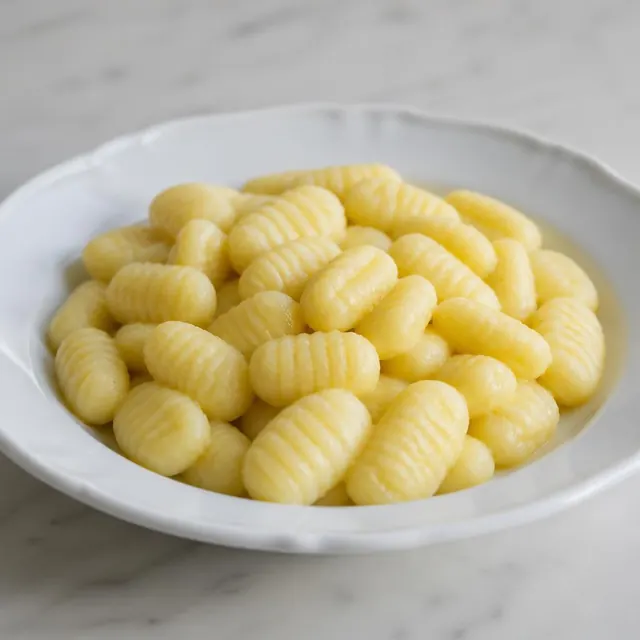
Potato gnocchi (gnocchi di patate)
Italian potato dumplings made from floury potatoes boiled in their skins and plain flour, without eggs, shaped over a fork and cooked in salted water until they float; served with a sauce (ragù, pesto, tomato), which is not part of the recipe. Following Pellegrino Artusi (La scienza in cucina, recipe no. 89); 4 servings.
Total time: 85 min4 servingsFinal yield 1,300 g
Ingredients
- 1,000 gPotatoes, russet, flesh and skin, raw (Includes foods for USDA's Food Distribution Program)
- 350 gWheat flour, white, all-purpose, unenriched
- 50 mlBeverages, water, tap, drinking
- 4 lBeverages, water, tap, drinking not counted – removed
- 4 gSalt, table editorial addition
Allergens
Contains: Gluten
Derived from ingredients – check the package label.
Method
- Boil the potatoes in their skins in unsalted water (or steam them) for 30–40 minutes until a knife slides in without resistance. Drain and let them steam dry for a minute.
- Peel the potatoes while still hot (hold them with a fork or cloth) and press them through a ricer onto a floured board. Spread them out and let the steam escape for 2–3 minutes.
- Sprinkle most of the flour over the potatoes and work it in briefly by hand just until you have a smooth, soft, slightly sticky dough; do not knead for long, or the dough will toughen and the gnocchi turn hard. Keep the rest of the flour for dusting.
TipPotato dough: dumplings, noky, gnocchiPotato dough wants dry, cooled potatoes, just enough flour to hold, and quick hands: kneading and standing make it slack and sticky.Show less
Why
A cooked potato is a cluster of cells full of swollen starch (see the Mashed potatoes card); when long kneading or blending ruptures the cells, the released starch forms a sticky mass with the water from the potatoes, more flour then gets added, and the dumpling turns out tough and gummy. Floury potatoes of cooking type C, or B, have more starch and less water and give a supple dough with less flour, whereas watery waxy potatoes of type A thin the dough; that is why the potatoes are boiled in their skins or baked and left to steam off and cool before use. Finished dough softens and gets sticky as it stands, and the more flour then goes in, the tougher the dumpling, so it is worked quickly and cooked at once. In the water it keeps its shape when the water only simmers and the surface sets quickly, whereas a hard boil and long cooking wear the surface away and the dumpling or gnocchi falls apart. Green patches, eyes and sprouts of potatoes contain bitter, toxic glycoalkaloids (solanine), so the German BfR advises removing them generously.
How to do it
- Choose floury potatoes of type C, or B; boil them in their skins or bake them, peel and let them steam off and cool, even a day ahead in the fridge.
- Cut out green patches and eyes generously; do not use green, shrivelled or heavily sprouted potatoes, or potatoes that taste bitter.
- Grate the potatoes finely or put them through a ricer, do not blend them; add egg, salt and flour and bring the dough together quickly, just until smooth and holding its shape.
- Add the flour gradually: first cook one small test dumpling or gnocchi and add more flour only if it falls apart.
- Cook shaped dumplings and gnocchi at once, in small batches, in salted, gently simmering water; lift gnocchi out shortly after they float.
- Take a cooked dumpling out at once, pierce it and slice it with thread or a sharp knife; move gnocchi straight into the sauce or melted butter so they do not stick together.
If it goes wrong
Firm up sticky dough with only a small amount of flour or semolina and shape it at once, as more kneading makes it worse. If the test dumpling falls apart, add a little flour or egg; if a whole dumpling falls apart in the water, cook the rest of the dough as small gnocchi or fry it as pancakes. Tough, gummy dumplings will not soften again: slice and fry them in butter, perhaps with eggs or cabbage, and next time use less flour and knead less.
- Divide the dough, roll each piece into a rope about 2 cm thick and cut it into 2–3 cm pieces. Roll each piece with your thumb over the back of a fork or the coarse side of a grater so it gets ridges and a dimple.
- Bring 4 litres of water with 40 g of salt to the boil and cook the gnocchi in batches. As soon as they rise to the surface (after about 1–2 minutes), lift them out with a slotted spoon and toss them with the sauce at once.
Recipe tradition
Not yet verified
This recipe has not been checked against a documented culinary reference.
Food data sources
- USDA FoodData Central SR Legacy (2018-04) · USDA Agricultural Research Service, FoodData Central SR Legacy. · CC0 1.0 Universal
Nutrition
Calculated from the selected ingredients; not a laboratory measurement.
Whole recipe
- Energy
- 2,064 kcal
- Protein
- 57.6 g
- Fat
- 4.2 g
- Total carbohydrate (by difference)
- 447.8 g
- Total dietary fibre (USDA)
- 22.5 g
- Saturated fatty acids
- 0.8 g
- Sodium
- 1,609.3 mg
- Salt (sodium × 2.5)
- 4 g
Per serving
- Protein14.4 g11%
- Fat1.1 g2%
- Total carbohydrate (by difference)111.9 g87%
Share of energy from protein, fat and carbohydrate (4 / 9 / 4 kcal per g), not share by weight.
- Energy
- 516 kcal
- Protein
- 14.4 g
- Fat
- 1.1 g
- Total carbohydrate (by difference)
- 111.9 g
- Total dietary fibre (USDA)
- 5.6 g
- Saturated fatty acids
- 0.2 g
- Sodium
- 402.3 mg
- Salt (sodium × 2.5)
- 1 g
Per 100 g of finished food
- Energy
- 158.8 kcal
- Protein
- 4.4 g
- Fat
- 0.33 g
- Total carbohydrate (by difference)
- 34.4 g
- Total dietary fibre (USDA)
- 1.7 g
- Saturated fatty acids
- 0.06 g
- Sodium
- 123.8 mg
- Salt (sodium × 2.5)
- 0.31 g
Salt is calculated from sodium (g salt = mg sodium × 2.5 / 1000) and includes sodium from all ingredients.
A dash means the value is unknown, not zero.
Calculation limitations
- Nutrition is a calculated estimate, not a laboratory measurement.
- The final yield is an editorial estimate.
- Some ingredient quantities use documented estimates or household-measure assumptions.
- The number of servings is an editorial estimate (midpoint of the source range or based on the dish type and energy).
- Fibre, saturated fat and sodium of cooked ingredients are estimated from the consumed ingredient amounts; for drained ingredients, sodium is included only where the retained amount is an explicit editorial estimate.
- Some process effects could not be resolved in this calculation.