Kitchen terms · French cuisine
Bouquet garni
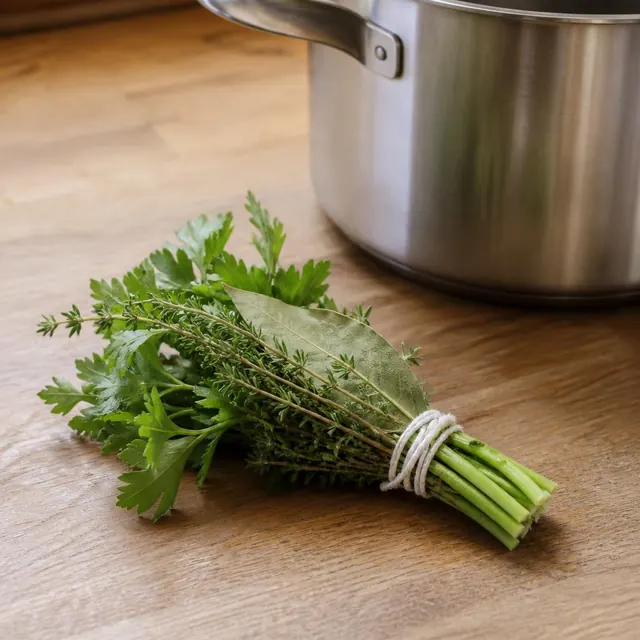
A tied bundle of aromatic herbs simmered with a stock, sauce or braise and removed before serving.
At a glance
- Origin
- France; a bundle of parsley, thyme and bay recorded in Gouffé in 1877.
- Production
- Herbs are tied into a bundle, cooked with the dish and then removed.
- Ratio
- Escoffier, white stock: 1 oz (≈ 28 g) parsley, 1 bay leaf and a small sprig of thyme.
- Use
- Stocks, sauces, braises and soups.
- Substitutes
- Mirepoix is diced vegetables with herbs, a bouquet garni only tied herbs.
In French cooking a bouquet garni is a small tied bundle of aromatic plants. The Trésor de la langue française describes it as a little packet of herbs that flavours sauces and similar dishes during cooking, and quotes Gouffé in 1877 with parsley, thyme and bay leaf. Larousse names thyme and bay and stresses that the herbs are tied together.
In the 1907 English edition of Escoffier’s guide the bundle is called a “faggot”. For brown stock Escoffier uses a faggot of a little parsley, a stick of celery, a small sprig of thyme and a bay leaf; for white stock one ounce (≈ 28 g) of parsley, a bay leaf and a sprig of thyme. In his recipes Escoffier then withdraws the faggot when about to serve.