Kitchen terms · French cuisine
Mirepoix
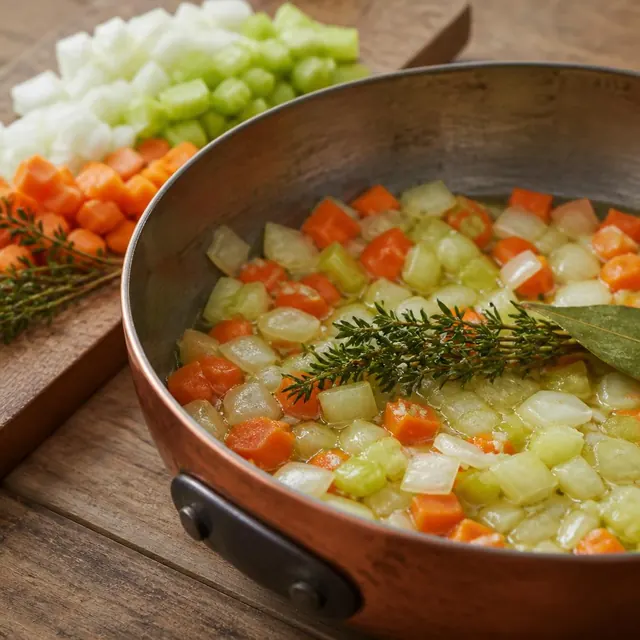
Diced vegetables with herbs, sometimes with ham or bacon, that give flavour to sauces, stocks and braised meat.
At a glance
- Origin
- France, recorded in Carême in 1833; name probably from the Lévis-Mirepoix family.
- Production
- Vegetables with herbs, sometimes ham, cut into dice and stewed in butter.
- Ratio
- Escoffier, fine mirepoix: 4 oz (≈ 113 g) carrot, 4 oz (≈ 113 g) onion, 1 oz (≈ 28 g) parsley stalks.
- Use
- Aromatic base for sauces such as espagnole and for braised meat or fish.
- Substitutes
- Matignon has the same ingredients, but the vegetables are finely minced.
The Trésor de la langue française defines mirepoix as a preparation of vegetables, aromatic herbs and sometimes ham or bacon, usually cut into small dice, that goes into sauces or is used in preparing meat or fish. The dictionary gives the earliest record in Carême in 1833 and derives the name probably from the noble Lévis-Mirepoix family, which produced a marshal of France created Duke of Mirepoix in 1751.
In his 1907 guide Escoffier likens mirepoix to matignon: it has the same constituents, namely carrot, onion, celery, raw ham, thyme and bay leaf, except that the vegetables are not minced but cut into more or less fine dice according to use. The ham may be replaced by lightly salted breast of pork or left out. A fine, so-called Bordelaise mirepoix for crayfish and lobster uses equal amounts of carrot and onion, a smaller share of parsley stalks and a little thyme and bay.