Sauces · French cuisine
Espagnole
The brown basic sauce of dark roux, brown stock, mirepoix and tomato – and mother of demi-glace.
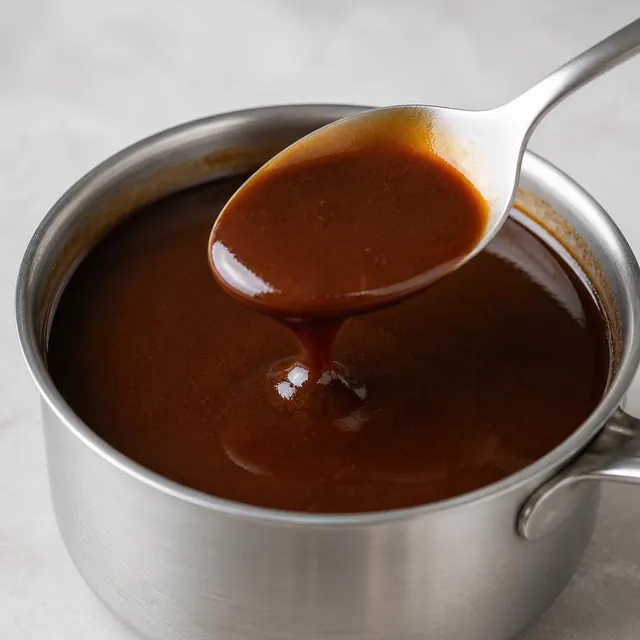
At a glance
- Origin
- France; among the grand sauces of Carême (1833) and Escoffier.
- Production
- Dark roux in brown stock with mirepoix and tomato, simmered and skimmed for hours.
- Ratio
- Escoffier: 1 lb brown roux to 6 quarts brown stock, reduced to 4 quarts.
- Use
- Reduced with brown stock it becomes demi-glace, base of the small brown sauces.
Espagnole is a brown sauce of dark roux and brown stock, with mirepoix (diced vegetables) and tomatoes added during its long simmer. Escoffier let it cook for hours, skimming constantly and moving it into clean pans, until it had reduced by roughly a third. Reduced further with more brown stock and finished with sherry, it becomes demi-glace, the base of the small brown sauces.
The mother-sauce system was outlined by Carême in 1833 with four grand sauces: espagnole, velouté, allemande and béchamel. Escoffier reworked it in Le Guide culinaire (1903); in the 1907 English edition the basic sauces are espagnole, velouté, béchamel, tomato and hollandaise, with allemande merely derived.
That is where today’s five mother sauces come from. In the French editions hollandaise sits rather among the small sauces.