Sauces · French cuisine
Velouté
The “velvety” sauce of pale roux and white stock – veal, poultry or fish.
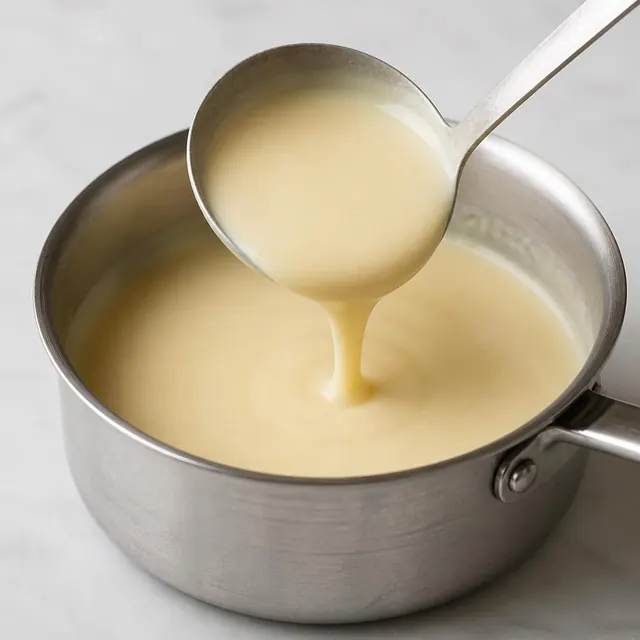
At a glance
- Origin
- France; among the grand sauces of Carême (1833) and Escoffier.
- Production
- Pale roux dissolved in white stock, simmered long and skimmed.
- Ratio
- Escoffier: 1 lb pale roux to 5 quarts white veal stock for 4 quarts of sauce.
- Pairs with
- Poultry, veal and fish, depending on the stock used.
- Use
- Base of allemande and of derived poultry and fish sauces.
Velouté (velvety) is a sauce of pale roux and white stock: veal in the classic form, poultry (velouté de volaille) or fish fumet in its variations. It was one of the four grand sauces Carême placed at the head of French cooking in 1833, and Escoffier kept it among the basic sauces.
According to Escoffier the roux is dissolved in cold stock, brought to the boil and simmered gently for about an hour and a half while impurities are skimmed from the surface; it is then strained, topped up with stock, skimmed again and stirred as it cools. Fish velouté simmers for only about twenty minutes.
It differs from béchamel in its liquid: stock instead of milk. Thickened with egg yolks it becomes allemande, which Escoffier no longer counted as a basic sauce in its own right.