Sauces · French cuisine
Béchamel
White sauce of roux and milk – a mother sauce of French cooking and Italy’s besciamella.
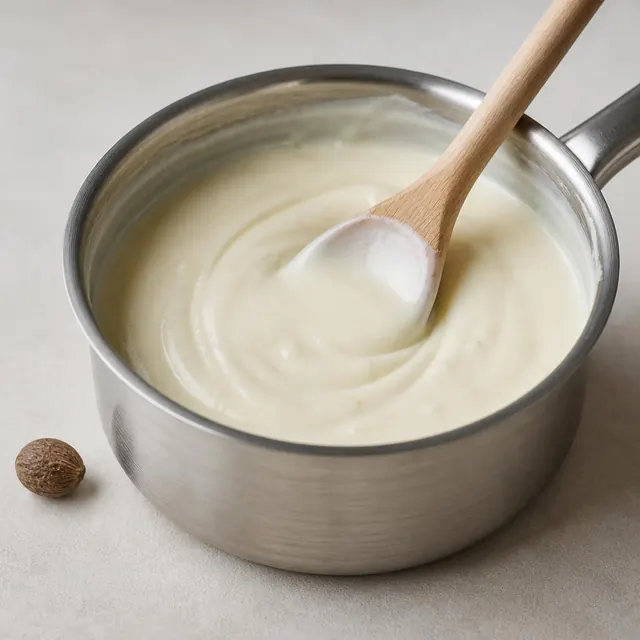
At a glance
- Origin
- France, documented in the reign of Louis XIV; Italian counterpart balsamella.
- Production
- White roux whisked with boiling milk, simmered with aromatics and strained.
- Ratio
- Escoffier: 1 lb white roux to 4½ quarts milk for 4 quarts of sauce.
- Pairs with
- Lasagne and baked dishes; Artusi serves it with pasta and green beans.
- Use
- Mother sauce for many small white sauces.
Béchamel is a smooth white sauce of milk thickened with a white roux of butter and flour, flavoured with onion, nutmeg, white pepper and thyme. The Oxford Companion to Food notes that the name is French and that the sauce appears in the reign of Louis XIV; that early version resembled today’s only slightly, and Carême still made it by enriching velouté with cream.
Escoffier lists it among the basic sauces in Le Guide culinaire: boiling milk is poured onto an almost cold roux and whisked, veal stiffened with onion and seasonings are added, and the sauce simmers for about an hour before being strained. In the Lenten version the veal is left out.
In Italy it is besciamella, earlier balsamella. In 1891 Artusi wrote that it matched the French béchamel, only simpler: flour, butter and half a litre of milk. Where the sauce truly began remains disputed.