Kitchen terms · French cuisine
Deglazing
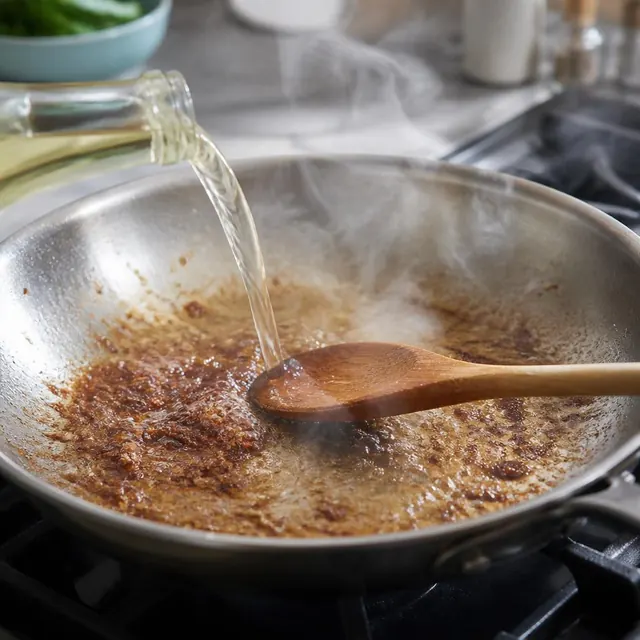
Adding liquid to a pan or roasting tin to dissolve the browned residue left by frying and turn it into a sauce base.
At a glance
- Origin
- French déglacer from glacer, first meaning to remove ice (1442).
- Production
- Liquid is poured onto the browned residue in a pan or tin and the residue dissolved.
- Use
- Pan sauces and roast gravy.
- Pairs with
- Wine, stock, cream, water; Madeira in Escoffier’s matignon.
- Substitutes
- Reduction then boils the liquid down and thickens it.
Deglazing comes from French déglacer, formed with the prefix dé- from the verb glacer. The Trésor de la langue française notes that the word first meant to remove ice, in 1442, and figuratively to warm; in cooking it means moistening the bottom of the vessel in which meat or fish has cooked with water, stock, cream or wine to dissolve and extend the juices stuck to it. As an example it quotes Escoffier: deglaze the pan with a glass of white wine.
In the 1907 English edition of Escoffier’s guide the operation is called “swilling”. For roasts Escoffier pours off part of the fat from the pan, adds prepared gravy, reduces it by half and strains it; he warns that removing all the fat loses much of the savour. The Cambridge Dictionary describes deglazing as adding liquid to the cooking juices and small pieces of food in a pan to make a sauce.