Kitchen terms · International
Maillard reaction
Non-enzymatic reaction of reducing sugars with amino acids and proteins that gives baked and browned food its colour and aroma.
At a glance
- Origin
- Louis-Camille Maillard, a French chemist, described the reaction in 1912.
- Production
- A reducing sugar reacts with the amino group of an amino acid or protein via Amadori products to melanoidins.
- Ratio
- Review (Foods 2025): bread crust browns around 160 °C, acrylamide forms above roughly 120 °C; values depend on composition and conditions.
- Use
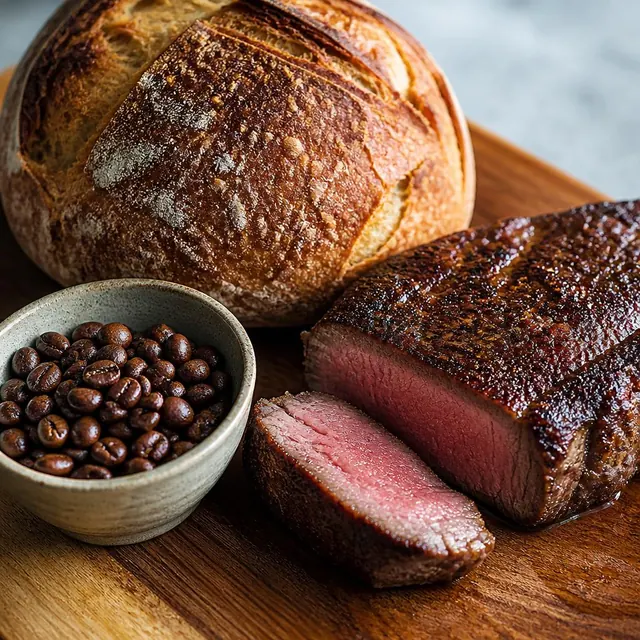
- Bread crust, seared and grilled meat, roasted coffee.
- Substitutes
- Caramelisation: browning of sugars alone without amino acids; enzymatic browning is catalysed by polyphenol oxidase.
The Maillard reaction is a set of non-enzymatic reactions in which the carbonyl group of a reducing sugar reacts with the amino group of an amino acid or protein. Via Amadori products it yields brown melanoidins and a great number of aroma compounds. It is named after the French chemist Louis-Camille Maillard, who described it in 1912 while heating a solution of a sugar with an amino acid.
It differs from caramelisation in needing an amino compound, whereas caramelisation is the breakdown of carbohydrates alone. In baking, roasting and grilling, however, both reactions commonly run side by side; a review of baking puts crust browning typically at around 160 °C.
The reaction rate rises sharply with temperature and also depends on pH, water content and the kind of sugar and amino acid. It proceeds slowly even in frozen storage over months. It slows down in an acidic medium; below pH 6, according to a review, it is very slow. Above roughly 120 °C acrylamide can form as a by-product, classed by the IARC as a probable carcinogen.
Recipes
Techniques and tips
Related entries
Sources
- Foods 14 (2025): Maillard Reaction: Mechanism, Influencing Parameters, Advantages, Disadvantages, and Food Industrial Applications: A Review
- Comprehensive Reviews in Food Science and Food Safety (2025): Influence of Nonenzymatic Browning Reactions on the Digestibility and Gut Microbiota Fermentation of Starch and Protein