Kitchen terms · International
Sautéing
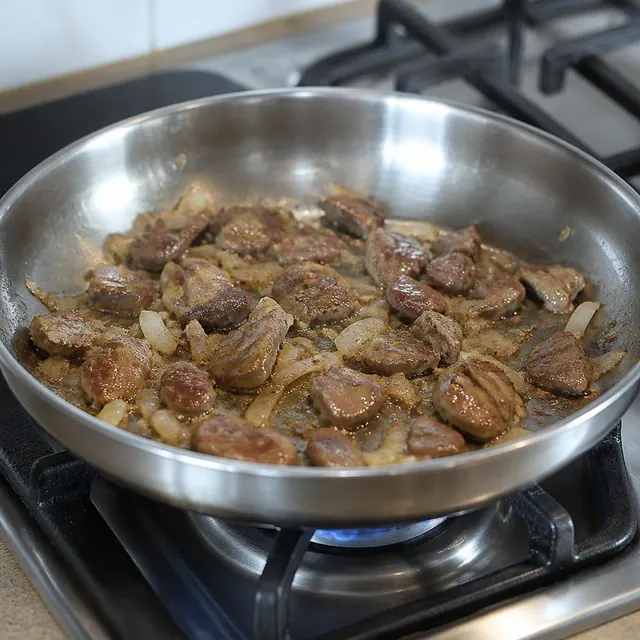
Quick cooking of small pieces of meat or vegetables in hot fat, without a lid and without added liquid.
At a glance
- Origin
- Czech restovat from German (SSJČ); Fr. sauter from Lat. saltare, culinary from 1767 (TLFi).
- Production
- Small pieces are browned in hot fat without a lid and without added liquid.
- Use
- Cut-up poultry and game, tournedos, cutlets, noisettes, liver, potatoes.
- Pairs with
- A pan sauce made by deglazing the browned residue after the meat is removed.
- Substitutes
- Braising: under a lid with a small amount of liquid.
The Academic Dictionary of Foreign Words defines restovat as frying in fat until the moisture has gone, with sautéed liver and potatoes as examples. The older standard dictionary of literary Czech marks the verb as colloquial, borrowed from German, meaning to fry or stew in fat.
Its French counterpart sauter, literally to jump, comes from Latin saltare; the culinary phrase faire sauter un mets is recorded from 1767. Escoffier defines the sauté as cooking dry, that is solely in fat – butter, oil or grease. He applies it to cut-up poultry and game and to small cuts such as tournedos, cutlets and noisettes, and the thinner and smaller the pieces, the faster they must be browned.
After lifting out the meat, Escoffier swills the pan with liquid for the sauce and returns the meat to it only long enough to warm through. The brown colour and aroma of sautéed food come mainly from the Maillard reaction between sugars and amino acids.
Recipes
Techniques and tips
Related entries
Sources
- Ústav pro jazyk český AV ČR: Internetová jazyková příručka (ASCS, SSJČ), heslo „restovat“
- CNRTL / ATILF: Trésor de la langue française informatisé, étymologie „sauter“
- Auguste Escoffier: A Guide to Modern Cookery (London 1907), č. 251 The sautés
- Foods 14 (2025): Maillard Reaction: Mechanism, Influencing Parameters, Advantages, Disadvantages, and Food Industrial Applications: A Review