Kitchen terms · International
Caramelisation
Browning of sugars by heat without proteins taking part, producing a brown colour and the bittersweet aroma of caramel.
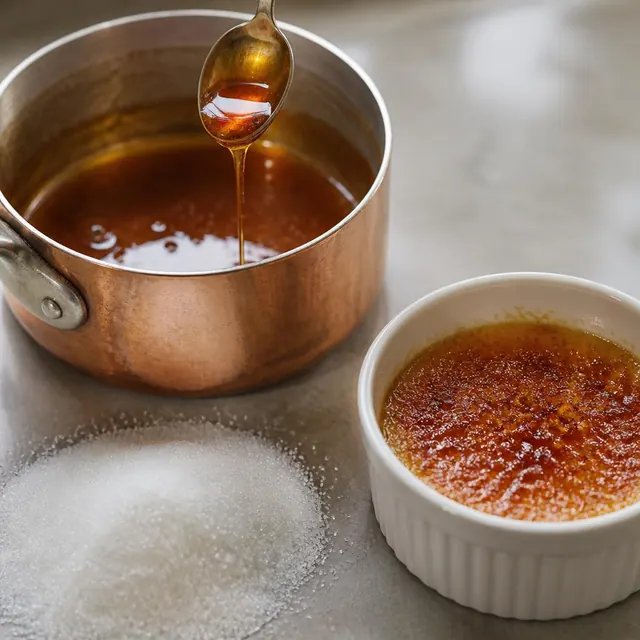
At a glance
- Origin
- Fr. caramel (1680) from Sp. caramelo, borrowed from Port., probably from Late Lat. calamellus, diminutive of calamus – reed (TLFi).
- Production
- Sugar is heated on its own or with water until it breaks down into brown, aromatic compounds.
- Ratio
- Review (2025): sucrose, glucose and galactose around 160 °C, maltose 180 °C, fructose lower; depends on time, pH and type of sugar.
- Use
- Caramel, caramel sauces, the crisp sugar layer on custards.
- Substitutes
- The Maillard reaction needs amino acids; in bread and meat both run together.
Caramelisation is a group of pyrolytic reactions in which heat breaks down carbohydrates alone; unlike the Maillard reaction, no amino acids take part. It produces a brown colour and nutty to burnt aromas. It speeds up with temperature, but bitter compounds increase too; it is slowest around neutral pH and accelerates in strongly acidic and alkaline conditions.
The caramelisation temperature varies with the sugar: a 2025 review gives 160 °C for sucrose, glucose and galactose and 180 °C for maltose, and less for fructose. It is not a fixed point – work from the University of Illinois showed sucrose decomposing significantly below its reported melting temperature, only more slowly. The word caramel entered French in 1680 from Spanish caramelo, itself borrowed from Portuguese, probably from Late Latin calamellus, a diminutive of calamus – reed.
Recipes
Techniques and tips
Related entries
Sources
- Comprehensive Reviews in Food Science and Food Safety (2025): Influence of Nonenzymatic Browning Reactions on the Digestibility and Gut Microbiota Fermentation of Starch and Protein
- J. W. Lee, L. C. Thomas, S. J. Schmidt: Investigation of thermal decomposition as the kinetic process that causes the loss of crystalline structure in sucrose (J. Agric. Food Chem. 59, 2011), abstrakt
- CNRTL / ATILF: Trésor de la langue française informatisé, étymologie „caramel“