Kitchen terms · French cuisine
Flambéing
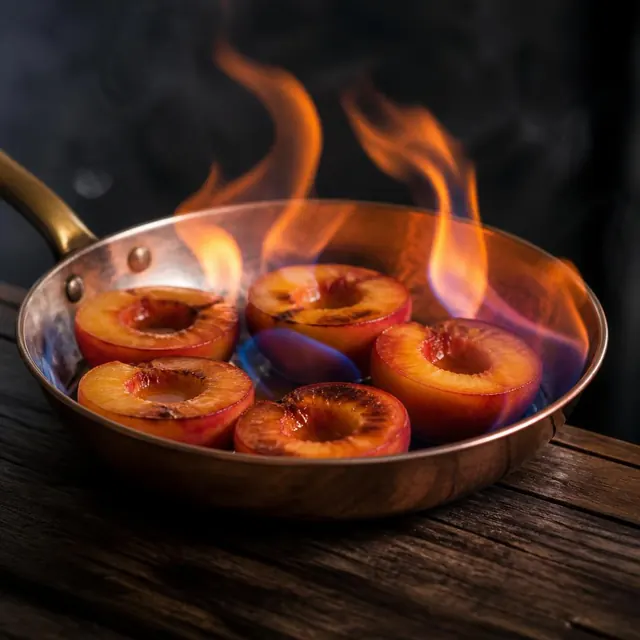
Pouring warmed spirit over a dish and setting it alight; the flame does not, however, remove all the alcohol.
At a glance
- Origin
- French flamber, to shine, to burn; in cooking, igniting a spirit.
- Production
- A warmed spirit is poured over the dish and set alight.
- Ratio
- USDA Release 6 (2007): flamed 75% of alcohol retained; stirred into hot liquid 85%; baked or simmered 1 h 25%; 2.5 h 5%.
- Use
- Fruit desserts and sweet omelettes; Escoffier flames peaches and an omelette with Jubilee cherries.
- Pairs with
- Cognac, rum, kirsch and other spirits.
Around 1165 French flamber meant to shine, and from the 14th century to pass something through a flame; the Trésor de la langue française also records singeing the down from poultry. In cooking the word most often means setting alcohol alight, such as cognac or rum, and the dictionary states explicitly that the burning only lowers the alcohol content. For pêches flambées in his 1907 guide, Escoffier adds heated kirsch and sets it alight at the moment of serving.
The popular idea that the flame burns off all the alcohol is wrong. The USDA Table of Nutrient Retention Factors, Release 6 of 2007, gives a retention factor of 75% for flamed dishes (based on the study by Augustin et al., 1992). For comparison: stirred into a hot liquid 85% remains, after 15 minutes of baking or simmering 40%, after an hour 25% and after 2.5 hours 5%.